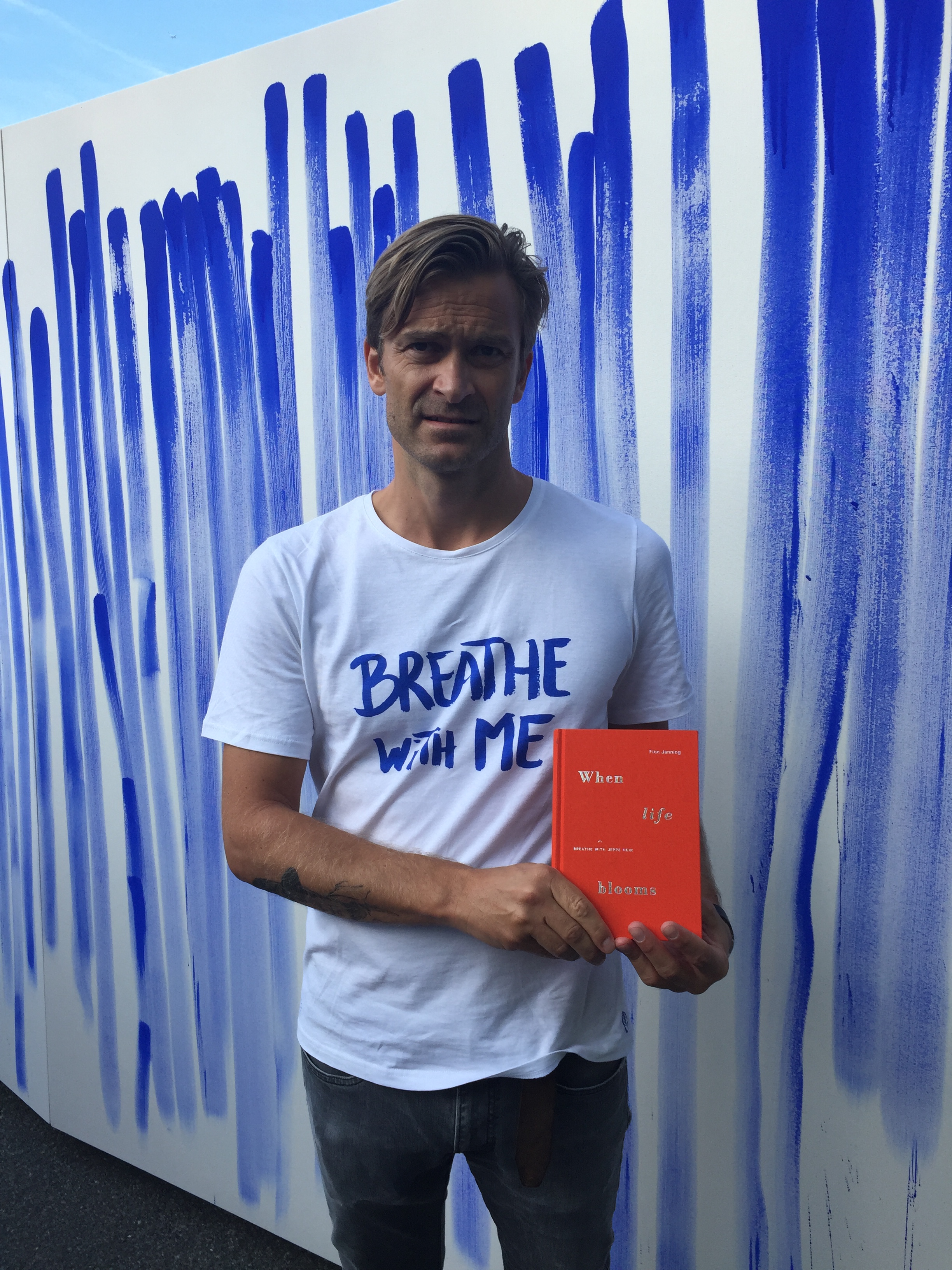
Når livet blomstrer

Den 28. november udkommer min nye bog, Når livet blomstrer – Breathe with Jeppe Hein.

Selvom der er tale om en bestillingsopgave har jeg forsøgt, at skrive bogen i forlængelse af den franske filosofs Gilles Deleuzes ide om, at “livet ikke er personligt.” Snarere er livet et casestudie, der kan rumme varierende grader af eksemplariske fortællinger.

Denne tilgang valgte jeg af flere grunde.

For det første, som en kærlig måde at konfrontere Jeppe Heins narcissisme på, uden at dømme denne. For det andet, tænkte jeg, at det kunne være sjovt, at skrive en slags biografi præget af tidens tendenser – fra 70erne og frem til i dag. For det tredje, for at vise hvordan hans kunst i høj grad er formet af tiden, fx den øgede konkurrencementalitet og teknologiske acceleration, der for mange, inklusive Jeppe Hein, fører til stress og angst. Efterfølgende finder mange, inklusive Jeppe Hein, mening i den fremvoksende spiritualitet.

Så, bogen er både eksemplarisk og en mytedræber. Den er et stykke liv på papir!

Forlaget skriver bl.a.:

“I 2009 sidder Jeppe Hein i en flyver i 10.000 meters højde, da han får et angstanfald og ikke kan trække vejret. Efter et år med over 15 udstillinger og utallige rejser siger hans krop simpelthen stop.

”Jeg måtte lære at trække vejret igen,” fortæller Jeppe Hein i bogen.

Forfatter og filosof Finn Janning har været ven med Jeppe Hein, siden de var helt unge. I bogen følger han på nærmeste hold Jeppe Heins menneskelige og spirituelle udvikling efter hans burn out og viser, hvordan den er uløseligt knyttet sammen med hans kunst.

Undervejs i beretningen om Jeppe Heins spirituelle og kunstneriske rejse giver Finn Jannings indsigtsfulde analyser en baggrund for at forstå, hvad der er på spil. Han kommer rundt om filosoffer som Aristoteles og Kierkegaard, den spirituelle tyske lærer Eckhart Tolle, forfatterne Albert Camus og Peter Høeg og mange flere, og dermed bliver bogen en slags filosofisk monografi, som læseren kan bruge til selv at overveje nogle af livets store spørgsmål.

Janning udvikler i bogen en eksistensfilosofi i forlængelse af kunstnerens spiritualitet og værker.”

God fornøjelse …

Når livet blomstrer

The philosophy of Byung-Chul Han

The French philosopher Gilles Deleuze once said: “There is no need to fear or hope, but only to look for new weapons.”

‘Weapons’ may give us the wrong associations, but what he refers to are concepts that, like a brick, can be used to destroy what is hindering the growth of our lives, and at the same time, help us build or create something sustainable.

The Korean philosopher Byung-Chul Han’s work can be seen a toolbox aimed at helping us understand our contemporary society, while also presenting us with concrete ideas, thoughts or ‘weapons’ that might help us overcome or resist our own weak desires and vanities.

Read the rest of my portrait of Byung-Chul Han that I wrote for The Mindful Word 

My review of The expulsion of the other

My review of In the Swarm

My review of Saving beauty

A small feature on Han, can be read here.

How Should I Live?

Before I try to give a decent answer, I would like to emphasize that I’m glad the question is personal. It refers to me, not you, or someone else. I don’t like moralizing, that is, telling other people how they should live, but I do like the element of self-knowledge and care that this question addresses.

Thus, “How should I live?” should live a joyous life.

Life, of course, is full of both joy and sadness, suffering and pleasure. Some of these are related to individual limitations, e.g. intellectual abilities. Others are related to social or political circumstances, e.g. financial.

Still, a useful guide is to live in a way that enhances a life’s joyous moments regardless of the circumstances.

How do I do that? From the French philosopher Gilles Deleuze, I’ve learned that we always have the thoughts and feelings that we deserve. At first this can seem brutally arrogant, but what he aims at is that our mental state depends on how we relate to or approach our experiences. The challenge that we all share, regardless of setback or misfortunes, is how we become worthy of what is happening. This is not acceptance as a kind of resignation; rather, it’s an approach to life that confronts obstacles or setbacks by trying to create a new form of life that minimizes the effects of what is hindering ourselves from living freely.

Therefore, I should live as a compassionate fighter, that is, become a person that fights by exploring what a life may become. What is possible? I fight hate, discrimination, domination, violence, etc. because it kills life. And by involving myself in this fight — although I have to acknowledge my intellectual limitations – I feel better. Actually, I feel alive. And to live a joyous life is to have an intimate affair with life, to experiment, and dance with it.

I remember the Chilean writer Roberto Bolaño once said that children typically are full of joy, and then he wondered why it’s so, before answering, that they are alive.

It sounds like a tautology: a joyous life is synonymous with how I should live because joy emerges through appreciation of being alive, which I accomplish by destroying  everything that seem to hinder life from flourishing, just as I create room for things that flourish. Nothing comes for free, except death.

Joy and happiness require hard work.

Learn to philosophize

Today, we live in a society organized mainly by capitalism. Not only is making money an objective that guides many people’s lives, but so are prestige, status, and social identity. Even when corporations claim that “people come first,” they refer to their employees’ skills and experiences as “human capital” or “cultural capital.”

Everything we do is a currency that can be counted. This problem can be seen through two concepts: power and freedom.

Today, the power that controls us (i.e. status, prestige, identity) appears invisible unless we pay very careful attention. But—and this is the problem—we rarely pay attention because that which works as an invisible or imperceptible power is also what seduces us not to pay attention.

The consequence is that we are not free. Freedom can be seen as both a problem and a possibility. It is becoming, emphasizing that we become by combining courage to stand against dominating ideals and norms with the imagination that things could be different. Thus, freedom is more than my individual liberty to do whatever I feel like doing because that neglects how everything is interconnected. Freedom is social; it’s about succeeding in creating a sustainable future—together.

Most philosophers – and this is probably no surprise – suggest that thinking is the best remedy against today’s maladies. But in order to think philosophically (i.e. reflect, contemplate, analyze) we must be capable of loving, that is, relating to others and the world with care.

Socrates is the example. He philosophized for free. And he showed that philosophy is social. Perhaps for that reason is it difficult to philosophize today when we have become too narcissistic. “The narcissistic-depressive subject only hears its own echo… Social media like Twitter and Facebook aggravate this development, they are narcissistic media,” wrote Korean philosopher Byung-Chul Han In The Swarm.

The question, therefore, is: how do we learn to pay attention?

Philosophy and mindfulness in the schools

The answer is to bring philosophy and mindfulness to schools at all levels, although my errand here is at business schools. Business is, of course, part of the current problem as well as it can become a crucial part of the solution.

Mindfulness is easy to implement as a non-religious meditation practice which helps cultivate and strengthen our capacity to pay attention. With this in mind, future leaders can with greater success make sustainable and responsible decisions that are not grounded in their own egos, or the ego of the board members. The point is to cultivate an awareness that will gradually make it desirable to make decisions on behalf of others – if for no other reason, then because we are all connected.

The combination of philosophy and mindfulness, I believe, is one the strongest assets against today’s rigid achievement society that makes many of us suffer in a way that very few people realize that they themselves are the perpetrators of their own misery. It’s also a strong tool against the current idea that transparency per se is good, although it undermines the most elementary of human relations: trust.

Still, before future leaders can act in a sustainable way, they must be aware of what is actually going on. And it is here that business schools can be part of creating a better future for all, because instead of speaking about attention and concentration, we can develop it. And once future leaders are aware, they will also question some of the models used in business.

The blogpost was originally post at Esencialblog at Toulouse Business School – Barcelona.

Compassion – Toward an Ethics of Mindfulness

This work is guided by two hypotheses with one overall objective of establishing an ethics of mindfulness . The first hypothesis is the concept of moral motivator or in- tentional moral. Both Western philosophy and mindfulness operate with an intention influenced by their moral beliefs. The second hypothesis is the relationship between moral reasoning and wisdom. That is, our reasoning is affected by our moral belief . To combine those two theses, I introduce the concept compassion from mindfulness and the ethics based on the French philosopher Gilles Deleuze. Hereby, I suggest that by practicing mindfulness, one can develop his or her capacity for compassion, but also – this practice – is a «way of life» that can help protect the planet: an ethical practice.

Read the entire paper here: Compassion – Toward an Ethics of Mindfulness.

“Compassion – Toward an Ethics of Mindfulness” is published in the journal Mindfulness & Compassion, vol. 3, issue 1.

We’re All Accountable

… From my essay on sexism, morality, identity politics, and compassion:

“I remember Rebecca Solnit saying something about men being the problem—not all men, but men. And she’s almost right. Because men, as philosopher Simone de Beauvoir said about women, aren’t born men; they become men. Weinstein didn’t come into this world as a sick misogynist. He, like all those like him, was formed by the culture in which he was brought up.

Luckily, I think, I spent a lot of time with my mother and my sister. Yet, many small boys spend time with their mothers, and less time with their fathers … or, at least, they used to. Does this mean that even women—some mothers—are favouring their sons? Encouraging them to see themselves as better than girls? Telling their daughters to passively obey?”

Read the entire essay here.

Philosophical Counseling

Some years ago, I was teaching a course in Philosophical Counseling. To my surprise, all that the students wanted to know was “What is the right thing to do?” Having that knowledge, they assumed, would make life easier. “Perhaps,” I said, “but not better or more interesting.”

Their request is part of the obsessive achievement eagerness of today’s society to perform well according to fixed ideals. It creates dullness when it comes to mental exercises. The unfortunate norm is the faster the better. I told them that philosophy is about developing problems, not delivering solutions. It’s a slow practice. It’s for life. My answer made them fidget with impatience. To philosophize, I emphasized, is to dwell on the fundamental questions, and these questions are developed in problems, just as the problems are enveloped in fundamental questions.

Yet, my students insisted: “So, what is the right question?”

I told them that this particular question was related to the problem embedded in the question. For example, how do you draw a clear distinction between right and wrong?

The ones who weren’t paying attention looked up from their screens.

In sports, where the rules are given, I said, it is rather obvious to tell whether a player is “doing it wrong.” Similarly, in business, where profit seems to guide every decision, knowing what is right and wrong may be easier. Life, however, is neither a game nor a business, although there is a tendency to classify people into winners and loser as if life were that simple. Such labeling is part of today’s achievement society. Everyone’s performance is measured according to an ideal–and ideal that is often related to the staus, prestige, power, and, of course, money that is associated with being a winner.

They went silent, so I went on. Of course, there are things in life that are rather obvious. For instance, no one needs philosophy to tell you that it is wrong to kill, discriminate against, or repress other people. Instead, philosophy begins when we start to questioning the obvious. Could I live another life? What is also possible? How may I also live?

A part of philosophy is to accept that some problems remain without solution; some questions can’t be answered once and for all.

Such a question is Which life is worth living?

Of course, one of my students then asked me: “Which life is worth living?”

This is how A Philosophy of Mindfulness – A Journey with Deleuze begins.

31DYvhXpQ0L._SX311_BO1,204,203,200_

Gratitude

I’m somewhere high among white clouds between Copenhagen and Barcelona, on my way back home to the latter. Suspended at this altitude, I’m struck by a sentimental notion.

A short time ago, I said goodbye to my parents in front of the airport. They stood quietly, waving, while I disappeared into the building. I recall this picture. It’s a picture filled with affection. Gratitude. I’m grateful. They know this. My actions speak volumes, to be sure, even though I do nothing.

Perhaps this is why I discern, no, actually, I recognize and feel a stifling doubt: How can I be sure that they know? Have I thanked them? Then, I think: thanked them for what? At this point, I rise to my feet and retrieve my computer from my rucksack in the luggage compartment overhead.

My parents are older than me. That’s the usual way of things, but they’re older in a way revealing that there are bigger divides between some generations than others. They were among the Baby Boomers born in the ’40s.

I probably belong in the mathematically unknown generation known as X, which is also linked to Y. Somewhere in between. I’m too young for Douglas Coupland and far too old for Miley Cyrus. Somewhere between ‘just too late’ and ‘a little too early’ is how I’ve always perceived myself.

Read the rest of the essay here

Right here, right now

“Know thyself” is one of Greek philosophy’s best know aphorisms. This aphorism, or saying as Aristotle called it, was inscribed in the forecourt of the Temple of Apollo at Delphi. Greek philosophy tried to turn people inward in a friendly confrontation with themselves and their approach to the life around them.

“Know thyself” was not the only aphorism in ancient Greece. Another well-known example is “Take care of yourself”.

The two aphorisms are tied. The better care you can take of yourself, the better you will know yourself. And the reverse. Philosophic practice consists of both. You cannot get to know yourself better without self-care. One way to show self-care is to know yourself better, for example, by acknowledging your limitations and mistakes.

The two aphorisms underscore that philosophy is a practical investigation of life. An investigation into what it means to live. Seen in this tradition, philosophy is both ethical and spiritual, because in order to gain self-awareness, the individual must necessarily take his or her experiences seriously. Philosophy becomes an ongoing testing of one’s opportunities and conditions for existence. Life becomes a great laboratory. And it is here that philosophy’s third aphorism or pillar comes into play, as a balance between “Know thyself” and “Take care of yourself”.

The third aphorism is “Know your place”.

Knowing your place is to know your own history as well as the history that surrounds you: for example, when you were born, where, in which body, with which colour, which gender. To know your place is one way of making the ideal of knowing yourself and taking care of yourself relative, as it always happens in a specific context. Life is always lived here and now. A here and now that winds back and forth in time, yet underscores that what happens is happening here and now.

It is through your presence in the now that you can take care of yourself, test or experiment with life as a lasting attempt to become better at living, meaning knowing yourself. It is never too late, as every self-examination begins here and now.

The moral is therefore just as simple as it is difficult to practice: If you are not paying attention to where you are, if you are never present, it is difficult to care for yourself and impossible to get to know yourself better.

This journey never ends, as you and I and everyone else changes all the time. That is why certain questions never go out of style:

Who are you? What kind of life do you want to live? Are you here?

***

In connection with the launch of a new Danish ecological clothing label, I was invited to write three semi-philosophical reflections: I am Right Here, Right Now is the second.

A Smile for You

It is said that a smile knows no boundaries, that it is universal.

A smile can cross continents and time. It can overcome ugly ideologies, whether they are tied to race, religion, age or sexual observance.

A smile is more mobile than the internet. It connects. It is life’s messenger.

A smile can be decoded at a very early age. Children know whether what they are doing causes concern or earns approval – just by looking at their parents or other adults.

A smile is a language that connects, touches and penetrates because it confirms life. No less than life.

A smile is a smile is a smile. It can be said that simply. It can’t be misunderstood. Naturally, false smiles exist. But such smiles are not really smiles, but rather false smiles. They are assumed, like the Joker’s smile in the Batman comics and films – pasted on. A false smile can seem frightening, because it pokes fun at life. No one knows that better than best-selling suspense author Stephen King, who in his book IT has a clown represent man’s deepest fear. The false smile lacks respect.

A smile is something happy, as well as something serious. It is a love missile that does not seek, but gives, shares. A smile is generous.

A smile comes when it comes, as we say. And indeed it does. But it is possible to cultivate a more smiling approach to life, as when the Vietnamese monk Thich Nhat Hanh encourages his readers to wake up with a smile on their lips. It is life you are smiling at, from and with. You have awakened, not died in your sleep. You can always smile, because things could be worse. You could be dead. A smile is what always makes us turn towards life, even when we feel that life has turned its back on us. A smile wills life.

A smile is disarming. You can go through most of a day without speaking to other people but still treat others with respect and kindness, if only you smile.

A smile is more than an upward curve on your lips. The smiling sun in children’s drawings always has a mouth turned upward. But even if your mouth were to be sewn shut, you could still smile with your eyes. In fact, you can smile with your entire face. Your entire body. You can have a smiling approach to life. Not a frivolous or unserious approach, but one that is life affirming. The French philosopher Michel Serres has said that people who age unattractively do so because they so rarely smile. Even your wrinkles can smile. Yes, even your frame can smile.

A smile always emphasizes three things: I have lived, I am living, and I want to live.
That is why you smile.


***

In connection with the launch of a new Danish ecological clothing label called Change yourself, I wrote three semi-philosophical reflections: A Smile for You is the first.

Blog at WordPress.com.

Up ↑