Opmærksomhedens filosofi

Hvordan vi kan etablere en mere kærlig forbindelse med verden og hinanden

Ved ph.d. Finn Janning

Opmærksomhed er forudsætningen for enhver erkendelse. Men det kan være vanskeligt at give en fremstilling af begrebet opmærksomhed, for uanset om vi vælger et videnskabeligt, et metafysisk, et etisk, et æstetisk eller et spirituelt aspekt, synes de at være forbundet. Vi har derfor brug for en filosofi om opmærksomheden, både den som retter sig indad mod selvet og den som retter sig udad mod verden (f.eks. Opmærksomhedens filosofi)

Forelæsningerne introducerer til og diskuterer elementer af det, der i dag ofte omtales som ’mindfulness’ samt især to vestlige filosoffer, der har beskæftiget sig indgående med begrebet opmærksomhed: Franske Simone Weil og irske Iris Murdoch. De forstår begge opmærksomhed som en handling, der tilsidesætter vores ego og etablerer en ikkedømmende forbindelse med verden – ’unselfing’, som Murdoch kalder det.

Fundamentet for forelæsningerne er filosofisk, men de vil også indeholde eksempler fra sportens og kunstens verden. Og der vil blive foretaget enkelte korte opmærksomhedsøvelser.

Opmærksomhedsfilosofi handler grundlæggende om det simple ønske om at komme i berøring med virkeligheden for bedre at kunne engagere sig i verden. Når dette lykkes, vækkes en umiddelbar livslyst og glæde. Om det så vil lykkes henover disse to mandage, må tiden vise.

1. undervisningsgang
Mandag d. 24. februar 2025 Kl. 16:15 – 18:00

2. undervisningsgang
Mandag d. 3. marts 2025 Kl. 16:15 – 18:00

Tilmelding her

Reading is sexy

Reading is sexy” står der på en plakat i min lokale boghandel. På plakaten er der et billede af skuespilleren James Dean, iført læsebriller, mens han læser digteren James Whitcomb Riley. Der findes versioner af samme plakat med andre ikoner såsom Marilyn Monroe. Det har altid været sexet at læse. Der er intet nyt i det. Det nye er, at bogen er blevet et artefakt. Mens vægten tidligere lå på læsningen, er det nu selve bogen, der er sexet. Bogen er ikke længere et monument, men en skulptur.

Den irske filosof Iris Murdoch skriver, at læsning er det mest fundamentale aspekt af kulturel visdom. Glem alle moderne virksomhedskurser om kulturelle forskelle, tolerance og inklusion; glem alt om påtaget dybsindighed, fordi David Foster Wallaces Infinite Jest står på din reol. Pointen er, at du skal sætte dig ned og læse – Shakespeare, Cervantes, Virginia Woolf og de andre store forfattere. Det er gennem litteraturen, at vi lærer, hvordan andre mennesker ser sig selv og verden i forskellige situationer. Det er gennem litteraturen, at vi bliver klogere på os selv. Det er gennem litteraturen, at vi skærper vores opmærksomhed – på verden og os selv. At læse er både en udadvendt og en indadvendt aktivitet, hvor det ikke længere handler om mig.

De fleste er forelskede i deres eget store, fede ego, som Murdoch kaldte det. Et ego, der altid står i vejen for, at virkeligheden for alvor kan udvide mig. At egoet er et problem, kan være svært for mange at forstå – især hvis de bilder sig ind, at det er sexet at blive set med Tove Ditlevsens Det tidlige forår på deres profil. Det er det ikke. Det er derimod sexet, hvis du har læst bogen og nu ved, at Istedgade er barndommens gade – ikke kun de prostitueredes og pushernes. Det sexede er forbundet med anstrengelsen, langsommeligheden, tålmodigheden og den uselviske opmærksomhed, som Murdoch kaldte unselfing. Disse dyder passer ikke ind i samtiden.

I dag handler det om at lade som om – fake it till you make it er det ynkelige mantra. Det ses dagligt, når folk hævder deres moralske overlegenhed, fordi de vælger ikke at se fodbold, ikke at drikke Coca-Cola, ikke at omgås bestemte mennesker. Eller når de pludselig render rundt med bestemte halstørklæder. Det hele er selvfølgelig blot en del af kapitalismens selvprofilering, solgt som moralsk dybde – ligesom de veltrimmede kendisser, der pludselig klamrer sig til en bog.

Havde flere læst bøger, ville de vide, at de moralske valg beror på allerede eksisterende idealer og normer, som vi vælger til og fra på samme måde som en beklædningsgenstand. Virkelige moralske beslutninger gør dog ondt, fordi de rummer en ubehagelig selverkendelse af, at jeg ikke er den, jeg bildte mig ind at være. Der findes ikke et moralsk blik, men der findes en opmærksom undersøgelse af virkeligheden. Forskellen er, at det første – forestilling om at besidde et moralsk blik – altid fremhæver egen moralske overlegenhed på bekostning af andre. På den måde er vi alle sammen moralsk gode – så længe vi kan finde et eksempel på nogen, der opfører sig værre end os selv. Dette er dog intet andet end narcissismens hellige rus.

Det moralske arbejde foregår hele tiden. Her handler det ikke om at tilegne sig en identitet, men om at blive klogere på livet, mens vi bestræber os på at overkomme vores ego, vores egne præferencer og behovet for at tilhøre en bestemt gruppe.

En uselvisk kontakt med virkeligheden er svær at opnå, men de gode romaner kan hjælpe os. Det er derfor, det kan være sexet at komme hjem til en person, du dater, og se deres bogsamling. Men det kan også være en turnoff, hvis det bliver klart, at bøgerne kun er til pynt – som IKEA-møbler. Det er læsningen, der er sexet – ikke bogen. 

Så, får du for lidt sex, så begynd at læs i sengen!

Bragt i Politiken den 23. februar 2025

Stress as a Status Symbol

It’s said that time is cyclical, repeating patterns like the annual arrival of summer—though each summer is different. When I read about a young politician who succumbed to stress, this cyclical principle came to mind. The cyclical nature of time, with its recurring patterns, can be seen in the way stress has been a societal issue for nearly two decades, with cases similar to the young politician’s emerging 10–15 years ago.

Historically, stress was primarily associated with society’s most vulnerable groups—those with low incomes, the unemployed, the less educated, and the ill. However, according to media portrayals today, stress has shifted to more privileged groups. The vulnerable are still stressed, but for different reasons: they struggle for survival, while many privileged individuals experience stress and anxiety, due to competition for status, power, and prestige.

This explosion of stress among the privileged coincides with the proliferation of self-help and anti-self-help books, both of which primarily target the more affluent. This has led to a new phenomenon: Stress survivors are now celebrated as modern heroes…

… The question is about why stress persists and what our stress narratives say about society. To explore this, we can turn to Aristotle’s ethical framework and Iris Murdoch’s concept of “unselfing.”

Read the rest in Psychology Today.

Life is not personal

What if life is impersonal?

In the book The Identity Trap, political scientist Yascha Mounk argues how some ideas (or his interpretations hereof) are causing new forms of polarization, separatism, control, and even repression.

The identity trap, according to Mounk, refers to those people and institutions that prioritize identity over universalism–especially when specific identity categories like race, gender, and sexual orientation are favored. 

The book is filled with illustrative examples from the US of “progressive separatism” and “strategic essentials”, claiming to be for equality while not treating all people as equals.

Yet, some of Mounk’s claims regarding the cause of the emergence of identity politics require a comment.

Foucault & Deleuze

For example, Mounk writes: “Many postcolonial scholars were especially aghast when Foucault, in his exchange with Deleuze, argued that the oppressed do not need intellectuals to speak on their behalf.”

Mounk refers to the French philosophers Michel Foucault and Gilles Deleuze, who in 1972 discussed the struggles of women, homosexuals, and prisoners, as well as the relationship between theory, practice, and power.

In their conversation, they try to break away from the idea that the intellectual “spoke the truth to those who had yet to see it, in the name of those who were forbidden to speak the truth,” as Foucault says. Instead of claiming to speak the truth or have privileged access to it as intellectuals, Foucault and Deleuze discuss “the necessity” for individuals “to speak for themselves.” In continuation, Deleuze stresses: “Who speaks and acts? It is always a multiplicity, even within the person who speaks and acts… Representation no longer exists.”

Representation no longer exists, how should this postulate be understood?

First, each human being is never one fixed being or belongs to one identity group but is a multiplicity. Therefore, a focus on identity that is too rigid is a trap because it imprisons thought. In continuation, no one can speak on behalf of a person or a group because each person or group already is a multiplicity; or, if you should speak on behalf, you speak in several voices, precisely what identity-based politics rarely master, for example, due to strategic essentialism.

In his philosophy, Deleuze operates with an ontology of difference and repetition, where identity manifests after encounters. Deleuze would find it imprisoning to want a particular identity–that is, to restrict thinking to essential forms of being, whether referring to races, ethnicities, sexualities, etc. Thus, he, too, would be against the identity trap, although with different arguments.

To become with life

For example, part of the current focus on identity is trying to undermine the old dominant social order, or what Deleuze and Guattari would call the majority of being “white, male, adult, ‘rational,’ etc.; in short, the average European, the subject of enunciation.” Still, Deleuze and Guattari don’t tear down a dominant system by changing one ideal or one dominating identity with another. The problem is not that it is a man who is white, etc., but that a specific identity is favored over another, that some forms of life are worth more than others. Mounk addresses this problem and shows how the US, in several contexts, favors non-whites, i.e., discriminates. (He gives examples of the distribution of COVID-19 medicine, access to some schools, and certain groups having access to startup help). 

The problem, however, is not male versus female or black versus white, according to Deleuze and Guitar, because everyone should be equally treated, just as there ought to be room for all life forms. The problem is that we think and add authority to specific identities. Add authority to particular identities. Therefore, they suggest becoming imperceptible and impersonal–or simply forgetting about all these identity markers that become a prison. The current urge to seek an identity hinders people’s capacity to think for themselves. Hindering people to become with life.

For Deleuze, what is strange and unfamiliar makes a person think. For example, in the 1970s, Deleuze was active in the early French gay rights movement. He was a member of the group FHAR (Front Homosexuel d’action Révolutionnaire). For some, it might appear strange that a husband and father of two would care for other people’s rights, but why? Due to empathy, imagination, and selflessness, connecting with people different from yourself is possible. For example, you can fight for education even if you have no children or health care, even if you are not sick. This is trivial, yet for some, unfortunately, it is not due to selfishness or progressive separatism (nationalism is an example).

Another argument in favor of Deleuze is that his philosophy moves away from a philosophy of being towards one of becoming. Yet, becoming is not about the point from which something originates or the point at which it arrives. With this, Deleuze would agree with Mounk’s critique against “strategic essentialism” and “progressive separatism.”

Identities are fiction

In A Thousand Plateaus, Deleuze and the psychoanalyst Félix Guattari write: “A becoming is always in the middle; one can only get it by the middle.” Becoming, therefore, does not represent an ideal, a norm, or a reference point. On the contrary, becoming produces new ways of living, sensibilities, and relating to things such as race, gender, or sexuality where everything intersects. No race or sexuality is prioritized for another.

To emphasize the strength of the concept of becoming, they write “becoming-imperceptible.”

The writer Chris Kraus quotes Deleuze for the sentence: “Life is not personal,” in her book, I Love Dick. That idea is incredibly liberating, which Kraus’ work illustrates because the individual life isn’t just about itself; there is always room for becoming someone else.

To put it more simply, identities are fiction.

Using Iris Murdoch’s concept, contemporary society needs a little dose of “unselfing” to improve the world. “Unselfing” means I turn my attention outward, away from myself and onto the world. As a result, I will see things as they really are and not through the lens of my selfish concerns. Unfortunately, this is difficult because many people’s vision is colored by their concern and interest, Murdoch calls it the “fat relentless ego” in The Sovereignty of Good.

The best way to avoid the identity traps is to prevent craving for one.

Dialog efterlyses

Den offentlige debat er præget af mennesker, der ikke lytter til hinanden og i stedet forkuserer på krænkelser. Men der er en anden vej. Dialogens vej. At læse den afdøde britiske forfatter Iris Murdoch er en god start.

Det – og mere – har jeg skrevet en kronik om, som Politiken bragte henover julen.

Den kan læses her eller her

Opmærksomhedens filosofi

Den, der tænker klart, lever klart …

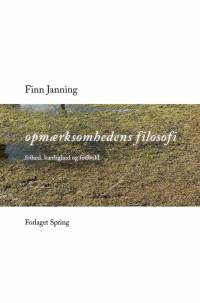
Med Opmærksomhedens filosofi – frihed, kærlighed og fodbold stiller Finn Janning spørgsmålet: Hvordan kan vi etablere en mere kærlig forbindelse med verden og hinanden? 

Janning viser med afsæt i fodbold og cykling hvorledes det enkelte menneske kan udforske eksistensens muligheder og gradvist blive klogere – på sig selv og de andre. Denne filosofiske visdom er eksistentielt klargørende, idet den, der tænker klart, lever klart. 

Hvordan klarheden optrænes, giver Janning flere bud på, men først og fremmest handler det om en empatisk og intuitiv indfølingsevne, der gør den enkelte i stand til at rumme dét, som sker. Netop her er fodbolden eksemplarisk, fordi det som sker med en spiller, også sker med tilskueren. 

I bogen præsenteres en poetisk filosofi. En særlig tilgang eller indstilling til verden, der er opmærksom, åben, problematiserende, beslutsom og frigørende. En tilgang, der sætter mennesket fri til at elske. 

Ud over sporten henter bogen inspiration hos blandt andre Ludwig Wittgenstein, Albert Camus, Simone Weil, Gilles Deleuze og Iris Murdoch. 

Bogen kan lånes på biblioteket, købes her eller købes – lidt endnu – direkte fra forfatteren.

Opmærksomhedens filosofi – frihed, kærlighed og fodbold

Send din adresse, beløbet er inkl. forsendelse.

DKK 250.00

Click here to purchase.

Against revenge

“The world needs bad men. We keep the other bad men from the door,” says the character Rust Cohle in the American crime-series, True Detectives. I thought of this sentence when I read Agnes Callard’s opening essay in the book On Anger (Boston Review Forum, 2020), which ends with the words: “We can’t be good in a bad world.” 

The underlying premise of her argument is that the world is bad. And it’s because the world is bad—tattered, for example, by inequality, racism, sexism, greedy capitalism, abuse of power, hunger, fatigue, etc.—that there is moral value in anger. Social movements such as #Metoo and Black Lives Matter emphasize this point. 

Perhaps more controversially, Callard claims that “once you have reason to be angry, you have reason to be angry forever. This is the Argument for Grudges.” Resentment of this type is often seen as being impotent, as Nietzsche claimed, and yet Callard present us with “the Argument for Revenge” where she tries to make a person’s desire for revenge something rational: she says, “revenge is how we hold one another morally responsible.” 

But before I go any further, let me pause to present the writer: Callard is an Associate Professor of Philosophy at the University of Chicago; she is also a columnist for The Point Magazine and The New York Times

Returning to her essay On Anger: Callard develops her postulation further when she writes that doing wrong—through revenge—doesn’t make you a worse person than when you were being wronged. In other words: “the victims of injustice are not as innocent as we would like to believe.” 

Thus, if I am wronged and I get angry, it is my moral responsibility to act on that anger and to seek revenge. Callard doesn’t present us with what would be an appropriate form of revenge. One reason for this is that she doesn’t operate with a clear moral guideline as to what is right and wrong. Instead, she seems to base such normative judgments on the individual’s feelings. “Anger,” she writes, “feels exactly as you would expect, if it were true that my moral accountability was a matter of you seeing what’s good for you in terms of what’s bad for me.”

Unlike a moral philosopher such as Iris Murdoch, Callard doesn’t aim to overcome “the big fat ego” that Murdoch believed to be the problem in moral improvement. In contrast, Callard centers on the person’s feelings, despite the fact that most people have been seduced or manipulated to “feel” inappropriate things. It is quite possible that a person will become angry due to a mistake, a misunderstanding, or even due to pure ignorance. 

Callard’s essay is followed by nine responses. Some of these merely repeat her argument, although others demonstrate the extent to which a true philosophical discussion is a mixture of humility and courage: while I acknowledge that I may be wrong, I nevertheless have the courage to present my ideas despite the risk of being wrong and having to think it all through again. 

Among the more significant responses is that of Elizabeth Bruenig, who argues in favor of forgiveness, saying that “it may be a necessary ingredient for peace as we know it.” Bruenig goes on to stress that forgiveness is not “something one does for oneself, as pop psychologists and wellness coaches often [would have it].” Although it may bring healing, forgiving is also painful because you’re “being asked to sacrifice for some higher good: peace or egalitarian order.” This approach tries to overcome Callard’s more individual moral evaluation from a transcendent perspective. 

Continuing with this theme, Misha Cherry argues, with the support of James Baldwin, about the need “to examine the context that gave birth to them [the crimes].” Here, Cherry is redirecting our attention away from a focus on the person, the egocentric individual, which is so typical in US political debate. One only has to think how convenient it was to be angry at Donald Trump and to ignore the culture or context that brought a person with such ideas and values to power. It is because we tend to focus on egos that we often ignore the context. 

Rachel Achs challenges Callard’s argument that “anyone who is wronged does have some reason to retaliate.” On reading this, I found myself thinking about the mafia and drug cartels who have their own reasons for being angry—which problematizes the claim that all anger is morally reasonable. While paying tax might make some people in Denmark angry, taking revenge by not paying tax while still benefiting from the welfare system, would not only be an example of unreasonable anger but also of plain stupidity. 

Oded Naáman asks whether revenge is the best option for moral improvement. Instead of revenge, an angry person or society might strive to change people’s mindsets and practical norms through new laws (e.g. to secure consent before sexual interaction), or through a better educational system that brings equality, justice and freedom to all—regardless of gender (including nonbinary persons and trans-persons), race, ethnicity, or sexual preference. 

The small book ends with a comment to the responses from Callard where she writes: “we need help to become the people we want to be—we are not already, ‘best’.” While it’s obvious that we need others because they can help us understand who we are and who we might become, it’s less obvious whether revenge is helpful. For example, does the other help due to his or her altruistic interest or just well-camouflaged selfishness? Also, I am skeptical about whether all people really know whom they want to be, that is, if what they want is truly their own desire, or whether they are being subtly seduced by political narratives or social media. 

After reading Callard’s essay and the responses, I am still left with the question: Why the need for revenge? I can easily understand and sympathize with the anger, but not with the need for revenge. I think one possible answer is that revenge is fueled by our own anger towards something we can’t let go of. It’s easy to get stuck in the past instead of “just” learning from it and then trying to overcome it. There is a need to make sure that it will not repeat itself, and this may be achieved through social experiments, education, new norms and values, etc.  

Thus, while anger can be productive and morally beneficial, it is only so, I believe, when it doesn’t lead to never-ending bitterness, self-righteousness and revenge. For example, Callard claims that once you have reason to be angry, you have reason to be angry forever, but I do not find her argument and examples convincing, and I also believe she is wrong.

Overcoming problems doesn’t necessarily require revenge; it calls rather, for a more creative approach that starts to build foundations for a future where people can experience equality, justice, and peace, while freely experimenting with different ways of living. 

With Nietzsche, I see revenge as resignation or resentment, which contrasts with trying to create new values, for example, through critical and innovative thinking. Critical thinking is a constructive example of the value of anger: a critique is actually something joyous because it has the potential to make us a little bit wiser, provided it is based on facts and convincing argument rather than on feelings and opinions. 

In her final reply to all the responses, Callard writes that anger is not only in one’s own self-interest. For example, I can be angry when other people suffer. And yet, despite this claim, it appears to me that the revenge she speaks of is always personal. Even when she proposes that “Love is a kind of attachment,” as in loving people who embody justice or equality, I fear that this too can easily lead to an attachment to one’s personal feelings about what constitutes equality and justice. Vanity, egoism, and narcissism are close by. 

Another way to define love could be by relating it to freedom—that is by being unattached and open to the continual process of becoming someone else. Søren Kierkegaard once wrote in a letter that “freedom is the element of love.” A simplistic interpretation of this could be that it is only unfree people who seek revenge. This is because it is only free people who are ready to set their egos aside and go where the truth takes them. 

I have dealt mostly with Callard’s essay, but the real strength of this book comes not only from her essay but also from all the responses. On Anger is an example of how rich and beneficial it can be to participate in a philosophical discussion—even if you, like me, are sitting on a bench in a park. 

Finn Janning, PhD, a writer and a philosopher. 

First published in Metapsychology, Vol. 25, No. 32

Opmærksomhedens filosofi

Den 17. juni udkommer jeg med bogen Opmærksomhedens filosofi – frihed, kærlighed og fodbold.

Den, der tænker klart, lever klart…

Med Opmærksomhedens filosofi stiller Finn Janning spørgsmålet: Hvordan kan vi etablere en mere kærlig forbindelse med verden og hinanden? 

Janning viser med afsæt i fodbold og cykling hvorledes det enkelte menneske kan udforske eksistensens muligheder og gradvist blive klogere – på sig selv og de andre. Denne filosofiske visdom er eksistentielt klargørende, idet den, der tænker klart, lever klart. 

Hvordan klarheden optrænes, giver Janning flere bud på, men først og fremmest handler det om en empatisk og intuitiv indfølingsevne, der gør den enkelte i stand til at rumme dét, som sker. Netop her er fodbolden eksemplarisk, fordi det som sker med en spiller, også sker med tilskueren. 

I bogen præsenteres en poetisk filosofi. En særlig tilgang eller indstilling til verden, der er opmærksom, åben, problematiserende, beslutsom og frigørende. En tilgang, der sætter mennesket fri til at elske. 

Ud over sporten henter bogen inspiration hos blandt andre Ludwig Wittgenstein, Albert Camus, Simone Weil, Gilles Deleuze og Iris Murdoch. 

Den kan forudbestille her.

As equals

Somewhere, I read that Black Lives Matter (BLM) is all about love. I like that. I think it’s true—all kinds of discrimination, hate and suffering can only be destroyed by love.

In her book All About Love: New Visions, the philosopher Bell Hooks (or, as she prefers, bell hooks) defines love as the will to extend or expand oneself for the purpose of allowing the spiritual self to flourish—including the selves of others. According to the existential philosopher Søren Kierkegaard, love is edifying. Love is a verb; it does something. But that is not all! In a letter to his then-fiancée Regine Olsen, Kierkegaard wrote, “Freedom is the element of love.

Love requires freedom. Or only free people can love.

I propose an understanding of freedom as being with friends. Freedom is the manifestation of a complete or meaningful relationship. Every relationship always assumes something that is not oneself. Love cannot therefore be reduced to self—love is, rather, an external force that arouses joy.

Seen in this light, I believe that the BLM movement shows a will to love, as it tries to overcome the devastating sadness that comes in the face of exploitation, discrimination, abuse of power, violence and death.

Read the rest of the essay here.

Doing Nothing

“Mother died today. Or maybe yesterday. I can’t be sure.” 

These are the opening lines of Albert Camus’s novel The Stranger. If these words seem gruesome, it’s because the reader has an expectation that a ‘normal’ person simply must know when his or her mother died. 

But does it really make any difference if my mother died today or yesterday? 

The Stranger, like so many other books and songs, reminds me of living with the dominant presence of  the Coronavirus. The days become indistinguishable. The virus—or death even—has become an intimate part of all aspects of my life.  

Camus’s story about Meursault, whose mother is dead, might be regarded as absurd. Instead of grieving at his mother’s funeral, Meursault falls in love with a girl. Afterward they go to the beach, where they bathe and make love. The girl wants to marry Meursault, and he tells her that it is of no consequence, but if she really wants to, he will go along with it. 

Today or yesterday, marriage or no marriage: Nothing really matters to Meursault. As if nothing is important. And that is exactly the point: Nothing—or death, to emphasize my point—is important. 

Since mid-march, I’ve been imprisoned—together with my wife and our three children—in our apartment in Barcelona, Spain. As a family, we do many things. Many more or less normal things, like cooking, eating, playing, working, homeschooling, reading, training, and watching a film together daily. 

Listing all these things, I can’t help realizing that I actually do nothing when it comes to fighting the pandemic. Of course, I’ve—we all have—been told that we do good by staying home. 

Still, I wonder: How can doing good feel like doing nothing? 

When I do nothing, I do so to the level that any Buddhistic monk would envy my capacity for non-doing. Non-doing resembles what we refer to when we say that something has presence. Life has presence. The Latin word prae-esseliterally means “to be in front of.” After 41 days (and counting) of imprisonment, I feel like standing more directly in front of life. It’s within reach; I can touch it, smell it—and, at the same time, I am also just being a witness to a crucial part of life, to the doctors, nurses, garbage collectors, and supermarket employees who are doing what the government calls essential work.

So, I wonder some more, whether all this doing nothing is absurd? After all, being a writer is not on the list of essential jobs.

When you write, it’s impossible to distinguish the story from how it is being told, its style, and general mood. The stories being written now will have another rhythm. Perhaps a kind of non-rhythm. For example, while doing nothing, it doesn’t matter what day it is. Presence doesn’t exclude time, but it binds time to a now and here. This is a liberating experience. Most of us are much more here: present.

Maybe that is why I never really did find Meursault’s behavior in The Stranger absurd; rather, it confirmed his capacity of being present with something much more important: death. 

The coronavirus is raising many questions, but one seems to be of great importance: How do we accommodate death? How do we live with the daily presence of death? 

The French essayist Michel de Montaigne said that to philosophize is to learn to die. The idea came from Plato, who saw his mentor Socrates condemned to death because he encouraged young people to think. Socrates could have avoided the punishment, but he chose to drink the poisonous potion of hemlock. 

One way of learning to die is to acknowledge the questions that the end of life confront us with. How can we minimize the estrangement that can arise in our meeting with death? Why does death make so many feel uncomfortable? 

I assume that the answer is not only—as typically proposed—related to the fact that death makes us reflect on whether we manage, or managed, to live sufficiently, whether we were attentive and full of appreciation and gratitude. Death is not what makes life meaningful per se. Quite the contrary, life is what makes life meaningful and worth living. I see the daily presence of death as a test of how well I live with nothing, for example, doing nothing, not being capable of doing anything, or more, accepting my mental or spiritual limitations. 

Doing nothing is for many people—in our current coronavirus—the same as doing good. But is it good in the sense that we come closer to dying without being dead? Perhaps it’s similar to Gandhi’s non-violence philosophy, which was not a resignation, not even the kind of refusal that is found in Melville’s short story “Bartleby, the Scrivener” and his “I would prefer not to”; rather it was doing non-violence. Nothing can, therefore, be done

So, doing nothing should not make people feel inferior or impotent. I don’t. Rather I am grateful to be witness to so many courageous women and men making things work. 

Many years ago, I accepted that I have a need to invent or create ideas, thoughts, or worlds of fiction. I don’t think that words can stop a virus, but perhaps they can heal wounds caused by the virus. Literature and art can challenge, shock, and expand our field of experience. It is difficult to share sorrow without the aid of art. What binds people together in Europe, where I am placed, is not the European Union; political solidarity is almost absent in the region. The borders are closed. Each nation is responsible for their own actions. What connects people are music and relieving words of compassion. Literature is like a string of sentences tying the past to the present, while throwing a lifebuoy of words into the future.

Death can easily steal time, as people stay in front of their screens slurping the corona news 24/7. It can also make time stand still. During these weeks, most people will experience why the French philosopher Henri Bergson defined time as duration. An hour can feel short or very long, even though 60 minutes is 60 minutes. Bergson can teach us that accepting what is real can be both a positive or negative experience, though it doesn’t change what time really is. 

Paying attention to the passing present moment is also a way of qualifying what forms of life we might leave behind when we can leave our apartments. What will I not forget? Which life is really worth living? 

During the crisis, we are confronted with the basics: Life is movement. Something in life moves us, makes us feel alive. Is death part of it? Yes. Love is another pole. It takes courage to accept the presence of death—that is, to be willing to risk everything for nothing. 

The coronavirus makes me become nothing, not feel like nothing. I am impermanent, constantly changing, becoming someone else. I hope that I might be of a kind of use, when and if I am capable of affirming life when it passes through me. Catching life with a word. Actually, becoming nothing makes me think of the British philosopher and novelist Iris Murdoch, who once said that “in the moral life the enemy is the fat relentless ego.”

 I believe that this corona-experience is good for my moral formation. 

The morale might be something like: Doing nothing is good, and when I become nothing, I am good. Why? Becoming nothing makes it easier to resonate with all life’s movements. 

First published in The Mindful Word, April 2020

Blog at WordPress.com.

Up ↑