A Philosophy of Mindfulness – A Journey with Deleuze is out!
"Write your way out of it." – J.D. Salinger

A Philosophy of Mindfulness is out!

In this book, I argue that we need a “new” philosophy because we—many of us, at least—are blind. We see rather little of that which surrounds us.
By mixing mindfulness with the affirmative philosophy of Gilles Deleuze, I unfold a philosophy of mindfulness. A philosophy that makes us less blind but also ethically responsible in relation to what we experience. Hereby, I move mindfulness from the sphere of psychology into philosophy, or from being primarily an inward-turned practice to an out-turned one.
A Philosophy of Mindfulness puts emphasis on experience, experiment, and actualization or affirmation. Each experience matters; life is the experience of making contact or being connected with what is in the midst of becoming—that is, life—and then passing it on to the next generations.

The second season of True Detective, written by Nic Pizzolatto, is about caring and being fucked. To put it simply, only those who care survive, but the survivors need to run away to avoid being fucked. The rest—that is the non-caring—well, they all get fucked, sooner or later.
So in a way the moral is sad, and no less sad in that it’s a pretty accurate picture of contemporary capitalist society. Corruption, loneliness, fights for possessions—whether land, kids, property, even fights for the right to deal or not deal with one’s past.
“[T]here is no outside to the world market: the entire globe is its domain,” Michael Hardt and Toni Negri wrote in Empire. The two writers stress that there is no outside to capitalism, that there is no other world we can refer to as being better, more beautiful, more righteous, and so on. A possible change of an ethical approach in business comes from within as a kind of counter-actualization of something overlooked or neglected, for example from the few human beings who have the capacity to care for life not money.
In True Detective a missing girl says – as a reply to the question whether she shouldn’t aim for more in life than just fucking: “Everything is fucking.”
It is, since everything is business, and is cool and calculated transactions. Fucking is not making love; it is just one’s person assumed right to use another person to fulfill his or her desires. And here, True detective shows us that it apparently is more acceptable when men fuck than when women do.
The sadness of gender inequality is still here in 2015!
“I support feminism, mostly for having body image issues,” says detective Ray Velcoro to his female colleague, Antigone. This can be interpreted in many ways, but women are under more pressure from men, society, and, perhaps, themselves to live up to a sexy ideal, whereas men, apparently, can still be old, fat, and ugly and be sexy, as long as they have money or power. Also, many men can’t avoid seeing the body rather than the person when they speak with a woman. Of course, this is black and white; but in the end, it seems like Pizzolatto puts all the blame on capitalism, not men per se.
It makes you wonder: Will business corrupt women, like it did with the men?
Let me draw a parallel between death, capitalism, and sex. Climbing Mount Everest, one will at one point enter “the death zone” (above 8,000 kilometers). In this zone, the level of oxygen is so low that only very experienced mountaineers can survive with this level of oxygen. And common for many human beings in “the death zone” is that they become much more selfish. There are many stories of people passing dead bodies, or passing people asking for help but are left because the others are so seduced by their objective: to reach the top. Capitalism is similar to the death zone. Most people forget all about moral responsibility; they focus on the ends not the means. To be rich is to be on the top of the world. And sex… it has always been a good business—just see how the porn industry helped establish the Internet, together with the military. Sex and war—there you have it. Once upon a time, it was war and peace.
What happened with peace of mind?
And it doesn’t stop there. To add another moral: those who are capable of confronting their own nightmares—in the second season, related to past experiences of solitude or abuse—learn to care and then move on. The positive moral is that moving on and caring go hand in hand. We are offered a way out. However, caring is something more than self-compassion; rather, caring as in having compassion for others.
Nic Pizzolatto knows—or I assume he knows—that each of us is always secondary to life. Life came before us, and it will still be here when we are gone. It is ‘others’ who make us alive, and in that sense we all need one another. Those who care as elements of their own interests and egoism, like Ray and Paul (custody of his son and less heterosexual pressure), here fate catch up with them.
The caring element is one of two things that ties the second season with the first (see more of this here: True Detective: Pessimism, Buddhism or Philosophy?). A true detective cares . The other element that ties the seasons together is one of the many celebrated statements from Rust Cohle, that the “world needs bad men to keep the other bad men from the door.” It still does. Now, however, the world is just getting worse and worse, so it is not just a job for bad men but also for bad women to clean out. Thus, we need bad men and women. Paul, Ray, and Frank can’t do it alone; they need Jordan and Antigone.
Perhaps there is a reason why only the women survive, not the men. Is it because no one gets away with anything? Do men always fuck up?
The second season is about karma, the Buddhist concept that emphasizes our actions bring results. Each moment we plant seeds, those seeds will bear fruits depending on various circumstances. One can’t control the outcome, only one’s motive for planting this seed. Therefore, one’s intention becomes important.
The last and most important moral of True Detective: try to bring a moment of awareness and reflection to your actions, basically to make wise choices.
Is it wise of Paul to hide his sexuality? Apparently not.
Is it wise of Frank to want to kill everyone and get all the money before he escapes? Apparently not.
Is it wise of Ray first to abandon his kid and then to return and say good-bye while being on the run? Apparently not.
Is it wise of Antigone to share her story with another, like sharing the responsibility to make one’s own burden lighter? Apparently so.
No one survives alone (was that yet another moral?).
Ray Velcoro dies out in nature under a big tree, the Bodhi spot. He dies peacefully, perhaps because we are told that he already lived many lives and that he is tired. Frank dies in the desert. Often we associate the desert as being a limitless space, a kind of freedom. But those are just delusions: deserts are full of sand and have a lot of heat, but are devoid of water and people; nothing but death. Frank was already dead. He already died a long time ago, when he decided to enter the business world where legitimate businessmen can’t be distinguished from illegitimate. Business is entering “the death zone.”
Antigone is the only true detective in the second season. Next time, we need both bad men and women to keep the bad men and women from our doors. In the end, if everything is fucking, then not only men fuck.

“Thirty years ago, ‘mindfulness’ was a Buddhist principle mostly obscure to the West,” Jeff Wilson writes in Mindful America. Today, however, it has managed to reach nearly every institution of American society (a tendency that is growing in Europe as well, although more slowly). How did this happen?
In Mindful America, Wilson explores the origin of the mindfulness movement. The book offers one of the first critical descriptions of the movement, which is focused on more that the movement’s practices. A key point is that mindfulness could only grow by distancing itself from Buddhism as a religion. This process took place in the 1980s through magazines, films, TV programs and, in particular, through bringing mindfulness into a medical context, where it later would open up a completely new field of research. Whether Buddhism really is a religion is something that has been debated before the era of mindfulness, but it is true that mindfulness (or the Mindfulness-Based Stress Reduction or MBSR-program of Jon Kabat-Zinn) would probably not be a part of more than 700 medical schools, hospitals, and health care programs worldwide if it were “sold” as religion.
Wilson wants to be neutral in his study, but this is difficult for him. “I do happen to be a Buddhist but am drawn to study mindfulness because of its prominence in the United States,” he writes. Being a Buddhist is both an advantage and disadvantage in his work. Wilson knows what he writes about, but it colors his perception at times. For example, he can’t help but see mindfulness as a second-rate Buddhist practice. He sees the maneuver of bringing mindfulness from Buddhism into a non-Buddhist context as problematic—a purely business practice; he fails to notice the extent to which it actually has contributed to something such as wellbeing.
Wilson favors a certain kind of origin of mindfulness as if there were only one right way to practice Buddhism. A bit similar if one were to criticize contemporary American pragmatics like Robert B. Brandom or Cheryl Misak because they diverge from the founding fathers Charles Sander Peirce and William James. Evolution is creative. Furthermore, the Dalai Lama looks positively on the matter of how Buddhism or aspects of Buddhism may contribute to reducing suffering in the West.
Having said the above, I still believe that Wilson has written a book that was highly needed. As with all things when they become popular, mindfulness attracts people who are mindful for the sake of money, not for the potential liberation of one’s mind. For example, one so-called mindfulness author writes, “mindfulness helps you fall in love,” while another writes, “what can that moment-to-moment awareness do for our sex lives” and “another bonus of eating mindfully is that it improves self-esteem.” Of course, by targeting sex and food, mindfulness is stretched to fit a need among white middle-class people. In addition, the focus on self-esteem (and worse, on identity) is problematic since among the more serious teachers of mindfulness, the “self” is a process. After all everything changes; everything is impermanent.
The critique that Wilson raises can be raised for the majority of the self-help industry. It targets people who seem to be existentially frustrated, perhaps even bored, rather than those that suffer socially or financially. A title like The Monk Who Sold His Ferrari, for example, tells us all we need to know about whom the book is targeting.
Mindful America does a very good job in exploring the mindfulness movement. In its transition from a Buddhist practice strictly for monks to a practice for mainstream Americans, it has had some ups—but mostly downs. The book is not an introduction to mindfulness; rather, it locates this transition in a sociological and cultural setting. It that sense, the need for mindfulness tells us more about the times we live in than about the actual practice itself. Sometimes it can be attractive to become what you’re not.
As Wilson says, “Today mindfulness is, quite simply, everywhere.” This assertion is both true and false. As a commercial concept it is indeed everywhere, but as a practice, it is not. If it were, the world would be a little bit more caring. Actually, if people were mindful then they wouldn’t buy books about mindfulness and sex and shopping and accounting, but simply be mindful.
This review was published in Metapsychology (Volume 19, Issue 32).

In recent years, there has been a growing interest in Buddhism and mindfulness meditation as well as some new-age philosophies that are often nothing more than pale imitations of Buddhist techniques. The interest is obvious. We live in an achievement-orientated, performance based culture and we are constantly forced, and even force ourselves to do something, and to set new goals and so forth. The result is that we become less aware and experience more narcissism, stress and depression.
In Sarah Shaw’s The Spirit of Buddhist Meditation we are told “When the mind is restless, that it is time to develop the factor of awakening that is tranquility, the factor of awakening that is concentration and the factor of awakening that is equanimity.”
Meditation can in other words, help us to become more mindful. “Mindfulness is the true refuge of the mind, mindfulness is manifested as protection, and there is no exerting or restraining of the mind without mindfulness.”
After I finished reading this book I didn’t know whether I should be impressed by or doubtful of all those people who claim to be mindful, because it requires diligence and self-control. It’s certainly hard work.
For those who are interested in Buddhism it can — especially for newcomers — be difficult to separate the wheat from the chaff (such as much of New Age thinking). As Shaw stresses, “a good tradition, teacher and friends, along with text, are the best ways of finding out about meditation for oneself.” Shaw is a knowledgeable teacher and a caring friend.
She deals solely with the Buddhist tradition, although that doesn’t mean that she is critical towards the important contribution to mindfulness made by Jon Kabat-Zinn and others, it is simply that her focus lies elsewhere. Shaw wants to show us how the texts have always been an important part of sharing Buddhist practices. In addition, she attempts to illustrate that Buddhism compared to other religions is less dogmatic. Rather it consists of good advice that comes from experience, or to put it differently: if one wants to wake up, then it is not enough to believe, one must act, and for example, meditate.
The Spirit of Buddhist Meditation can, therefore, be viewed as a rich introduction to the multiplicity of Buddhism, but also — and perhaps more likely — as a thorough guide for the more experienced meditators, or those who are already familiar with the philosophy of Buddhism. The book is littered with illuminating phrases, such as “What is required is that we try to live here and now ‘in our bodies'” — “You breathe in and out all day and night, but you are never mindful of it, you never for a second concentrate your mind on it. Now you are going to do just this” — “if we cannot control our minds, it will be impossible to control our actions and speech.”
A wide range of Buddhist writings on meditation are investigated and those already familiar with reading original Buddhist texts will appreciate the mixture of anecdotes, practical tips and endless repetitions within the same text. Sometimes this repetition can become a little boring unless, of course, one really pays attention to the minor differences that the text unfolds. Perhaps, the texts are written like that on purpose to cultivate our awareness.
Another reason for the repetition is that many of the texts come from an oral culture where the teacher would chant aloud. This of course explains why the reading can, at times, be a challenge. It is like listening to a love song on the stereo. Without the instruments, the rhythm and pauses, the experience can often seem more flat.
The Spirit of Buddhist Meditation explains the eight fold path of meditation, how meditation is practiced (sitting, standing, walking) and provides instructions on how to breathe, explaining why breathing is the foundation of a spiritual practice. (I may add that the word spirit comes from the Latin spiritus, which is a translation of the Greek pneuma, meaning breath). We also learn why there is no sane reason for clinging on to anything. The goal of Buddhism is to release one from the cycle of existence (Nibbána) and here the meditator enters a sphere of nothingness where, if you believe it, birth is caused by death. However, if you don’t believe in reincarnation, and I am skeptical; then you can still be open-minded and admit that we do not know for sure what happens when we die. For most meditators though, the experience of death may be beyond reach unless a life lived in retreats is desired. Despite this, with some practice and guidance it may be possible to experience that “space is infinite”, even though this concept can make most people feel dizzy thinking about it. If this is possible, then we may also understand that “consciousness is infinite.”
Everything is interconnected but this is not only a Buddhist idea as it can also be found in ecological thinking, or in the works of Spinoza or Deleuze. We may cultivate an experience through meditations. Again, the point of Shaw’s study is not the engage with other philosophies or psychological traditions, but to show the richness within the Buddhist tradition.
The Spirit of Buddhist Meditation will most likely attract people who already meditate, or those who would like to do so. However, it can also serve as a useful introduction to Buddhism in general, as well as act as an inspiration for people who work in the growing service industry, helping people recover from the negative effects of modern day capitalism.
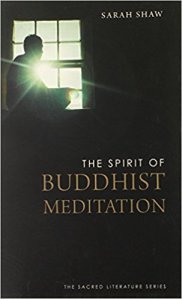
Published in Metapsychology (Volume 19, Issue 23).

I just released the essay Inside with illustrations by Jeppe Hein.
 The essay is a contribution to Hein’s exhibition, All We Need Is Inside at 303 Gallery, New York, US.
Enjoy.
 FINN JANNING