Or how being “no one” means belonging to all.
Read more in Psychology Today.
"Write your way out of it." – J.D. Salinger
Read more in Psychology Today.
The French philosopher Gilles Deleuze once said: “There is no need to fear or hope, but only to look for new weapons.”
‘Weapons’ may give us the wrong associations, but what he refers to are concepts that, like a brick, can be used to destroy what is hindering the growth of our lives, and at the same time, help us build or create something sustainable.
The Korean philosopher Byung-Chul Han’s work can be seen a toolbox aimed at helping us understand our contemporary society, while also presenting us with concrete ideas, thoughts or ‘weapons’ that might help us overcome or resist our own weak desires and vanities.
Han was born in Seoul, South Korea in 1959. He studied metallurgy in Korea before moving to Germany in his early twenties to study philosophy, German and theology. Today, Han is a professor at the University der Künste in Berlin. His initial fame sprang up with the publication of his book Müdigkeitsgesellschaft (2010), which, directly translated, means ‘the fatigue society.’ In English, this was cleverly translated to The Burnout Society (2015).
Han’s thesis is that today’s neoliberalism has made politics psychological or mental. The logic of neoliberalism has invaded our minds. It’s our ability to be present in our lives, to think and to love that is threatened by this invasion. Neoliberalism—for many, at least—has become an uninvited guest that refuses to leave our minds.
Han declares, in all of his work, that we have become narcissistic. For this reason, it’s time for citizens to care more about society’s welfare than their own egos. “Responsibility for the community defines citizens. Consumers lack responsibility, above all,” Han writes in his 2018 book, In the Swarm: Digital Prospects. The result of this narcissistic development is well-known: stress, burnout and depression. “Depression is a narcissistic malady,” Han states in The Agony of Eros (2017).
Eros or love is the only thing that may conquer our contemporary depression. As Han writes, “Depression represents the impossibility of love.”
Still, it’s difficult to love, because we are not really free. It’s not just that society pressures us to fit in, perform faster and achieve more, but rather that we ourselves want this. We try to appear as positive, smooth and shiny in public as possible, as if our lives are all made up of ‘good vibes.’
In 2017’s Saving beauty, Han writes: “The smooth is the signature of the present time.” This kind of smoothness, he continues, “connects the sculptures of Jeff Koons, iPhones and Brazilian waxing.”
Today, smoothness and waxed bodies, quite sadly, are seen as the same thing as beauty. The morale behind this is clear: Smooth, smoother, smoothest = good, better, best. All that is strange, secret, or negative—in other words, all that passes through our thoughts—disappears, due to the ongoing repetition of sameness.
We lack a critical yet creative and life-affirming approach to overcoming this confinement. When we avoid the negative, the difficult and the painful, we amputate life. Our lives tend to circle around ourselves, making the circle smaller and smaller as we Google ourselves into unconsciousness.
To contrast this shallow development, Han turns to the writings of Plato, Kant, Hegel and Heidegger, in which there is no distinction between beauty and the sublime. Experiencing sublime beauty is not supposed to be pleasurable; rather, it hurts. It makes you fall and stumble. It is similar to falling in love, because you can lose yourself and act rather stupid.
“The sight of beauty does not cause pleasure, but shocks,” Han stresses in Saving beauty. It’s the matter of experiencing our own fragility that contemporary society minimizes. Art can shake us, make us see the world differently and help us perceive our own limitedness and flaws. “The longing for beauty,” Han says, “is ultimately the longing for a different mode of being, for another, altogether non-violent form of life.”
The strength of Han’s analysis lies in how he uses two guiding concepts in all his books: freedom and power. They both encapsulate the problem with contemporary society and can also open us up to alternative ways of living our lives.
Freedom is both a problem and a possibility. It is becoming, emphasizing that we become by combining courage to stand up against dominating ideals and norms with the belief that things could be different. Freedom is found in becoming whatever disobeying those ideals enables us to become. Real freedom is socially anchored, and as Han says in Psychopolitics: Neoliberalism and New Technologies of Power (2017): “Freedom is a synonym for the community that succeeds.”
By making freedom social, he tries to relate it with truth. Perhaps this is where Han shows how courageous he is, by reintroducing the problematic concept of truth in philosophy. In Saving beauty, he speaks about the need to save beauty. Why? Because, as he writes: “Beauty promises freedom and reconciliation,” and “truth is freedom.”
In other words, a world of smoothness is false. It’s a world of ‘post-truth.’ For Han, the beautiful is both true and good; it’s almost as though the Korean philosopher is turning Platonic. And he is—at least in the way that the French philosopher Alain Badiou is Platonic.
In both Saving beauty and The Agony of Eros, Han ends up advocating for Badiou’s idea that the task of philosophy is to be loyal or faithful towards whatever binds us together (what is true, in other words). Han distinguishes himself from Badiou when he more practically shows why or how we can show fidelity to what really takes place in our lives.
Fidelity is unconditional in that it presupposes commitment and awareness. That means we should try to become capable of matching all parts of life, instead of just doing so when life is pleasurable and smooth.
“The saving of beauty is the saving of that which commits us.” This loyal commitment or involvement is related to the kind of awareness that mindfulness cultivates, as a non-judgmental and kind approach to what is happening now and here.
Han also uses his Eastern roots in his philosophical thinking. Back in 2002, when he was still an unknown, he published a book called The Philosophy of Zen-Buddhism.
In this book, he illustrates that the Buddhist concept of ‘nothingness’—as the absence of an exclusive subjectivity—is what makes Buddhism pacifistic and non-violent, because there is no essence where power can be concentrated. Also, the concept of ‘emptiness’ is the reason why narcissism is something very un-Buddhist. There is no unchangeable ‘me’ in the mirror; rather, I am being formed by life.
The Korean thinker also illustrates that humour is something that links Western and Eastern philosophy. Nietzsche, for example, claimed that laughing was an expression of freedom. The Danish philosopher Søren Kierkegaard once said that “freedom is the element of love,” so it follows that without humour, there’s no freedom, and without freedom, there’s no love. Or to put it differently, it’s difficult to love people who never laugh, or take themselves too seriously.
In Buddhism, Han writes, there is no miracle, only hard daily work: Letting go of the past and not transcending or dreaming of a world beyond this one. He compares Buddhism with walking. Walking has no future, as you’re always in the midst of walking. To die means to walk, he says, emphasizing that we are always dying. Similarly, Michel de Montaigne said that to philosophize is to die.
‘Dying’ means always walking, philosophizing, exploring and experimenting with life, not as a way of meeting a specific objective, but as a way of being grounded in the here and now. Western and Eastern philosophy, I believe, share this humble approach to life. We never philosophize or meditate to conquer the world, but to praise its beauty.
Many Eastern ideas are reflected in Han’s suggestions for how to overcome today’s stress, burnout, exhaustion and ever-growing narcissism. For instance, in The Burnout Society, he encourages us to stop, sit down and take a break. Philosophy is here defined as ‘an intervening time,’ ‘a time of ‘non-doing,’ ‘a peace time,’ as he calls it.
The concept of ‘non-doing’ resembles elements of Buddhism and mindfulness in that it stresses that we don’t need to be doing things constantly, Rather, non-doing allows things to unfold at their own pace.
Similarly, in The Transparency Society (2015), Han proposes that although we are forced or coerced into participating in an ongoing style of positive communication—declaring, “I like,” over and over, again and again—we don’t have to like everything. It’s not more communication that is needed, but creative or alternative approaches to living a richer life. To be creative, a person needs to stop and allow themselves to be formed or touched by what is happening as it happens, in the here and now, without judging it according to some predefined ideal.
A last example is provided in Psychopolitics, in which Han he reawakens the ‘philosophical idiot’ as a way out of today’s malady. The idiot doesn’t belong to a specific network or alliances, so he or she is free to choose. The idiot doesn’t communicate; instead, he or she facilitates a space of silence and loneliness, where they only say what deserves to be said. The idiot listens, as a generous way of stepping aside to give room to the others.
“The art of listening takes place as an art of breathing,” Han writes in The Expulsion of the Other: Society, Perception and Communication Today (2018).
Han’s work is accessible for non-philosophers, and is a good guide to understanding and navigating oneself through today’s demanding, achievement-based society. He encourages us to Relax. Do nothing. Become no one. See time as something peaceful.
Time passes, whether we want it or not. Then it returns and changes everything. Let go. Listen. Embrace moments of non-communication. And breathe.
I published an essay in The Magnolia Review.
It’s called “A Borderless Life” and can be read here.
Late one August evening in a small provincial town, a woman steps out her front door. In her hand, she holds a slim leather briefcase, probably containing a laptop. When she steps down from the small landing in front of the door, a mild breeze fills the air, gently tousling her long blond tresses. She tries to pull her hair back behind her ears without any luck. From the back pocket of her jeans she pulls out a bandeau and ties those unruly locks into a simple ponytail. Now, with no hair interrupting her vision, she looks first to the right and then to the left before turning around to lock the door behind her. After checking twice that the door really is locked, she rotates to face the street for the second time.
This time she looks to the left first. Actually, at this point, her whole body shifts as she evaluates the possibility of going in that direction.
Is this the right way?
Read the rest of the essay in Terse Journal.

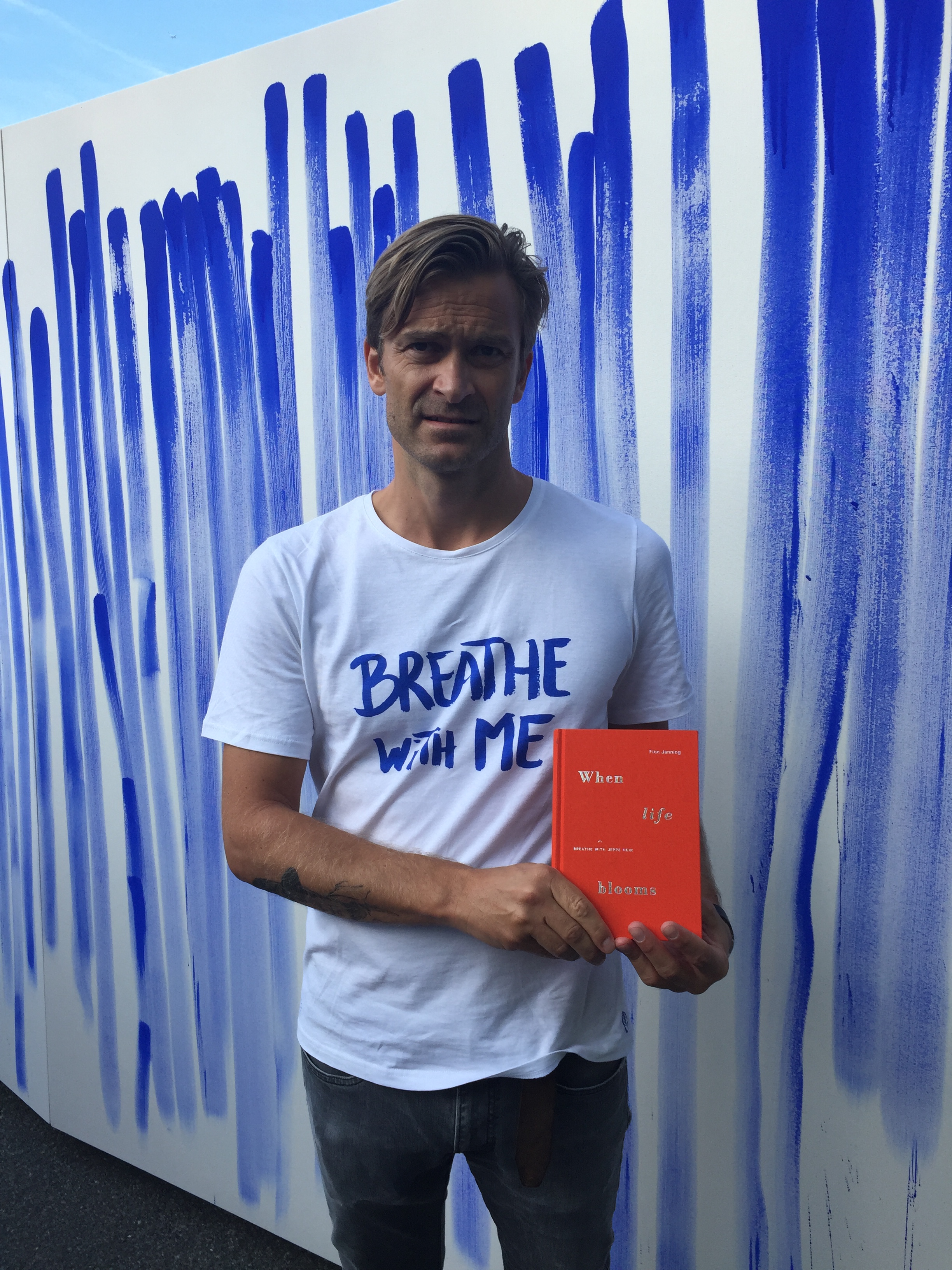
I’m pleased to announce that my new book, When life blooms – Breathe with Jeppe Hein will be released November 28th.
The publisher writes about the book:
“Danish artist Jeppe Hein soared to the top of the international art scene before the age of 35. His works were showcased at the world’s finest exhibitions and sold for sky-high prices. Then suddenly his body said stop. In 2009 Hein went down with stress.
In this book philosopher Finn Janning follows Jeppe Hein’s development from the tome immediately after his diagnosis with burn out and onward – a period where Hein underwent psychoanalysis and developed and interest in yoga, breathing exercises and spirituality.
Janning shows how spirituality has become more present in Hein’s works, and in the book, he develops an existential philosophy in continuation of the artists spirituality and art.”
I may add:
Although I was commissioned to write this book, I aimed at turning it into a philosophical biography that describes the life of the artist Jeppe Hein. In doing so, I’ve tried to exemplify Gilles Deleuze’s idea that “life is not personal,” that is to say, each life is a case study.
I choose this approach as a way of addressing the narcissism of the artist without making the narrative confronting, or in anyway judgmental.
Instead, I illustrate how Jeppe is formed by the major cultural trends during the last 40 years, such as the growing accelerating and spirituality and social entrepreneurship. He is an artist of his time.
It’s a book that tests and nuances the popularity of today’s spirituality through a philosophical, primarily existential lens.
ENJOY
The French philosopher Gilles Deleuze once said: “There is no need to fear or hope, but only to look for new weapons.”
‘Weapons’ may give us the wrong associations, but what he refers to are concepts that, like a brick, can be used to destroy what is hindering the growth of our lives, and at the same time, help us build or create something sustainable.
The Korean philosopher Byung-Chul Han’s work can be seen a toolbox aimed at helping us understand our contemporary society, while also presenting us with concrete ideas, thoughts or ‘weapons’ that might help us overcome or resist our own weak desires and vanities.
Read the rest of my portrait of Byung-Chul Han that I wrote for The Mindful Word
My review of The expulsion of the other
My review of In the Swarm
My review of Saving beauty
A small feature on Han, can be read here.
Before I try to give a decent answer, I would like to emphasize that I’m glad the question is personal. It refers to me, not you, or someone else. I don’t like moralizing, that is, telling other people how they should live, but I do like the element of self-knowledge and care that this question addresses.
Thus, “How should I live?” I should live a joyous life.
Life, of course, is full of both joy and sadness, suffering and pleasure. Some of these are related to individual limitations, e.g. intellectual abilities. Others are related to social or political circumstances, e.g. financial.
Still, a useful guide is to live in a way that enhances a life’s joyous moments regardless of the circumstances.
How do I do that? From the French philosopher Gilles Deleuze, I’ve learned that we always have the thoughts and feelings that we deserve. At first this can seem brutally arrogant, but what he aims at is that our mental state depends on how we relate to or approach our experiences. The challenge that we all share, regardless of setback or misfortunes, is how we become worthy of what is happening. This is not acceptance as a kind of resignation; rather, it’s an approach to life that confronts obstacles or setbacks by trying to create a new form of life that minimizes the effects of what is hindering ourselves from living freely.
Therefore, I should live as a compassionate fighter, that is, become a person that fights by exploring what a life may become. What is possible? I fight hate, discrimination, domination, violence, etc. because it kills life. And by involving myself in this fight — although I have to acknowledge my intellectual limitations – I feel better. Actually, I feel alive. And to live a joyous life is to have an intimate affair with life, to experiment, and dance with it.
I remember the Chilean writer Roberto Bolaño once said that children typically are full of joy, and then he wondered why it’s so, before answering, that they are alive.
It sounds like a tautology: a joyous life is synonymous with how I should live because joy emerges through appreciation of being alive, which I accomplish by destroying everything that seem to hinder life from flourishing, just as I create room for things that flourish. Nothing comes for free, except death.
Joy and happiness require hard work.
This work is guided by two hypotheses with one overall objective of establishing an ethics of mindfulness . The first hypothesis is the concept of moral motivator or in- tentional moral. Both Western philosophy and mindfulness operate with an intention influenced by their moral beliefs. The second hypothesis is the relationship between moral reasoning and wisdom. That is, our reasoning is affected by our moral belief . To combine those two theses, I introduce the concept compassion from mindfulness and the ethics based on the French philosopher Gilles Deleuze. Hereby, I suggest that by practicing mindfulness, one can develop his or her capacity for compassion, but also – this practice – is a «way of life» that can help protect the planet: an ethical practice.
Read the entire paper here: Compassion – Toward an Ethics of Mindfulness.
“Compassion – Toward an Ethics of Mindfulness” is published in the journal Mindfulness & Compassion, vol. 3, issue 1.

Some years ago, I was teaching a course in Philosophical Counseling. To my surprise, all that the students wanted to know was “What is the right thing to do?” Having that knowledge, they assumed, would make life easier. “Perhaps,” I said, “but not better or more interesting.”
Their request is part of the obsessive achievement eagerness of today’s society to perform well according to fixed ideals. It creates dullness when it comes to mental exercises. The unfortunate norm is the faster the better. I told them that philosophy is about developing problems, not delivering solutions. It’s a slow practice. It’s for life. My answer made them fidget with impatience. To philosophize, I emphasized, is to dwell on the fundamental questions, and these questions are developed in problems, just as the problems are enveloped in fundamental questions.
Yet, my students insisted: “So, what is the right question?”
I told them that this particular question was related to the problem embedded in the question. For example, how do you draw a clear distinction between right and wrong?
The ones who weren’t paying attention looked up from their screens.
In sports, where the rules are given, I said, it is rather obvious to tell whether a player is “doing it wrong.” Similarly, in business, where profit seems to guide every decision, knowing what is right and wrong may be easier. Life, however, is neither a game nor a business, although there is a tendency to classify people into winners and loser as if life were that simple. Such labeling is part of today’s achievement society. Everyone’s performance is measured according to an ideal–and ideal that is often related to the staus, prestige, power, and, of course, money that is associated with being a winner.
They went silent, so I went on. Of course, there are things in life that are rather obvious. For instance, no one needs philosophy to tell you that it is wrong to kill, discriminate against, or repress other people. Instead, philosophy begins when we start to questioning the obvious. Could I live another life? What is also possible? How may I also live?
A part of philosophy is to accept that some problems remain without solution; some questions can’t be answered once and for all.
Such a question is Which life is worth living?
Of course, one of my students then asked me: “Which life is worth living?”
This is how A Philosophy of Mindfulness – A Journey with Deleuze begins.

The main argument in Todd May’s book, A Fragile Life: Accepting Our Vulnerability, is that most of us would be unwilling to choose an invulnerable life even if we were given the opportunity. Of course, we all understand that in reality, it is impossible to live a life where we avoid all sources of pain. In his book, the author proposes that we should accept our vulnerability and acknowledge that the suffering is part of life. The question is: How do we develop that acceptance within ourselves?
It is doubtful whether May is correct in his assumptions regarding what most people might choose or might not choose. When supporting his supposition, he references Buddhism, stoicism, and the thoughts of Tolle Eckard, an extremely popular spiritualist currently. Many people might find the opportunity to live an invulnerable life, one in serenity or full awareness, an attractive option. However, this possibility seems highly unrealistic for the majority of us if we take the philosophical perspective seriously. Still, regardless of the truth regarding this particular claim, May’s book can be a useful companion for people who want to reflect on their lives. It is full of examples and is written for a broad audience.
The book starts by setting the scene regarding the inevitable vulnerability inherent in our lives. It then moves on to discuss to what extent having a project is required to provide meaning for our lives. He suggests that, “understanding how we can suffer requires that we first understand how we live.” May loosely follows the ideas of Bernard Williams with his suggestion of a meaningful project since it is embedded in a net of social practices such as rules and norms. By living our lives according to a meaningful project, we encounter some of the first potential problems. He writes that , “many of the ways we are vulnerable to sufferings” comes from the various things affects us negatively, that is, hinder “our ability to engage with our projects.”
The two opening chapters of the book provide excellent examples of the problems that result from vulnerability as compared to invulnerability. Next, May introduces various philosophies that claim to provide us with a model of how to live without suffering: Buddhism, Taoism, Stoicism, Eckard, and Epicurean. He describes how psychological and physical pain are connected for example. Then, he mentions that one of the challenges when it comes to suffering is whether or not we are capable of accepting the situations we cannot control. This section begins to sound like a book for consulting managers, but it does present an easily understood summary of these various philosophical schools of thought.
One of the guiding ideas links the introduction and his conclusion is how our past has led us to who we currently are and where we are in our lives today. The question is whether we should affirm our past or just simply accept it. May favors the latter approach. He uses the example of the Holocaust to illustrate his point. This is not an event we would want to affirm. Instead, he suggests that we accept that it happened neither affirming nor refusing it. Similarly, we should try to accept our past without necessarily assigning it a positive or negative value.
May’s book focuses on the fundamental question of how to live a life worth living with or without suffering. The answer that May provide us hinges on acceptance. We should learn to acknowledge our suffering. Acceptance, he writes, “does not render us immune to our suffering. It does not take us beyond our fragility. But neither does it leave us bereft. To accept the contingency of things and the quiet sadness that may go along with it is not to lie prostrate before the world. Rather, it is to embrace a perspective that can, with luck, help us find a path.”
The book deals with an interesting existential issue. Even though he uses personal stories as well as the experiences of others, the book never truly had an effect on me. It lacked the power of classical existentialist work, which really cut into my flesh. Perhaps, May’s conclusions were too banal. While I do feel that the invulnerable philosophies presented were relevant, the argument could have easily worked even without their reference. The distinction between a life with or without suffering is already clear enough. I would rather that he strengthened the argument regarding why it might be “attractive” for our lives to include suffering. For example, he could explore how we might develop creativity and artistic expression in an attempt to overcome our miserable lives.
Still, the book would be useful for newcomers to philosophy in my opinion. Also, readers who like a more conversational style would enjoy this book. The conclusions are not dramatic, but they might generate a new interest in the reader for further study of the existential philosophies that May summarizes in passing.
First published in Metapsychology, Vol. 21, Issue 21.
 FINN JANNING