Kunsten ikke at arbejde

Det er vist nok ti år siden, at jeg skrev om Kunsten at arbejde.

En anmelder skrev følgende:

“Med et filosofisk udgangspunkt præsenteres nye opfattelser af nogle af arbejdslivets store problemer i dag: stress og depression. Bogen er henvendt til medarbejdere, ledere og andre, som professionelt beskæftiger sig med disse ting.

I denne bog går han filosofisk til modstand mod det, han betegner som en tidens trend, angsten – som får os til at søge coaching og guidebøger, fordi vi ikke stoler på os selv. Med bogen vil han vise, at der er en anden vej. Vi skal eksperimentere med livet og arbejdet.

Der er skrevet mangt og meget om at håndtere nutidens vilkår i arbejdslivet, stresshåndtering og coaching. Bogen her adskiller sig ved sit filosofiske udgangspunkt og ved ikke at servere færdige løsninger, men bibringe læseren nye og anderledes perspektiver på stres-suppedasen

Der er ikke decideret tale om en populærpsykologi. Hertil er den sprogligt og forståelsesmæssigt for krævende. Alligevel vil den have visse ledere, konsulenter, coaches og medarbejdere som målgruppe, hvorved dens ambitiøse budskaber om nyt fokus vil have chancer for udbredelse til en større kreds.”

Hvis du stadigvæk er stresset, så læs bogen!

Drugs and Society

My brother died from an accidental overdose when he was 26 years old. Ever since, I have had an interest in drug addiction—never in a scientific way, but always with an eye on the debate. On this blog, I have reviewed and mentioned some of the authors mentioned below, just as I have published a few chronicles in Danish newspapers (Narkomaner er (også) mennesker, Udbud og efterspørgsel slog min bror ihjel og Legalisér narko).

Recently, I read Carl Hart’s book, High Price: A Neuroscientist’s Journey of Self-Discovery That Challenges Everything You Know About Drugs and Society. The title says it all!

Hart is a professor of neuroscience and psychology at Columbia University. In High Price, the author mixes memoirs with summaries of his and others’ scientific research into drug abuse and addiction. This blended approach gives him street credibility. 

His reason for telling his own story is to illustrate how growing up in certain areas with lower income, poor education, unemployment, and racism affects people negatively. Basically, the underlying—and very important—moral of the book is that drug addiction is caused bymany of society’s problems, not the reasonfor them. This contradicts many of the stories most people are being told about drugs and crime. 

Similarly, Italian writer Roberto Saviano and journalist Johann Hari both claim that anti-drug policies (e.g., the war on drugs) are causing more harm than the drugs themselves. Why? Because the criminalizing drug policy marginalizes poor, undereducated, and (at least in the US) often black people. However, to actually solve the problem of drug abuse, a government ought to focus more on education, employment, racism, and alleviating general life anxieties and loneliness. 

Loneliness plays a crucial role in addiction. At one point, Hart refers to Bruce Alexander’s “Rat Park” (which made me think of the Rat Pack!) experiments of the late 1970s and early 1980s. Hart describes how rats in a social, enriched, and engaging environment self-administered morphine on offer in their cages at a significantly lower rate than rats kept in solitary cages with no alternatives offered to them. 

Most of Hart’s own research follows Alexander’s results. For example, Hart tested whether drug users would choose financial rewards over a certain kind of drug and determined that it depends on the alternative and the context. Sometimes the drug abuser would choose money or sex instead of drugs. Also, addiction is not a consequence of drug use. Sometimes people just use drugs because there is nothing else. In Alexander’s work, the rats lived in isolation. For this reason, the studies suggest, they preferred drugs over water, even if it meant killing themselves. Hart mentions that, if you were in isolation with only one film to watch or one book to read, you would probably watch or read it many times simply because you had nothing else to do. Yet, that doesn’t make you an addict! 

Again, this is related to the social environment. If you grow up in a place with little future, no money, no care, a lot of violence, discrimination, etc., then perhaps alternatives to drugs are few (or less obvious).

Thus, the conclusion High Price offers is: change the people and environment around you; then, you will change yourself. Or, change the world, and you will change accordingly.

Carl Hart’s book is an important contribution to a discourse that still seems to be governed by ignorance and prejudices.

Can I Involve You?

I took the elevator up to the third floor. Normally, I would have taken the stairs in order to get a bit of exercise. But normal doesn’t exist anymore. Did it ever?

I just turned thirty-seven and I am feeling slightly lazy after having written books for the last decade or so. Not that writing books is a cushy job. Quite the contrary. It’s freaking hard work. It’s just that I do it sitting down, five to six hours a day. And I do it every damn day! That takes its toll on the thigh muscles. At times my limbs creak more than the chair I sit on. I know, it’s an overused metaphor, but I can only blame IKEA for this unpleasant sound. Well, nevertheless, or maybe because of all this, I took the elevator. I also didn’t want to arrive sweaty or out of breath. I hate sweaty people. I hate people who are out of breath.

Up on the third floor, a youngish artist had an exhibition called Moving Borders. I had been sent to cover the exhibition for a major Spanish journal. The artist was “up and coming,” they said (the journal in Spain that is) when they called to offer me the assignment. Up and coming. Who isn’t? I thought, but of course I didn’t say that. Like so many other writers before me, I said basically nothing unless in writing. Instead, I watched everything with all of my senses open. I watched and watched until my eyes stung. I looked like the English comedian Marty Feldman. Google him, if you don’t get an instant image.

Read the rest of the short story in Daedalus Magazine

How will I be remembered?

He sits on the sofa and looks at their wedding pictures. It was three years ago. Not even three years, he thinks. They both looked so happy. Drunk. Elegantly wasted, as they had been so many times before. And later. Everything was later for them, postponed. For nearly thirteen years they had been together. That’s a long time. At such an age, most kids would be baptized.

Was it too long?

Read the rest of my short story in Daedalus Magazine.

Against the bandwagon mentality

I

The philosopher André Comte-Sponville, once said: “It is better to be too honest to be polite than to be too polite to be honest.” 

Although I agree with Comte-Sponville, I think that disagreements can be managed with kindness. For example, one should never be too polite to confront people who are discriminating, manipulating, lying or harming other people, but always try to do so in the friendliest manner. 

One way of meeting the world with kindness could be by following the Norwegian philosopher Arne Næss  (who was inspired by Spinoza and Gandhi and made an important contribution to ecological thinking). In his book, “Communication and Argument,” he suggests the following recommendations for objective public debate:

1. Avoid tendentious irrelevance, e.g. personal attacks or claims about opponents’ motivations.

2. Avoid tendentious quoting, e.g. quotes shouldn’t be edited to fit the argument.  

3. Avoid tendentious ambiguity, e.g. ambiguity can be exploited to support criticism.

4. Avoid tendentious use of straw men, e.g. views shouldn’t be assigned to the opponent that he or she doesn’t hold

5. Avoid tendentious statements of fact, e.g. information put forward should never be untrue or incomplete, and relevant information should not be withheld.

6. Avoid tendentious tone, e.g. irony, sarcasm, pejoratives, exaggeration, subtle (or open) threats

These suggestions, today, are rarely seen. Due to social media (specifically, its rapidness and the need to be present or visible constantly), we see a growing “cowboy mentality,” where people shoot first without thinking. Online shaming is an example of this “bandwagon mentality,” where the herd uncritically follows what appears or sounds to be right or good. 

II

A recent example of this “bandwagon mentality” is the Junot Diaz case. When the Dominican-American writer was accused five or six months ago of sexual misbehavior (i.e., forcible kissing and yelling), few questioned the credibility and gravity of the claims, whereas many uncritically jumped on the bandwagon and even upgraded the accusations to label Diaz a sexual predator. Now, after the Boston Review, M.I.T., and the Pulitzer Prize Board have conducted thorough investigations, Diaz is welcomed back. The accusations against him weren’t credible. 

What happened?

Facts, as the French philosopher Bruno Latour once said, are a product of a trustworthy inquiry. Thus, some facts are stronger than others. The reliability of facts depends on the strength and practice of the institution or network that produced these facts. In other words, facts and moral values hang together. It is morally wrong to claim something without evidence or to claim the opposite of what the evidence shows. Unfortunately, the moral debate surrounding false accusing is rare, almost as if accusations are accepted because of powerful men having silenced women for so many years. Yet, morality is not a contest to get even; it is a long, persistent practice of acting responsibly, demonstrating care and respect, and showing trust and equality in all situations. This is the only way to overcome oppression, whether related to gender, race, religion, or sexual preferences. 

The “bandwagon mentality” emphasizes that public philosophy is needed. One of the challenges of contemporary philosophers is to do work that inspires people to philosophize.

A simple way of addressing the “bandwagon mentality” is through imagination. Actually, being kind, polite, and civil requires imagination, such as imagining that we might be wrong or what we are being told might be wrong. In short, being humbler. For example, we could question what we take for granted, question why we take certain things for granted, question what kind of values our lives produce, question the identity that some people cling to, etc. (see e.g. All women are not angels)

For instance, we may ask why some people deliberately lied or exaggerated about Junot Diaz being a sexual predator and misogynist when he wasn’t. Is the problem epistemological, as when some people don’t know what they say when using certain concepts? Is it a semantic problem, as when some people misunderstand certain utterances, even utterances that most other people find meaningful? Is it a moral problem, as when some people claim and postulate what they can’t prove? Is it a mental problem, as when some people see and hear things that other people can’t?

Then again, it might just be an example of admiration turning into envy, frustration, and hate. After all, artists are known for self-pity and narcissism.

So, what to do? Civility, kindness, and politeness are never acts of blindness; rather, they are acts of compassion, in the sense that none of us can live without others. The others help us stay alert.

Simple advice: Before communicating, debating, or politicizing with others (especially if we accuse them of bad things), we need time to reflect, analyze, and think. We are thereby able to find solutions to those problems that few people dare consider today because, unfortunately, it is easier or more convenient to just follow the herd.

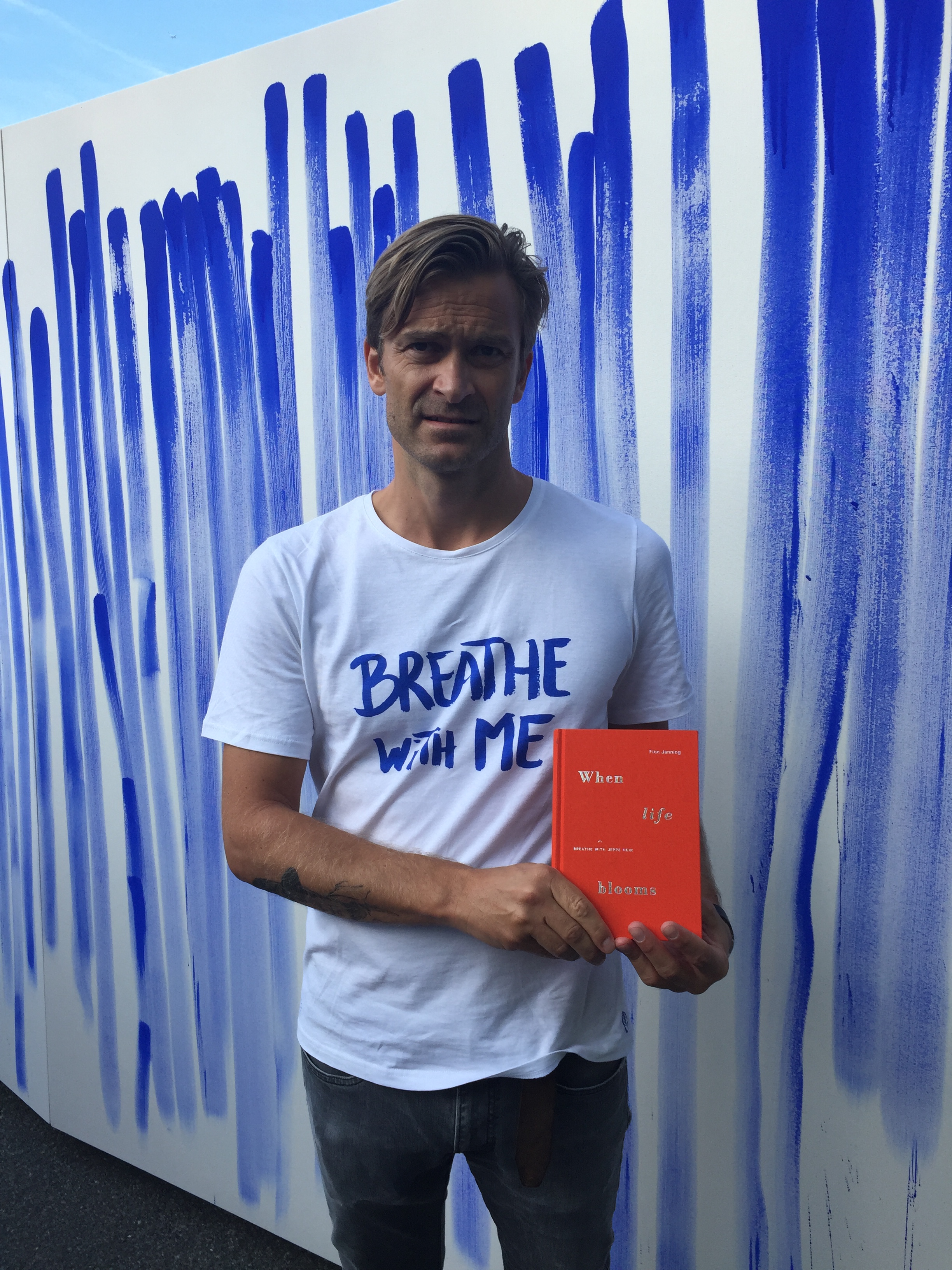
When life blooms

I’m pleased to announce that my new book, When life blooms – Breathe with Jeppe Hein will be released November 28th.

The publisher writes about the book:

“Danish artist Jeppe Hein soared to the top of the international art scene before the age of 35. His works were showcased at the world’s finest exhibitions and sold for sky-high prices. Then suddenly his body said stop. In 2009 Hein went down with stress.

In this book philosopher Finn Janning follows Jeppe Hein’s development from the tome immediately after his diagnosis with burn out and onward – a period where Hein underwent psychoanalysis and developed and interest in yoga, breathing exercises and spirituality.

Janning shows how spirituality has become more present in Hein’s works, and in the book, he develops an existential philosophy in continuation of the artists spirituality and art.”

I may add:

Although I was commissioned to write this book, I aimed at turning it into a philosophical biography that describes the life of the artist Jeppe Hein. In doing so, I’ve tried to exemplify Gilles Deleuze’s idea that “life is not personal,” that is to say, each life is a case study.

I choose this approach as a way of addressing the narcissism of the artist without making the narrative confronting, or in anyway judgmental.

Instead, I illustrate how Jeppe is formed by the major cultural trends during the last 40 years, such as the growing accelerating and spirituality and social entrepreneurship. He is an artist of his time.

It’s a book that tests and nuances the popularity of today’s spirituality through a philosophical, primarily existential lens.

ENJOY


Når livet blomstrer

Den 28. november udkommer min nye bog, Når livet blomstrer – Breathe with Jeppe Hein.

Selvom der er tale om en bestillingsopgave har jeg forsøgt, at skrive bogen i forlængelse af den franske filosofs Gilles Deleuzes ide om, at “livet ikke er personligt.” Snarere er livet et casestudie, der kan rumme varierende grader af eksemplariske fortællinger.

Denne tilgang valgte jeg af flere grunde.

For det første, som en kærlig måde at konfrontere Jeppe Heins narcissisme på, uden at dømme denne. For det andet, tænkte jeg, at det kunne være sjovt, at skrive en slags biografi præget af tidens tendenser – fra 70erne og frem til i dag. For det tredje, for at vise hvordan hans kunst i høj grad er formet af tiden, fx den øgede konkurrencementalitet og teknologiske acceleration, der for mange, inklusive Jeppe Hein, fører til stress og angst. Efterfølgende finder mange, inklusive Jeppe Hein, mening i den fremvoksende spiritualitet.

Så, bogen er både eksemplarisk og en mytedræber. Den er et stykke liv på papir!

Forlaget skriver bl.a.:

“I 2009 sidder Jeppe Hein i en flyver i 10.000 meters højde, da han får et angstanfald og ikke kan trække vejret. Efter et år med over 15 udstillinger og utallige rejser siger hans krop simpelthen stop.

”Jeg måtte lære at trække vejret igen,” fortæller Jeppe Hein i bogen.

Forfatter og filosof Finn Janning har været ven med Jeppe Hein, siden de var helt unge. I bogen følger han på nærmeste hold Jeppe Heins menneskelige og spirituelle udvikling efter hans burn out og viser, hvordan den er uløseligt knyttet sammen med hans kunst.

Undervejs i beretningen om Jeppe Heins spirituelle og kunstneriske rejse giver Finn Jannings indsigtsfulde analyser en baggrund for at forstå, hvad der er på spil. Han kommer rundt om filosoffer som Aristoteles og Kierkegaard, den spirituelle tyske lærer Eckhart Tolle, forfatterne Albert Camus og Peter Høeg og mange flere, og dermed bliver bogen en slags filosofisk monografi, som læseren kan bruge til selv at overveje nogle af livets store spørgsmål.

Janning udvikler i bogen en eksistensfilosofi i forlængelse af kunstnerens spiritualitet og værker.”

God fornøjelse …

Når livet blomstrer

The Philosophical Imagination

In The Philosophical Imagination, Richard Moran brings together a wide variety of essays that cover art, moral psychology, and philosophy of minds, as well as some essays that can be read as small monographs of contemporary philosophers.

He segmented 16 essays into three parts: Art and Aesthetics, Reading of Contemporary Philosophers, and Agency and the First person. The first part explored the concept of imagination as more than just a capacity to imagine certain things. Moran understands imagination as an approach to life or a way of connecting. Imagination, he said, “Has less to do with simply imagining something to be the case, or imagining doing or feeling something, and more to do with what we ordinarily think of as ‘imaginativeness.’ It is concerned with the ability to make connections between various things, to notice and respond …”

To some extent, this explanation could serve as a methodological guide for most of the essays, in which Moran was making connections with art and other philosophers—as he did in the second part—such as Iris Murdoc, Stanley Cavell, Bernard Williams, and Kant. Moreover, certain themes are linked together, e.g., when Moran unfolds Murdoch and her critique of existentialism, he ends up writing, “The personality is already interested in the choice before one chooses, and when the choice is postponed, the personality chooses unconsciously or the choice is made by obscure powers within it.”

These ideas are clarified later, in the third part, e.g., in the essay Interpretation Theory and the First Person, where he states, “A future theory of behavior could do very well without providing a reason to eliminate reference to persons and beliefs in our relation to ourselves and to others.” Furthermore, this idea is present in the essay called Self-Knowledge, “Transparency,” and the Forms of Activity, where self-knowledge is indicated as “a form of ‘transparency’ where a person can tell us what they think about some possibility by reflecting on that possibility itself.”

Philosophical imagination emerges in the gap between what is conscious and what is unconscious, or what is real and what is fiction.

In a way, Moran illustrates that the difference is blurry (i.e. between fiction and non-fiction), which is why art and literature can affect us or enrich us just as powerfully as anything “real” in life.

The essays in this collection are well written, they are accessible to non-academics as well as useful for academics—particularly in the area of aesthetics where Moran with impressive ease has blended Plato, Aristotle, and Hume, to clarify the concept of beauty in Kant and Proust. Moran’s style of writing is not polemical, but educational, although he is never pedantic. He embodies that philosophical thinking takes time. Actually, he lives up to his own credo, when he says, “I am working in a tradition of doing philosophy that takes the work of reading to be as centrally a form of philosophical thought as any other, and not a substitute for the real thing.” Personally, I found Moran to be a good companion to think with and to learn from.

I will return to some of the essays, if and when, I will work with rhetoric, metaphors or art in a more classical sense.

Published in Metapsychology, Volume 22, Issue 45

The philosophy of Byung-Chul Han

The French philosopher Gilles Deleuze once said: “There is no need to fear or hope, but only to look for new weapons.”

‘Weapons’ may give us the wrong associations, but what he refers to are concepts that, like a brick, can be used to destroy what is hindering the growth of our lives, and at the same time, help us build or create something sustainable.

The Korean philosopher Byung-Chul Han’s work can be seen a toolbox aimed at helping us understand our contemporary society, while also presenting us with concrete ideas, thoughts or ‘weapons’ that might help us overcome or resist our own weak desires and vanities.

Read the rest of my portrait of Byung-Chul Han that I wrote for The Mindful Word 

My review of The expulsion of the other

My review of In the Swarm

My review of Saving beauty

A small feature on Han, can be read here.

Shouldn’t I say something out of love?

Readers of the stream of philosophical blogging that I have produced during the last few years will be familiar with the Korean philosopher Byung-Chul Han. Behind me, I have 11 or 12 of his books—small essays to be more exact—and some of them I have mentioned here, here, and here.

In The Expulsion of the Other (2018), Han continues his analysis of our everyday existence in today’s achievement society. The Other is expulsed due to the terror of the Same.

“In that hell of sameness, humans are nothing but remote-controlled puppets.”

Expanding on this idea, Han returns to the question “Why?”. He claims that if it becomes irrelevant, nothing is understood, then adds, “knowledge is understanding … Insight in an emphatic sense is also transformative.” That philosophical thinking is transformative is well known, but some philosophers—especially phenomenalists—may differ regarding the Why-question, claiming that it leads to unending regress: because, because, because. Instead, for example, Merleau-Ponty would prefer How- and What-questions.

Still, Han’s errand is to illustrate that when everything is reduced to the Same, we become blind or deaf because the strangeness or even the painfulness of the Other is erased. The world turns flat and boring. After all, the subject of seduction is the Other: “the Other as eros.”

Eros is part of thinking, an idea that Han developed in his essay The Agony of Eros; it’s Eros that makes us courageous enough to take a step into the unknown.

Continuing, Han stresses that neoliberalism is not guided by reason; quite on the contrary the freedom of neoliberalism is an advertisement: “… freedom itself is exploited. People willingly exploits themselves under the illusion of realizing themselves.”

“We do it to ourselves,” as Radiohead once sang, “and that’s what really hurts.”

The ideas that Han present here are not new. He has repeated these, at least, since the publication of Müdigkeitsgesellschaft in 2010 (English, The Burnout Society, 2017). But still, like repeating a good joke, small nuances are added.

Han’s style is Hegelian; he operates in dualism. It makes him easy to follow but at times he misses, at least in my opinion, the blurry gap in between. For example, Sameness is bad because it makes us numb whereas the Other opens us for thinking; negativity is good because it challenges and affects us, whereas the terror of positivity makes us empty; love is the answer whereas today’s narcissism and the endless string of selfies only creates emptiness and depression; it’s better to listen than just communicate. Lastly, today’s notion of authenticity is “the self’s neoliberal form of production.”

It’s difficult not to agree. Today people optimize their bodies and souls to become attractive, sellable commodities. Status, prestige, and power are guided by the market, not by love as a political and transformative power.

Still, when Han quotes Deleuze for saying, “Playing the fool has always been a function of philosophy” because the philosopher breaks with the predominant, i.e., the Same, Han tends to be against or opposing the Same from an opposite position. Black or white. However, in my opinion, Deleuze’s philosophy doesn’t create an opposition to a dominant position; rather he is more prepositional, more immanent, placed in the midst of life pointing out new forms of life.

Han, on the other hand, is transcendental. I sense his German roots, Hegel and especially Heidegger, when it comes to truth and origin. He tends to aim at reawakening an “original animal” within. For example, he follows Heidegger’s concept of Eigenlichkeit, the potential for being that suffers from the seductive power of They (Das Man). We are narcissistic in the eyes of the Other because we want to be liked and followed by them, but Han want us to be more true to ourselves regardless what They say and feel. Intuitively I follow him (although I understand the self as a changing process of becoming, not something solid but something else), and similar ideas can be found, for instance, in psychologist Edward Deci’s Why We Do What We Do, where he writes, “…narcissism involves desperately seeking affirmation from others.

Narcissism is not the result of Eigenlichkeit, but is its antithesis.

Continuing, Han writes that the constant hypercommunication “destroys both you and closeness. Relationships are replaced by connections.”

How do we overcome the terror of positivity, the hell of Sameness?  Han suggests that we use listening as a generous invitation for another to speak. “Listening is a bestowal, a giving, a gift. It helps the Other to speak in the first place.” My silence, therefore, expresses a hospitality.

In conclusion, Han tells us what most of us already know, but unfortunately many find it difficult to live up to: Love is the answer. “Only eros is capable of freeing the I from depression, from narcissistic entanglement in itself.”

What Han doesn’t explore sufficiently in this essay is the delicate balance between a healthy self-love (I would call it self-care) and narcissism; that is, today many people are selling love, praying love, even acting lovingly but in a way that seems to be fueled by their desire for status and prestige related to being a loving person. There is a political correctness that has even invaded love, playing with Heidegger’s distinction between Eigenlichkeit and Das Man; authenticity and They.

It could be interesting to relate his ideas to Spinoza, who defines love as the increase of our joy, as well as of our power to act and think, with the recognition of an external cause. His love is social. Thus, instead of striving to be honest towards myself (Eigenlichkeit), maybe I should try to engage with love and care for others. In a way it would make better sense to love my wife than myself because her love makes me more powerful and joyous. And, therefore, I can act with more compassion socially.

I’m not sure that Han would disagree with these preliminary thoughts; still, what he gains in his accessible and stimulating analysis is perhaps what I miss: a more thorough study where the treatment and diagnosis hang together better. For example, yes, we should listen, but what do we do when what we hear is unacceptable, such as misogyny, racism, and extreme nationalism? Shouldn’t I say something out of love?

If love is the answer, then it means that when there is no doubt, there is love. Seen in this light, Han’s book is full of compassion because every time love is absent, we should doubt, imagine, think … how to enhance love.


First published in Metapsychology, Volume 22, Issue 43

Blog at WordPress.com.

Up ↑