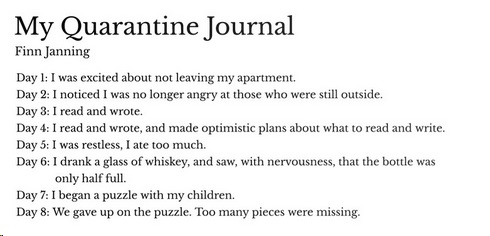
My first eight dates of quarantine began Friday the 13th of March. This part of the journal was published in Beyond Words, issue 2, April 2020.
Today (22th of April) is my 41st day of quarantine … so to be continued.
"Write your way out of it." – J.D. Salinger

My first eight dates of quarantine began Friday the 13th of March. This part of the journal was published in Beyond Words, issue 2, April 2020.
Today (22th of April) is my 41st day of quarantine … so to be continued.
Hvad kan vi egentlig lære af corona-epidemien? Det er der mange bud på i disse tider. Forfatteren og filosoffen Finn Janning er overbevist om, at den tænkepause, som corona giver os, vil få mange til at gøre op med den måde, de hidtil har levet på.
Du kan høre podcasten her
Spain—the country closed down two weeks ago—Friday, March 13, to be exact. As an uninvited ‘guest,’ the Coronavirus invites all kinds of (perhaps premature) reflections. For instance, are European countries moving in a totalitarian direction?
They are not, I would claim, and for two reasons: Europeans would never allow it, and more importantly, democracies deal with threats like the Coronavirus better.
Although many European citizens are experiencing and will experience various limitations on their individual freedom—you can get a fine for strolling around without a justifiable purpose—democracy is not only about freedom, but also about duty and responsibility. Acting responsibly requires each one of us to be conscious about what we do and why we do it.
The core of democracy is that it teaches us that we should not be concerned only for ourselves. Rather, we are in this together. I have a responsibility not only for my own health, but also for the health of other citizens. In other words, I am responsible for the others’ well-being, as they are for mine.
As a consequence, I find it meaningful to limit my freedom of movement, minimize (physical) social contact and so forth, because I might become a risk for other, more vulnerable citizens.
***
Freedom and responsibility hang together. Our responsibility is the string that ties us together and what actually makes us free. Norms are meaningful—not because they are universal or come from a fictional god; on the contrary, norms are social artifacts made and remade by human beings.
The Danish philosopher K. E. Løgstrup said in The Ethical Demand (1956) that ‘trust is fundamental.’ Each person holds a part of the other’s life in his or her—hopefully clean—hands, and vice versa. By laying oneself open to the others, we accept our shared vulnerability. The ethical demand or obligation doesn’t refer to specific transcendental moral categories, only this basic trust.
“Human life could hardly exist if it were otherwise.” For example, I trust that it is not just my wife, our three children and me who are staying home. I trust that other families are doing the same. Any epidemic or pandemic exposes how well a society acts in a responsible and trustworthy manner. Do we care about one another, or just about our own opportunistic interests?
Trust and responsibility are the exact opposite of egoism. I might go out for a run because I—statistically—am not at risk. I might empty the supermarket, and thereby neglect other citizens’ well-being.
It appears as if trust and responsibility are threatened by the coronavirus. In contrast, I would claim that these fundamental qualities were already threatened by capitalism. Yet, the Coronavirus might reactivate our civic spirit. I see this virus as an invitation to reflect more deeply about our lives.
I think we’d like to remember at least three things. First, the huge amount of inventive and creative ways in which we share our loss and fear. For example, when we reach out to our fellow human beings through singing, clapping and helping. The amount of generosity in Spain (and elsewhere) is touching. Second, we are in this together. Third, we can only prevail if we trust each other.
Trust is what actually brings us together, much more than holding hands. Trust reaches further than our hugs. Trust reaches out to the future. If trust is fundamental, it is because it doesn’t distinguish between the lives worth preserving and those regarded as not worth preserving—at least not beforehand.
Trust, of course, can be broken, but only because it was already there to begin with. Trust, as I see it, is related to the kind of thinking about being interconnected that can be found in mindfulness and ecological thinking. For instance, if I neglect or ignore another person, I also neglect or ignore myself. None of us can exist alone.
***
I believe that the virus will make us remember that we can’t survive without trust and compassion, because we’re all interconnected. We depend on each other. This interdependency is what distinguishes totalitarian regimes from democracies.
Saying this is not the same as giving democratic governments carte blanche. In any democratic society, citizens must critically monitor the actions taken by the government. It’s part of the deal.
In today’s rigid, populistic world of identity politics, we rarely focus on healing the wounds between races, genders and sexual orientations. On the contrary, we often fertilize these, to create enmity and rigid group loyalty. Similarly, sometimes the precautions and arrangements made by politicians can create more panic than calm.
Still, I would contend that the panic is not so much related to the temporary limitations of our individual freedom as it is to how openly and honestly the politicians communicate. It’s obvious that some politicians are corrupted by money and power; they think in terms of voters and elections. Yet, others actually do think. To think is to care for matters beyond our own interests.
Therefore, the best solution is, of course, not a dictatorship but citizenship. In a trusted democracy, when a politician asks citizens to act responsibly (to activate their public spirit), they wash their hands, limit public transportation, keep their distance or stay at home for weeks, as my family does now in Spain (until April 11, as the situation is right now).
When democracy works, politicians don’t have to create new laws, but through honest and thoughtful communication, they can awaken civic spirit.
The civic spirit is not about rights, but about duty, and the silent demands that tie us together. Duty and obligation not only come before rights, they also encourage us to think and act consciously, evaluating whether we need to do a certain thing that may be within our rights.
Do I really need to fulfill my right to mingle, right now, when social contact ought to be minimized? Of course not. This is also why things should not return to ‘normal,’ because many things were abnormal before the Coronavirus: neoliberal greed, resource scarcity, climate destruction, stress, anxiety…
It’s not about our rights, but our shared obligations. Rights tend to reduce everything to a question of being for or against. Life is not that stubbornly simple. No one is for the Coronavirus. In the same vein, no one is for avoiding their grandparents; it is just a necessary and responsible choice.
Civic spirit stresses that the value of our lives is related to what we leave behind—thoughts, behaviours and gestures that enable future citizens to live and act freely.
The Coronavirus puts all of us in a difficult situation. It tests our attitude towards others, and our trust in their maturity and ability to act responsibly. The Coronavirus is not only a catastrophe; it is also an opportunity for us to see ourselves, to relate to the world with more kindness and compassion, and to change our capitalistic forms of life.
The better we act together, the sooner we can start kissing, hugging and drinking together again—like real democratic citizens.
– 26. March 2020
This essay was first publish in The Mindful Word
I de her dage, hvor corona-epidemien vender op og ned på mange menneskers hverdag, kan situationen så give noget positivt til vores liv. Hvis man spørger forfatter og filosof Finn Janning, så kan situationen give os en fornyet klarhed om vores eget liv. Daniel Cesar taler med forfatter og filosof Finn Janning.
Du kan høre udsendelsen her
Forfatter og ph.d i praktisk filosofi Finn Janning tror og håber, flere vil tage de erkendelser, de gør sig sammen med familien under coronakrisen, med videre.
”Travlhed er ikke et udslag af handlekraft eller vigtighed, men snarere et vidnesbyrd om, at den forjagede person ikke ved, hvor han eller hun er på vej hen i livet.”
Sådan skrev Finn Janning, der er forfatter og ph.d. i praktisk filosofi, tidligere på ugen i et debatindlæg i Information. Heri pointerede han også, at ”hastværk er tæt forbundet med generel uopmærksomhed”.
Men hvordan mener Finn Janning, det ses i forhold til familielivet, var jeg nødt til at spørge. Her er han ikke i tvivl:
– Mange familier kører efter et ret stramt skema; skole, arbejde, fritids- og sportsaktiviteter, legeaftaler mv. Det betyder, at der kan være en tendens til at kigge mere på uret end på ens børn eller partner. Det handler mere om at nå frem i tide, end at være til stede. Dette er en triviel pointe, men ikke desto mindre glemmer mange at efterleve den, selvom det er klart, at den største gave, vi kan give vores børn – og andre – er vores opmærksomhed, siger han til fødslen.dk.
Læs resten af interviewet her.
Jeg forudser, at de fleste i løbet af de næste 14 dage vil opleve udgangsforbuddet medføre en frigørende klarhed om eget liv. Coronaen kan fortælle os, at frihed er at være bundet af nogle meningsfulde bånd. Og at disse bånd aldrig er kapitalismens, men kærlighedens, skriver forfatter og filosof Finn Janning i dette debatindlæg.
Læs kronikken i Information.
Jo mere sammensindet styrkes af corona, des mere lider kapitalismen
Kapitalen er styret af tanken om, at den stærkeste overlever. Men i coronakrisen klarer vi os kun, hvis vi samarbejder.
Cykelsporten kan lære os at håndtere coronavirussen som et hold. De, der er bekendte med cykling, kender til fænomenet, når fem forskellige ryttere i et udbrud arbejder sammen. Det kan virke underligt, da de netop ikke kører for samme hold eller nation. Filosofien er dog simpel: Ingen af de fem ryttere kan komme alene frem til målet uden samarbejde. Hovedfeltet, i dette tilfælde virussen, vil æde dem op, en efter en. For at undgå det, må de skiftes til at trække læsset, mens de fire andre ligger i læ. Sådan skifter de.
Samme altruistiske princip gør sig også gældende på de enkelte cykelhold, hvad enten private eller nationale. Her er der en kaptajn, vores er Mette Frederiksen, men vi kører ikke kun for hende, vi kører for at vinde, som hold. Og så længe hun har gode ben, altså fremstår dygtig og handlekraftig på en meget svær rute, så arbejder vi loyalt.
Det interessante spørgsmål er, hvorvidt de personer, der ikke arbejder for holdet og heller ikke vil arbejde på tværs af holdene, hvis det er nødvendigt, simpelthen mangler holdånd. Holdånden er demokratiets styrke, men kapitalismens akilleshæl.
De mennesker, der mangler holdånd i Spanien, hvor jeg bor, er gerne de velhavende. På grund af deres penge føler de sig bedre – tilsyneladende også moralsk bedre – end andre. De tager ud af byen til deres små ekstrahuse for at redde sig selv, fordi de kan. Men de tænker sjældent på, at de måske tager virus med til en landlig og afsides region, hvor der er få læger, men gerne mange ældre.
Sporten, som ellers bliver klandret for at være styret af penge, handler reelt om samarbejde. Det samme kan siges om fodbolden, hvor den bedste fodboldspiller Lionel Messi mangler et godt hold for at vinde. Alene kan han ikke. De, der tager ud i deres sommerresidens, hamstrer eller trodser forbud, fordi de ikke selv er i risiko, mangler den holdånd, der kan sikre en sejr.
På en måde er det sigende, at jo mere samfundsånden styrkes i disse dage, desto mere lider kapitalismen. Det er selvfølgelig hårdt og trist, at mange mennesker lider økonomisk, men det er også en del af kapitalismens natur.
Kapitalen er styret af socialdarwinismen perversion: Den stærkeste overlever. Men den stærkeste er ikke den rigeste, det er derimod den som kan arbejde sammen med andre.
Det er ikke, når aktiekurserne stiger, at vi er kommet igennem krisen. Nej, det er vi først, når vi igen kan begynde at afholde cykelløb og spille fodbold. Så kan vi igen mødes med vores venner, nede på baren, drikke og råbe sammen. Den eneste forskel er dog, at vi nu ved, at sporten har lært os mere om livet, end kapitalismen nogensinde har formået.
Bragt i Politiken, søndag den 22. marts.
Jeg har også deltaget i podcasten Aftenklubben på radio Nova omkring coronavirussen. Den kan høres her.
“I’m not much interested in ethics or morals. I’m interested in how we experience the world.” – Arne Næss.
As a student of philosophy, I read the Norwegian philosopher Arne Næss’s books about modern philosophy. He wrote in an engaging and clear style that demonstrated deep philosophical breadth and he invited the reader to think along with him.
One of his strengths as a philosopher was this inviting, almost conversational style, which was related to his intuitive approach to life. By “intuitive,” I refer to something necessary—an open approach in which you follow life wherever it takes you, because it leaves you no possibility of escape.
To some extent, Næss made philosophy available to all. Ever since, I’ve always liked the idea that all people can learn to philosophize with a little training.
Years later, I was hiking in Norway and it was here I that I really came to appreciate Næss’s work on the deep ecology movement. On an intuitive level, I experienced the harmony and co-existence with nature that he often mentioned.
I hiked with a friend for 20 days. We spent the days walking, sitting, and observing. At one point, I noticed that I shared the same rhythm with the life around me. I experienced the interconnectedness found in nature.
Næss called his brand of philosophy “eco-philosophy,” or “ecosophy,” which fuses the words “ecology” and “philosophy.”
In his work, he expanded on the concepts of existentialism and life-philosophies. At first, this might seem banal, but he treated both concepts with scholarly depth while connecting them with real-life experiences. This is always risky, especially for philosophers, who fear nothing more than being called “shallow” or having their views labelled “pop.”
However, what Næss emphasized was, for instance, that based on solid scrutiny of some part of your life (such as your work or your partner), you can evaluate how much joy or sadness that particular aspect brings. Furthermore, we always have the choice of changing how we respond to what happens, so we have to assume some responsibility for the quality of our lives.
Næss was, among others, inspired by Rachel Carson’s 1962 book Silent Spring, which alerted the world to the dangers of the misuse of pesticides. The book opens dramatically with, “There was once a town in the heart of America where all life seemed to live in harmony with its surroundings.”
Nature was once noisy and full of life, and then came devastating silence, according to Carson—the silence of the death of nature. “No witchcraft, no enemy action had silenced the rebirth of new life in this stricken world. The people had done it themselves,” she said.
The challenge for Carson, and later Næss, was figuring out how to change human attitudes towards pollution and pesticides; that is, how to change our relationship with the world.
Within his “ecosophy,” Næss linked people and nature. Ecosophy is “relational thinking,” he said, emphasizing that nothing lives in isolation. “The larger world becomes part of our own interest,” he wrote in Ecology, community, and lifestyle: Outline of an Ecosophy. Thus, everything is connected.
One of Næss’s key concepts was “self-realization,” which shouldn’t be mistaken for self-centeredness or egoism. Rather, it’s more of an ongoing and respectful process of becoming one with nature.
This is what many, including myself, often experience during longer periods of engagement with the natural world. Some experience something similar during meditation as a way of fine-tuning their relationship with the world.
Another key idea for Næss was that everything has intrinsic value. Therefore, we shouldn’t use nature as a means to achieving something else.
Unfortunately, many see nature as a resource to be used for our benefit, which is partly due to the instrumental thinking that seems to permeate most of our education and activity today. For example, many view nature as something “out there,” whereas nature is actually part of us.
Similarly, the destructive mantra of economic growth, which only leads to stress, has nothing in common with spiritual growth. Nurturing your spiritual growth also means nurturing the growth of all other forms of life.
For this reason, Næss tried to move our care for the environment from the sphere of ethics to the sphere of ontology. For this to be helpful, we need to re-examine how we perceive and understand our world as we gradually become one with it, and develop a participatory and compassionate understanding of our relationship with life.
Næss was not only highly skilled in the classical history of philosophy, he was also influenced by Gandhi’s thinking. His meshing of Gandhi’s thoughts and Spinoza’s ethics of joy made his philosophy rather original. He emphasized the importance of respecting alternative ways of living even when he disagreed with them.
As he said in an interview, cited in Ecology, community, and lifestyle, “I think that intellectuals might consider their intellects in a more Spinozistic way, and cultivate … a loving attitude towards what (they) have insight into … without making the terrible mistake of becoming sentimental or fanatical.”
A good introduction to Næss and the deep ecology movement is The Ecology of Wisdom: Writings by Arne Næss, which has an excellent preface and introduction by Alan Drengson and Bill Devall (two other prominent figures within this environmental movement). As it says in the introduction, “Mindful practice brings our ecosophy alive from moment to moment. Love and care live only in the present.”
Another option is the film The Call of the Mountain: Arne Naess and the Deep Ecology Movement (1997), which offers an interesting portrait of the man, his philosophy and the movement. Filmmaker Jan van Boeckel teamed up with Arne Næss himself to capture the spirit of the philosopher in his natural habitat, the mountains of Norway.
Regardless of what medium you choose to use, studying Næss is always a good place to start when you want to awaken or reawaken your relationship with nature.
First published in The Mindful Word
Together with Wafa Khlif and Coral Ingley, I just published the book called “The Illusion of Transparency in Corporate Governance.“
Here we’re questioning whether transparency help or hinder true ethical conduct.
As we write:
Transparency is generally seen as a corporate priority and a central attribute for promoting business growth and social morality. From a philosophical perspective, society has experienced a gradual paradigm shift which intensified after the Second World War with the advent of the information era. As a fundamental part of an inescapable, hegemonic capitalist system and given the insistent emphasis on it as a moral imperative, transparency, this book avers, needs to be examined and challenged as to its true governance value in building a sustainable twenty-first century society. Rather than clinging to the fantasy of complete transparency as the only form of accountability, corporate governance is strengthened in this way by practicing true social responsibility, which emerges not from outward-looking compliance but from a deeper place in the corporate psyche through inward-looking contemplation and the development of moral maturity.
See more about the book here.
“The artist is a seer, a becomer,” wrote the philosopher Gilles Deleuze and the psychiatrist Félix Guattari in their book, What Is Philosophy?
I thought of this quote the other day, when a student of mine asked me, “What are you: a meditator or a philosopher?”
I’m not sure whether there is—or has to be—a difference, I told her, “I’m a philosopher who meditates. I guess like a carpenter, schoolteacher or football player sometimes does that, too.”
“So to philosophize is, in a way, to meditate,” she said.
“Yes.”
I’m certain that no one philosophizes without paying attention. The philosopher is a seer, I believe, or to put this in simpler, less romantic terms: To think requires us to be aware of what’s happening inside ourselves as well as outside in society.
Let me share a few thoughts from Deleuze that may show how philosophy is related to mindfulness or meditation. Let’s call it a mindful philosophy.
The writer as artist has seen something—something that he or she passes on, in a way, that gives the reader enhanced access to this world.
For instance, a novel or a memoir is a communication of experiences that typically involve ethics and knowledge. A novel answers the question of how a person acts, reflects, thinks and feels during certain circumstances. This is why literature can be a way of gaining experiences that make us more mature, as it allows us to experience other forms of life.
Like the philosopher, the writer as artist is a seer and he or she confronts the reader with his or her ethical limitations. Deleuze states that “In the act of writing there’s an attempt to make life something more than personal, to free life from what imprisons it.” (from Negotiations)
This means, among other things, resisting the urge to follow the dominant fantasies and ideas controlling our lives—just think of status anxiety. And yet, to resist means, first and foremost, to resist death.Report this ad
For this reason, you write to give the unborn a possibility to live freely; that is, to live a healthy life. The writer is affirming life when he or she sets free what lives.
“To affirm is to unburden: not to load life with the weight of higher values, but to create new values which are those of life, which make life light and active,” Deleuze stresses in Nietzsche & Philosophy (italics in original).
To release, set free and create values in life—this is why we want to spend time with certain writers. They extend our boundaries.
Now, let me be even more specific. I meditate so that my life can become meditative; that is, so I can let life pass through me while I try to pass on or affirm what lives.
The writer is generous when he or she passes on life. This idea also indicates that to produce art (or think philosophically), there has to be something at stake—a matter of life and death.
“A creator who isn’t grabbed around the throat by a set of impossibilities is no creator,” Deleuze says in Negotiations.
So, just imagine being grabbed by the throat. It’s not necessarily a nice image, but it’s essential. To breathe is to live. It’s basic.
Through meditation or writing (and perhaps other activities, as well), I confirm on a daily basis my intention to affirm what lives, to actualize that which is in the midst of becoming alive. And I do see this as a kind of resistance.
Today we live in a world in which people exploit themselves in their quest for status, prestige and power. We live in a world in which some repress and discriminate against others due to differences in race, gender, sexual preference and more.
Inequalities are growing. People are scared. The news is fake.
And yet, what I propose is that we, through meditation or philosophy, cultivate our capacity to pay attention to what we don’t want to pass on (for instance, discrimination), but also to what’s worth affirming (such as love and friendship).
Seeing means making contact with what happens and being connected with life. Becoming sensuous is also related to our capacity to be affected, which is crucial to experiencing, but also to experimenting and transforming—creating alternative ways of living, feeling and thinking.
Today, we need to do more than just address inequalities. We need to create lives that are lived beyond any rigid identities, whether we’re speaking of race, gender or some other identifier. It’s here that mindfulness can help people become more sensible and aware.
I don’t wish to claim that we, as artists, meditators or philosophers, are better than others—of course not. We can all learn to “see” and philosophize, with a little help from meditation and maybe some encounters with Kierkegaard along the way.
Once we begin paying attention, we also begin to question things, so it turns out the student questioning me was already ahead of me. That being said, I guess I’m just a student who’s occasionally disguised as a teacher!
First published in The Mindful Word
 FINN JANNING