Når livet blomstrer

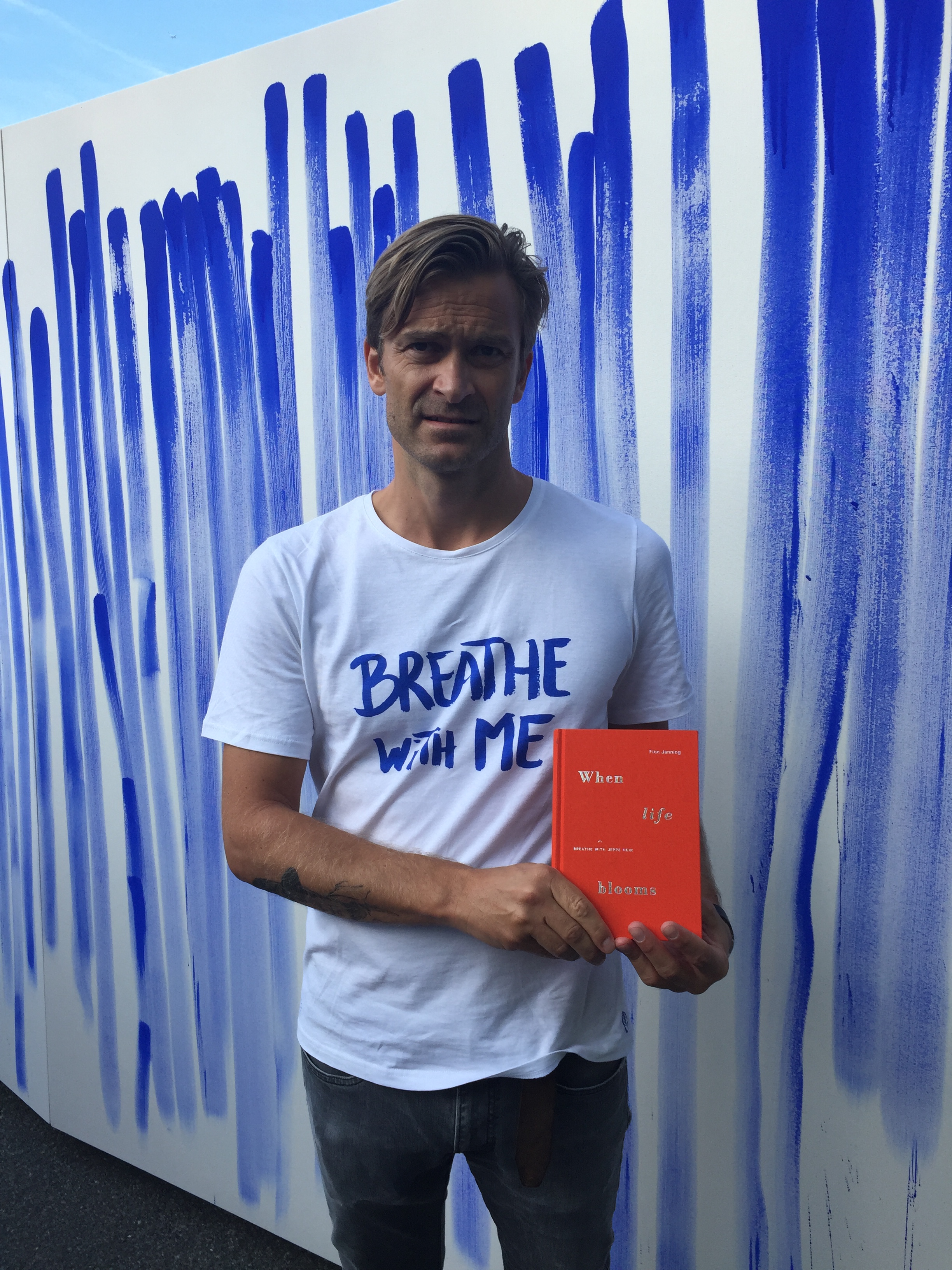
Den 28. november udkommer min nye bog, Når livet blomstrer – Breathe with Jeppe Hein.

Selvom der er tale om en bestillingsopgave har jeg forsøgt, at skrive bogen i forlængelse af den franske filosofs Gilles Deleuzes ide om, at “livet ikke er personligt.” Snarere er livet et casestudie, der kan rumme varierende grader af eksemplariske fortællinger.

Denne tilgang valgte jeg af flere grunde.

For det første, som en kærlig måde at konfrontere Jeppe Heins narcissisme på, uden at dømme denne. For det andet, tænkte jeg, at det kunne være sjovt, at skrive en slags biografi præget af tidens tendenser – fra 70erne og frem til i dag. For det tredje, for at vise hvordan hans kunst i høj grad er formet af tiden, fx den øgede konkurrencementalitet og teknologiske acceleration, der for mange, inklusive Jeppe Hein, fører til stress og angst. Efterfølgende finder mange, inklusive Jeppe Hein, mening i den fremvoksende spiritualitet.

Så, bogen er både eksemplarisk og en mytedræber. Den er et stykke liv på papir!

Forlaget skriver bl.a.:

“I 2009 sidder Jeppe Hein i en flyver i 10.000 meters højde, da han får et angstanfald og ikke kan trække vejret. Efter et år med over 15 udstillinger og utallige rejser siger hans krop simpelthen stop.

”Jeg måtte lære at trække vejret igen,” fortæller Jeppe Hein i bogen.

Forfatter og filosof Finn Janning har været ven med Jeppe Hein, siden de var helt unge. I bogen følger han på nærmeste hold Jeppe Heins menneskelige og spirituelle udvikling efter hans burn out og viser, hvordan den er uløseligt knyttet sammen med hans kunst.

Undervejs i beretningen om Jeppe Heins spirituelle og kunstneriske rejse giver Finn Jannings indsigtsfulde analyser en baggrund for at forstå, hvad der er på spil. Han kommer rundt om filosoffer som Aristoteles og Kierkegaard, den spirituelle tyske lærer Eckhart Tolle, forfatterne Albert Camus og Peter Høeg og mange flere, og dermed bliver bogen en slags filosofisk monografi, som læseren kan bruge til selv at overveje nogle af livets store spørgsmål.

Janning udvikler i bogen en eksistensfilosofi i forlængelse af kunstnerens spiritualitet og værker.”

God fornøjelse …

Når livet blomstrer

How Should I Live?

Before I try to give a decent answer, I would like to emphasize that I’m glad the question is personal. It refers to me, not you, or someone else. I don’t like moralizing, that is, telling other people how they should live, but I do like the element of self-knowledge and care that this question addresses.

Thus, “How should I live?” should live a joyous life.

Life, of course, is full of both joy and sadness, suffering and pleasure. Some of these are related to individual limitations, e.g. intellectual abilities. Others are related to social or political circumstances, e.g. financial.

Still, a useful guide is to live in a way that enhances a life’s joyous moments regardless of the circumstances.

How do I do that? From the French philosopher Gilles Deleuze, I’ve learned that we always have the thoughts and feelings that we deserve. At first this can seem brutally arrogant, but what he aims at is that our mental state depends on how we relate to or approach our experiences. The challenge that we all share, regardless of setback or misfortunes, is how we become worthy of what is happening. This is not acceptance as a kind of resignation; rather, it’s an approach to life that confronts obstacles or setbacks by trying to create a new form of life that minimizes the effects of what is hindering ourselves from living freely.

Therefore, I should live as a compassionate fighter, that is, become a person that fights by exploring what a life may become. What is possible? I fight hate, discrimination, domination, violence, etc. because it kills life. And by involving myself in this fight — although I have to acknowledge my intellectual limitations – I feel better. Actually, I feel alive. And to live a joyous life is to have an intimate affair with life, to experiment, and dance with it.

I remember the Chilean writer Roberto Bolaño once said that children typically are full of joy, and then he wondered why it’s so, before answering, that they are alive.

It sounds like a tautology: a joyous life is synonymous with how I should live because joy emerges through appreciation of being alive, which I accomplish by destroying  everything that seem to hinder life from flourishing, just as I create room for things that flourish. Nothing comes for free, except death.

Joy and happiness require hard work.

Philosophical Counseling

Some years ago, I was teaching a course in Philosophical Counseling. To my surprise, all that the students wanted to know was “What is the right thing to do?” Having that knowledge, they assumed, would make life easier. “Perhaps,” I said, “but not better or more interesting.”

Their request is part of the obsessive achievement eagerness of today’s society to perform well according to fixed ideals. It creates dullness when it comes to mental exercises. The unfortunate norm is the faster the better. I told them that philosophy is about developing problems, not delivering solutions. It’s a slow practice. It’s for life. My answer made them fidget with impatience. To philosophize, I emphasized, is to dwell on the fundamental questions, and these questions are developed in problems, just as the problems are enveloped in fundamental questions.

Yet, my students insisted: “So, what is the right question?”

I told them that this particular question was related to the problem embedded in the question. For example, how do you draw a clear distinction between right and wrong?

The ones who weren’t paying attention looked up from their screens.

In sports, where the rules are given, I said, it is rather obvious to tell whether a player is “doing it wrong.” Similarly, in business, where profit seems to guide every decision, knowing what is right and wrong may be easier. Life, however, is neither a game nor a business, although there is a tendency to classify people into winners and loser as if life were that simple. Such labeling is part of today’s achievement society. Everyone’s performance is measured according to an ideal–and ideal that is often related to the staus, prestige, power, and, of course, money that is associated with being a winner.

They went silent, so I went on. Of course, there are things in life that are rather obvious. For instance, no one needs philosophy to tell you that it is wrong to kill, discriminate against, or repress other people. Instead, philosophy begins when we start to questioning the obvious. Could I live another life? What is also possible? How may I also live?

A part of philosophy is to accept that some problems remain without solution; some questions can’t be answered once and for all.

Such a question is Which life is worth living?

Of course, one of my students then asked me: “Which life is worth living?”

This is how A Philosophy of Mindfulness – A Journey with Deleuze begins.

31DYvhXpQ0L._SX311_BO1,204,203,200_

Be open to everything

This weekend I participated in Jeppe Hein’s exhibition Don’t Expect Anything, Be Open to Everything at the König Gallery in Berlin.

I organized a short writer workshop.

See more about it here.

Underneath a little meditation on writing.

IMG_4238

The Boy in the Classroom

It begins with a boy who was not born a nationalist and ends with a nationalist who was never a boy.

At least, that is a possible beginning and end. In the words of Aristotle, we now only lack the middle to have a complete story.

So now that we know it begins with a boy, let’s move towards the middle, where we can place him geographically in Barcelona, Spain …

Read the rest of the essay “The Boy in the Classroom“, or read the entire literary magazine Loud Zoo.

A Philosophy of Mindfulness

 A Philosophy of Mindfulness is out!

Cover

In this book, I argue that we need a “new” philosophy because we—many of us, at least—are blind. We see rather little of that which surrounds us.

By mixing mindfulness with the affirmative philosophy of Gilles Deleuze, I unfold a philosophy of mindfulness. A philosophy that makes us less blind but also ethically responsible in relation to what we experience. Hereby, I move mindfulness from the sphere of psychology into philosophy, or from being primarily an inward-turned practice to an out-turned one.

A Philosophy of Mindfulness puts emphasis on experience, experiment, and actualization or affirmation. Each experience matters; life is the experience of making contact or being connected with what is in the midst of becoming—that is, life—and then passing it on to the next generations.

Resisting the Self-Improvement Craze

“Selp-help books don’t work.” – Svend Brinkmann.

Svend Brinkmann, a professor of psychology, has written what I hope will be—but fear won’t be—the last self-help book. Contrary to the intentions of these books, they rarely help anyone but the publisher and, sometimes, the writer. It’s good business, Professor Brinkmann would agree.

Brinkmann’s Stand Firm: Resisting the Self-Improvement Craze is a paradoxical book. On the one hand, it’s billed as an “anti-self-help” book, while, on the other hand, it’s yet another self-help book. The author says, “The idea is that it will act as a kind of anti-self-help book, and inspire people to change the way they think about, and live, their own lives.” This description could fit any self-help book. Perhaps for this reason, he writes a few pages later, “Overall, the book should be read as a self-help book.” However, this one has a clear agenda: it tries to eliminate all other books in this genre.

In Stand Firm, Brinkmann presents seven steps to counteract the accelerating pace of contemporary culture and to find peace of mind. These steps are based on an easy-going reading of the Stoics and the philosophy of common sense. They are:

  1. Cut out navel-gazing.
  2. Focus on the negative in your life.
  3. Put on the “no hat.”
  4. Suppress your feelings.
  5. Sack your coach.
  6. Read a novel—not a self-help book or biography.
  7. Dwell on the past.

The first three steps are dualistic. Instead of looking inside ourselves, we should look outward. Instead of being positive all the time, we should cultivate our negativity. Instead of saying “yes” constantly, we should say “no” once in a while. It’s all about balance. Then, to emphasize this point, we are also encouraged to put a lid on our emotions—especially the more negative ones. Finally, we should just get rid of the coaches who tell us to look inside and be positive and authentic, and then we perhaps could read a novel, while we dwell on the past. Most novels, after all, deal with memories.

Thus, Professor Brinkmann encourages us to relax, that is, stand firm against the moralizing domain of change, movement, and development. “Mobility trumps stability in an accelerating culture,” he writes. Therefore, it has become difficult to put down roots or to achieve stability. How we then find balance, that is, know what is worth standing firm on and what is not, is probably the task that this professor finds most difficult to address. So, in a sense, he only helps the reader half of the way.

Stand Firm places itself in the continuation of the Frankfurter School and critical theory, with the main enemy identified as capitalism. This diagnosis of an improvement-obsessed culture is well-argued and solid, but it doesn’t add up to anything new. We can find more or less similar diagnoses in other self-help books or literature on mindfulness. However, Brinkmann’s errand isn’t so much a critique of capitalism as it is of positive thinking. His claim is that this pop psychology approach doesn’t lead to a richer life. On the contrary, what we need is a dose of negativity.

This particular fight against positive thinking is what makes Brinkmann’s book innovative, mainly because his critique of the self-improvement craze is formulated in the tone of those business consultants who push positive thinking. He uses their own vocabulary against them. This makes his ideas easier for the reader to follow because the vocabulary is familiar, but it also serves to keep the conceptual framework of the book rather simple (cf. the traditional self-help book).

Personally, I miss a deeper understanding of concepts such as self, time, character, and introspection. And, perhaps more importantly, as mentioned above, I’d like to read Brinkmann’s thoughts on what I should stand firm on in a metaphysical, changeable world. Yet, my frustrated interests stress that, like most self-help books, this advice is addressed to a privileged reader, who seems more bored with, and confused about, life rather than really suffering.

Let me clarify this point further. For instance, many people can’t just say “no” at work because they can’t afford to lose their income. Also, since Brinkmann refers to our duty to do good deeds, then when is it right to be tolerant and when is it right to express our disagreement with those who are intolerant? Imagine that we witness sexism or discrimination in our organization, what is our duty as good employees? What is our duty if we are also a father or mother and, therefore, also a primary supporter of our family?

Based on the examples in the book, the ideal reader doesn’t suffer financially. For example, we are encouraged to discipline ourselves by avoiding an extra glass of wine or desert, not cheating while playing golf, or taking the bus instead of our car. I recall a classic self-help book about a man who sold his Porsche . . . To continue, Brinkmann suggests that we should visit a museum once a month, as well as reading at least one novel per month. This tells us something about who he expects to read his book.

Still, I have respect for this author’s project. I think that Brinkmann shows courage in writing this self-help book disguised as an anti-self-help book. Also, more importantly, his work as an academic—a highly-respected professor at a good Danish university—give his words more weight. He legitimizes the idea that it’s okay to be negative and so on. He deserves a big round of applause for this undertaking. This book will without doubt help many people who are caught in our current performance society.

Yet, some other questions emerge: How can we know when to say no if we are encouraged not to reflect or engage in introspection (i.e., steps one and three)? Philosophical self-knowledge has nothing to do with the navel-gazing that he so rightly attacks, but this knowledge is needed to minimize self-deception. Also, how do we know what is our duty? What is right or even morally good in society? Morality is related to knowledge that changes over time. For example, people now rarely beat their children to educate them because this doesn’t cultivate caring and curious individuals. These norms are human artefacts that can be rejected. Similar, we might ask: How do we dwell on our past and write our story without at least a little self-reflection? Or, even more clearly, if we should avoid the cliché of being authentic, then how does this interact with Brinkmann’s ideas about creating a coherent character?

In most self-help books, we are often encouraged to locate a narrative thread in our life to develop a trustworthy character. These threads can be rather inventive ways to suit personal agendas. Personally, I doubt whether life isn’t more a zig-zag movement of becoming another, rather than staying predictable. In the end, this is a rather conservative book with elements of nostalgia, but perhaps this is needed.

I wonder, still, whether it’s sound advice to encourage people to be too polite to be honest if this violates their duty. I prefer to resist conformity by creating alternatives, whereas Brinkmann tends to come close to advocating passive nihilism. For instance, he writes, “People have to adapt to the world around them.” This sound like resignation, not acceptance. Furthermore, this advice sounds like the business consultant adage that, instead of following “best practices,” sell the “best fit.” This is also not without problems. Perhaps, the professor has written af selfmanagement book?

Is it a problem that this book is both against the wellness syndrome but also part of it? I’m not sure. What Brinkmann’s advice lacks in precision, might also gain it more popularity, and his message is needed. I fully support his critique of the self-help industry and the current “terror of positivity,” as Byung-Chul Han once called it.

Thus, despite these critical remarks, my questions actually show this book’s quality. Unlike other self-help books, this invites us to question and think. So, perhaps what it offers really is more anti-self-help than self-help. I do truly hope that this will be the last self-help book. I hope so because Brinkmann’s advice is far better than the majority in this genre.

Therefore, if you have a coach, then sack him or her. Do it, and do it now. Then, go to the library or local bookstore and get yourself a novel. Read. If you’re not convinced, then read Dr. Brinkmann’s book. Give it to a colleague and so forth. Then, perhaps one sunshiny day, the libraries and bookstores will be full of novels, essays, and poetry instead of . . . yet, another self-help book camouflaged as anti.

I recommend Stand Firm for those who are tempted by the self-improvement craze.

Blog at WordPress.com.

Up ↑