Is it happening again?

‘It is happening again,’ says the giant to FBI Special agent Dale Cooper in David Lynch’s mystery series Twin Peaks. This sentence came to me today, as the trial against 12 Catalan separatist leaders began in Madrid. The sentence made me reflect:

Witnessing the Catalan separatists’ campaign for independence, I couldn’t help but recall the warning signals revealed by my old German teacher when he showed us the symbols and manipulation used by German supremacists.

What concerned me was not just the flags; rather, it was their degradation of the rest of Spain while simultaneously elevating themselves. Similarly, when the separatists claimed to be victims, suppressed as an endangered species, I saw no real victims, only a very calculated form of control (I don’t refer to the unnecessary police brutality October 2017, but to life in general in Catalonia, see also Compassion in Catalonia).

I think that the mixture of creating a culture of victimisation combined with establishing a society of control, where our minds are controlled through unconscious social conditioning, is what makes the Catalan separatists powerful, but also scary if one casts an eye over history.

It’s common to view what is happening in Catalonia through the lens of history, especially the Spanish Civil War, which took place from 1936 to 1939. And it goes without saying that General Francisco Franco ranks among the worst dictators in human history.

Still, some simple facts should be pointed out: today, Spain is not a totalitarian regime; Spain is no more Francoland than Germany today is Hitlerland. Contentions to the contrary are as incongruous as they are wrong.

To clarify another fact: the Catalan language and culture are not under threat today. On the contrary, instead of giving children the opportunity of a bilingual education, most schools in Catalonia teach only in Catalan. Spanish is being taught as a foreign language. Through this, a basic right is being taken away from Spanish citizens.

For the separatists, language is not a means of communication, but an identity marker; it’s a password that separates ‘true’ Catalans from those Catalans who feel Spanish. Hereby, the separatists have – quite paradoxically, in the style of Franco – created a control system that differentiates and categorizes people.

What is needed is not more communication for or against; rather, it’s noncommunication; a reflective pause that eludes the current communicative control in which people blindly say and do what they say and do because this is what other people say and do.

Unfortunately, such a break seems unrealistic. The PR campaign of the Catalan separatists can’t stop without everything collapsing. To make things even worse, the turbulence of the last few years has awakened other nationalists in Spain, such as the political party Vox.

Perhaps, here we are at the core of the problem: All identity markers, whether national or cultural, are prisons. Nothing more than fictions. The problem with the novel written by the Catalan separatists is not that it is full of lies and exaggerations; rather, that it’s provincially tiring because all the characters are stereotypical and far too predictable. It’s a fantasy that has lost its grip on reality.

The challenge in Catalonia – and elsewhere in the world – is to regain trust in humanity. So far, the separatists have mostly promoted distrust in everything and everyone but themselves and their world view. Yet, without basic trust between humans, life cannot function.

Democracy is the ongoing organisation of disagreement. For example, I disagree strongly when artists and comedians in Spain are hindered in their right to express themselves freely – including when they criticise nations, politicians, and religions. But I also believe that people who deliberately violate the laws of the constitution should be held juridically responsible. To violate the law is to disrespect the principle of the equality of all citizens. Since all human beings are, by definition, different, the only thing that makes us the same, socially, is the law.

A democracy stresses that we are in it together. All of us. Equally. Here and now. It doesn’t matter if you’re Catalan, Danish, a man, a woman, white, black, speak this language or that. Writing this seems embarrassingly banal, yet I see many around me who appear to have forgotten this fundamental concept. For this reason, ‘it is happening again’: the victimization, the exaggerations, the lies …

This opinion was first published in Spain in English, 17th February 2019

Are we thinking?

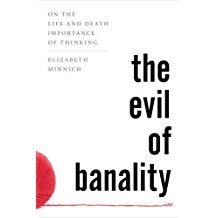
I’ve been unfairly slow in writing my review of Elizabeth Minnich’s book, The Evil of Banality: On the Life and Death Importance of Thinking. This is unfair because this is the kind of book everyone should read. It’s that good and that important. I may even use the cliché and say it’s timely. We live in a post-truth age, where fake news seems to manipulate everyone and keep them from acting responsibly, that is, from thinking.

Let me start with an example from my own backyard. I live in Barcelona in Catalonia, Spain, a place that has really been put on the map in the last few months. Here, Catalan separatist or nationalists play with people’s emotions and try to generate a certain belief, regardless of whether it’s true or not. For example, Spain is not a dictatorship; people are free in Catalonia to express their opinions. The Catalan language is not threatened; rather it’s spoken everywhere. All things the Catalan separatist claim. Furthermore, although I disagree with the imprisonment of certain Catalan politicians, they are not in prison for their ideas but for conducting illegal activities. While the Spanish government is not a perfect democracy, it is, nevertheless, still a democracy.

Thoughtlessness can also be related to the misuse of some concepts or ideas such as freedom of expression. Recently, a Catalan school teacher blamed one of his student in front of the whole class because the student’s father worked in the national police force. The teacher claimed that the police beat everyone and even killed someone. Afterwards, a Catalan politician said that, in Catalan schools, teachers have freedom to express themselves. That is, the teachers are free to say and act as they see fit. This is an extreme example, and not common, but I know that in Denmark such behavior would cause numerous problems and lead to scrutinizing the schools. In Catalonia, politicians seem to lack the capacity to reflect critically on their own behavior and ideas.

What does this have to do with Minnich’s book? Everything. She addresses how evil emerges when we “go along thoughtlessly—without paying attention, reflecting, questioning.” In other words, our lack of thinking, of critically evaluating what happens—including our own thoughts and behavior—can lead to many evils in this world. Thus, critical thinking is mandatory for all democracies. Minnich asks “What, how, are they thinking? Are we thinking? . . . How could they make sense of what they were doing?” These questions are alarming when put in a context like apartheid, Rwanda, or the sexual abuse of women and children.

The title of her book is an allusion to Hannah Arendt’s Eichmann in Jerusalem: A Report on the Banality of Evil, where Arendt concluded that Nazi crimes against Jews were also crimes against humanity. She showed how a totalitarian government affects every bureaucracy by dehumanizing them and motivating people to act without questioning.  Arendt called this “sheer thoughtlessness.”

Minnich continues, “I found myself reversing her (in)famous phrase and, having done so, thinking that perhaps it would have helped had she spoken, as she did not, of ‘the evil of banality,’ rather than—or, as I now think, in addition to—‘the banality of evil.’ To think of evil as ‘banal’ was then altogether too difficult.” Here, Minnich stresses that when someone has done something wrong, we tend to ask them, “What were you thinking?”

The foundational thesis of her book is that people who are doing evil are not thinking.

Minnich offers many examples in her book: From fiction like Camus’ The Plague to Darfur and Rwanda. She also develops two key concepts to help us understand the relationship between evil and thoughtlessness: intensive versus extensive evil and intensive versus extensive good.

Extensive evil refers to horrific harm-doing that persists for months, even years. For example, genocide, slavery, apartheid, financial exploitation, mistreatment of workers, or, as has recently become evident, when “powerful” men exploit and abuse women. It’s tempting to see the kind of people who do these things as psychopaths or sick. (I can’t help but see Weinstein and his ilk as sick.) However, Minnich emphasizes that these activities are done by inconspicuous people like your quiet next-door neighbor. She mentions several alarming examples from South Africa and Rwanda. And here we must collectively take responsibility if we witness any kind of wrongdoing. For instance, this is happening right now through the #MeToo Campaign. Such campaigns can relieve some of the pain; they can help, encourage, and illustrate that another world is possible,  one of trust, respect, and equality. Similarly, I would argue that when a school system becomes political, promoting rigid nationalism and legitimizing hate, as in some cases in Catalonia, then we must look at this with care—even if we only speak of a handful of concrete examples. Ignorance should never be an option.

Minnich emphasizes that we should be careful not to confuse extensive evil with intensive evil. Intensive evils “are great harms done by one or a few people. In that sense, they are contained . . . When they burst into our lives, almost all of us are genuinely spectators, not participants, not enablers, not perpetrators.”

She says extensive evil spreads like a plague, whereas intensive evil is like a poison. The book is full of such precise literary and metaphorical examples that make it not only a pleasure to read but also easy to follow.

The problem, Minnich says, is that we think of extensive evil as intensive. That is, we may convince ourselves that only a few schools are indoctrinating their students, only a few men are raping women, only a few people are sexually abusing children, only a few organizations are over-stressing and discriminating against their workforce. “Thinking of all evils as if they were intensive—taboo, smacking of possession, shocking to still-functioning conventional society, hence readily felt to be anti-rational—blinds us to the on-the-ground realities especially of extensive evils that are enabled, instead, by such familiar motivators as careerism and greed . . .”

What to do? Well, we could all strengthen our vison. It’s a matter of “seeing, admitting, and thinking through the realization that there have been, and somewhere now are, times in which what ‘everyone is doing’ is morally, politically, deadly wrong.”

Luckily, we can also cultivate critical thinking. Through education, we can try to eradicate automatic thinking, like when some Catalan separatist always declare, “It’s Spain’s fault.” Automatic thinking is just confirming our default-setting without any reflection about what actually takes place.

In the last part of the book, Minnich offers a beautiful reminder of what philosophy is and what it can do. “Socrates was a practitioner and teacher of thinking and not knowledge.” That is, he was open, curious, and constantly questioning not only why and what people were thinking but also how they were living according to their thoughts or beliefs.

Like Arendt, Minnich stresses how stupidity and thoughtlessness are not the same thing. “Very smart people can be very thoughtless just like the rest of us.” This emphasizes that we need to be aware of how the system is nurturing a certain kind of behavior. Here, many studies in social psychology can inspire readers who wish to explore this further.

Still, some may ask, how can we really know if we are trying to critically and openly assess what is happening? Minnich says it clearly: “Self-respect is earned not by recognition, praise, status, net worth, power, influence or anything else externally conferred but by continuing to recognize ourselves as someone we can live with, and not be ashamed?”

I agree. I think of how some politicians seem incapable of being ashamed. They are determined to play the game well, to advance their career, and to achieve their objectives, regardless of the disagreement and suffering of the people they are supposed to govern. Is it arrogance? Minnich notes, “. . . Sometimes we do stop and think, and simply say, at the right moment, the No that is actually a profound Yes to what we will not violate because that is something we just cannot do and still live with ourselves.”

Yet, some people never seem to stop and think. How can some live with themselves?

Elizabeth Minnich’s The Evil of Banality merits a better and more thorough review than what I can provide here. Nevertheless, it deserves to be read. Recommend it to your friends, especially if you know someone who is in charge of other people’s destinies. It is well written, very well argued, full of good examples, and it is inspiring.

See also philosopher Skye Cleary’s interview with Elizabeth Minnich here.

theevilofbanality


The Boy in the Classroom

It begins with a boy who was not born a nationalist and ends with a nationalist who was never a boy.

At least, that is a possible beginning and end. In the words of Aristotle, we now only lack the middle to have a complete story.

So now that we know it begins with a boy, let’s move towards the middle, where we can place him geographically in Barcelona, Spain …

Read the rest of the essay “The Boy in the Classroom“, or read the entire literary magazine Loud Zoo.

Blog at WordPress.com.

Up ↑