To exist is to play

The writer and philosopher Albert Camus was known for his existentialist essays, novels, and love of football. Every intellectually curious football fan is probably grateful for this. I know I am. In this essay, I argue that Camus’s love for football corresponds to his existentialist love for living joyfully and free.

In his unfinished autobiographical novel The First Man, Camus writes about how the protagonist overcame his shame of wearing old clothes in the classroom and “on the playground, where football was his kingdom. But that kingdom was prohibited because the playground was made of cement, and soles would be worn out so quickly that his grandmother had forbidden Jacques to play football.” 

Of course, Camus played – even if the punishment meted out by his grandmother’s ox whip was harsh. He was driven by a hungry love of life; as the protagonist says: “I’ve loved life, I’m hungry for it. At the same time, life seems horrible to me; it seems inaccessible. That is why I am a believer, out of skepticism. Yes, I want to believe; I want to live forever.”

Camus’s hunger for life was based primarily on his love for his mother, but also on the simpler joys of life, such as football. It is natural to ask: What is the relationship between the game of football, love for life, and philosophy? Camus himself pointed out – in an article dealing with his younger years as a goalkeeper for the club Racing Universitaire d’Alger (RUA) – that “what I know most surely in the long run about morality and obligations, I owe to football.”

To some, this may sound too romantic, even blasphemous, as it may seem that linking sports – in this case, football – and philosophy is like mixing oil and water. For example, the Argentine writer Jorge Luis Borges commented, “Football is popular because stupidity is popular.” If this statement is compared with Camus’s, it is tempting to ask whether football is both educational and stupid. My answer is no, although I agree with Borges that stupidity is widespread. Stupidity can be found everywhere, including in football, but football is also much more than a game. For example, football might be a place to learn important truths such as that freedom is a crucial element of love.

Read the rest of the essay at Daily Philosophy

Hverken ofre eller bødler

De fleste har sikkert deres egne strategier, de griber til, når verden bliver alt for meningsløs og absurd. Selv søger gerne jeg hjælp hos mænd og kvinder, der er klogere end jeg selv. Således også nu, mens krigen mellem Israel og Hamas udfolder sig i Gaza på sit mest sindsoprivende. Som så ofte før, er det den franske forfatter og filosof Albert Camus, jeg søger hjælp hos.

Albert Camus (1913 – 1960) blev født og opvoksede i Algeriet, indtil han i 1938 flyttede til Frankrig, hvor han snart markerede sig som toneangivende intellektuel. Ganske som sin ‘eksistentialistiske’ kollega, filosoffen Jean-Paul Sartre, sluttede Camus sig efter krigen til den modstandsbevægelse, der kæmpede imod Frankrigs koloniherredømme i Algeriet.

Men – og dette er et vigtigt men: Modsat Sartre var Camus imod enhver form for vold.

I forbindelse med udgivelsen af den revolutionære forfatter Frantz Fanons bog Fordømte her på jorden – i hvilken Fanon retfærdiggør anvendelsen af vold med den begrundelse, at kolonisatorerne jo også selv anvender vold – skrev Sartre et berømt (eller berygtet) forord. En ofte citeret sætning herfra lyder: ”at dræbe en europæer er at slå to fluer med et smæk og på samme tid eliminere en undertrykker og en undertrykt, så det, der bliver tilbage, er en død mand og en fri mand”.

Vold kan ikke befri

Camus afviste den vold, Sartre ophøjede. For Camus var der intet befriende i volden. Aldrig. Snarere så Camus det som sin moralske pligt, at fordømme enhver form for vold – uanset om den blev udøvet af en algerisk partisain eller af en fransk soldat.

Camus kan i den forstand minde lidt om den Israelske intellektuelle Yuval Noah Harari, der har skrevet flere begavede indlæg efter Hamas’ terrorangreb i Israel. Udover at kritisere en facilt moraliserende venstrefløj for at undlade at fordømme Hamas’ angreb i sin travlhed med at fordømme Israels brutale modsvar, taler Harari om behovet for at tænke i muligheder for fredelig sameksistens mellem israelere og palæstinenser. Han nævner specifikt behovet for at få bistand fra neutrale intellektuelle, der ikke vælger side efter instinkt, men som mere fintfølende og pluralistisk undersøger mulige veje til at bilægge konflikten og forsone parterne.

Samme håb nærede Camus, men hensyn til algeriere og de franske ‘bosættere’ i Algeriet. Camus vidste udmærket, at den franske tilstedeværelse for de fleste blev betragtet som illegitim kolonisering. Alligevel talte han om en forståelse for, at både algeriere og franskmænd burde kunne ‘føle sig hjemme’ på det samme sted. Det afgørende var at vælge side mellem dem, ”som i nødsfald accepterer at være mordere, og dem, som af alle kræfter vægrer sig herimod,” som Camus skriver i artikelsamlingen Hverken ofre eller bødler.

Frankrig vanærer sig selv

Betød det så, at Camus ikke var kritisk over for Frankrig? Slet ikke. I flere artikler skriver han, hvordan Frankrig har bragt sig selv vanære gennem dets brug af vold og tortur. Han skriver: ”Man ønsker, at vi skal elske eller afsky det og det land eller det og det folk. Men vi er nogle stykker, som føler, at vi ligner alle andre mennesker og derfor ikke kan acceptere et sådant valg.”

Ulykkeligvis er kærligheden og hadet for mange forbeholdt et land, et folk, en kultur. Men denne udskilning underminerer det faktum, at alle mennesker ligner hinanden.

I stedet for mord, vold, tortur og had, forsøger Camus at fremme en realitetssans. Han beskriver, som ”den kunst at tage hensyn til nutid og fremtid på én og samme tid, og at opnå så meget som muligt, mens man ofrer så lidt som muligt.”

Camus taler om en dialog, der foregår på tværs af grænser – lande, nationer, ideologier og religioner – hvor det ikke handler om at opbygge en ny ideologi, men om at skabe en ny livsholdning, der værner om livet ved slet ikke at acceptere mord, vold og terror.

Morderisk messianisme

Det der hindrer en ikkevoldelige dialog, er flere ting. Den ene er, at dialoger skal befries fra politiske ideologier og fra, hvad Camus kalder ”enhver messiaslære.” Dialogen forudsætter, at ingen deltager ønsker at se sig selv, som ofre eller bøddel. Ingen skal altså lukrere på medlidenhed eller på dårlig samvittighed. Dialogen kræver, at alle deltagende stopper med at leve i en verden, ”hvor mord er legitimeret”. Dialogen må tage afstand fra det princip, som anvendes af både israelere og palæstinensere, nemlig at ”målet helliger midlerne.” Uanset mål, så må alle deltagere i meningsfuld dialog tage afstand fra visse midler, nemlig mord og vold.

Camus nævner, at vi i dag må stille os to spørgsmål: ”Ja eller nej, ønsker De, direkte eller indirekte, at blive dræbt eller voldtaget? Ja eller nej, ønsker De, direkte eller indirekte, at dræbe eller voldtage?” Alle de, som vil svare nej til disse to spørgsmål, må uvægerligt forandre deres måde at tænke politik og forandringer på, fordi forandringer ikke længere kan tvinges igennem ved hjælp af fysisk styrke, men ene og alene på baggrund af den menneskelige fornuft.

Det betyder, skal vi følge Camus, så ikke, at en kamp for palæstinensisk selvstændighed er illegitim. Men kampen kan og må foregå værdigt og menneskeligt. ”Gandhi viste, at du kunne kæmpe for dit folk og vinde uden at holde op med at være en anstændig person. Uanset hvilken sag der forsvares, vil den altid blive vanæret af det vilkårlige drab på en uskyldig skare, hvor morderen på forhånd ved, at han vil ramme kvinden og barnet.”

I forordet til en artikel citerer Camus filosoffen Friedrich Nietzsche: ”Det er bedre at dø end at hade og frygte; det er bedre at dø to gange, end at gøre sig hadet og frygtet; det må en dag blive den vigtigste grundsætning i ethvert politisk samfund.”

Det er bedre at lide uretfærdigheder end at begå dem. Det er dog væsentlig svære, end det lyder. De fleste kan sagtens forstå palæstinenserne og israelernes vrede, hvorfor neutrale intellektuelle også er nødvendige for at fremme en fredsskabende dialog.

Desværre synes hver enkelt nation og gruppe af individer opsatte på at retfærdiggøre egne forfærdeligheder ved at fortælle om den andens forbrydelser. Offeret bliver til bøddel og omvendt. Alt for mange bruger deres intellektuelle ressourcer på at legitimere egen anvendelse af mord og vold. Lyt blot til Hamas og Israel – og deres respektive heppekor.

Ensidig fordømmelse er modproduktiv

Det værste der kan ske er, at én slags vold retfærdiggøres eller undskyldes, mens en anden fordømmes. En sådan tilgang kan aldrig fremme andet end mere vold. Desuden underminerer den erfaringen af, at alle mennesker er lige og forbundne.

Ifølge Camus var det den intellektuelles rolle, ”udelukkende at arbejde for pacificering, hvorved fornuften igen kan finde vej.”

Krigen mellem Algeriet og Frankrig kostede en million menneskeliv, før Algeriet fik selvstændighed i 1962. Det oplevede Camus aldrig, da han døde i 1960.

Enkelte ville måske sige, at målet helligede midlerne, men ikke Camus. Fremtidig fred og sameksistens skabes nu og her, men aldrig gennem mord og vold, kun gennem dialog, hvor ens modstander ikke nedgøres og umenneskeliggøres, men det stik modsatte:

Humanisér din modstander, se ham eller hende, som et menneske med følelser, drømme og håb.

Det formår de færreste israelere og palæstinensere uden tvivl i den aktuelle blodrus, og derfor er det så meget desto mere magtpåliggende ikke at forfalde til intellektuel dovenskab, reducere konfliktens kompleksistet og tage entydigt parti.

Alles liv har værdi, jøders, israeleres, araberes, palæstinenseres.

Krøniken blev bragt i Information den 3. november.

Living by Courage, Generosity & Wisdom

Finn Janning says empathy and compassion are necessary for our thriving and even our survival.

“Mother died today. Or maybe yesterday. I can’t be sure.” These are the opening lines from Albert Camus’ novel The Stranger (1942). If these words seem gruesome, it is because the reader has an expectation that a ‘normal’ person simply has to know when his or her mother died. Expect this not, says Camus. Or perhaps he is saying, keep an open relationship with death. The French writer may also be asking: Does it make any difference? Today, or yesterday – my mother is dead!

However, it doesn’t get any better with regard to the reader’s possible expectations when the novel’s protagonist Meursault – the one whose mother is dead – does not seem to grieve at her funeral. On the contrary, he falls in love with a girl during the ceremony. Afterwards they go to the beach, where they bathe, and subsequently make love. The girl wants to marry Meursault, and he tells her that it is of no consequence, but if she really wants to, he will go along with it.

You can read the rest of the essay in Philosophy Now, Issue 148: February/March 2022

Opmærksomhedens filosofi

Den 17. juni udkommer jeg med bogen Opmærksomhedens filosofi – frihed, kærlighed og fodbold.

Den, der tænker klart, lever klart…

Med Opmærksomhedens filosofi stiller Finn Janning spørgsmålet: Hvordan kan vi etablere en mere kærlig forbindelse med verden og hinanden? 

Janning viser med afsæt i fodbold og cykling hvorledes det enkelte menneske kan udforske eksistensens muligheder og gradvist blive klogere – på sig selv og de andre. Denne filosofiske visdom er eksistentielt klargørende, idet den, der tænker klart, lever klart. 

Hvordan klarheden optrænes, giver Janning flere bud på, men først og fremmest handler det om en empatisk og intuitiv indfølingsevne, der gør den enkelte i stand til at rumme dét, som sker. Netop her er fodbolden eksemplarisk, fordi det som sker med en spiller, også sker med tilskueren. 

I bogen præsenteres en poetisk filosofi. En særlig tilgang eller indstilling til verden, der er opmærksom, åben, problematiserende, beslutsom og frigørende. En tilgang, der sætter mennesket fri til at elske. 

Ud over sporten henter bogen inspiration hos blandt andre Ludwig Wittgenstein, Albert Camus, Simone Weil, Gilles Deleuze og Iris Murdoch. 

Den kan forudbestille her.

Fodboldens sportidiotiske morale

Hvad er det, som gør fodbolden værd at beskæftige sig som mere og andet end underholdning, spørger forfatter og filosof Finn Janning i forlængelse af Platon, Camus, Borges og Barthes. Er der en sportsidiotisk morale? Noget essentielt på spil?

”Fodbold er populær, fordi stupiditet er populær,” sagde den argentinske forfatter Jorges Luis Borges. En anden, og lige så kendt forfatter, den franske Albert Camus, sagde modsat: ”Alt hvad jeg ved om moral og forpligtelse, skylder jeg fodbolden.”

Betyder det, at moralen i fodbold er populær og stupid? Nej, nok snarere, at Borges intet vidste om fodbold. Det fortælles i hvert fald, at Borges – der døde kort forinden den argentinske fodboldspillers Diego Maradonas famøse ”guddommelige” mål mod England i 1986 – slet ikke vidste, hvem Maradona var. Alligevel er jeg enig med Borges: Stupiditet er populær. Den er allevegne.

Jeg vil faktisk gå så vidt at påstå, at folk, der bruger tid på fodbold, reelt ikke er dummere end folk, der bruger uanede mængder tid på nyheder eller politik. Fodbold er kun ikke underholdning, men også godt for vores empati og retfærdighedssans.

Lidt forsigtigt tænker jeg, at fodbold uden tilskuere, svarer til et demokrati uden borgerinddragelse. Det er denne kætterske påstand, jeg vil undersøge.

Læs resten af essayet her.

Doing Nothing

“Mother died today. Or maybe yesterday. I can’t be sure.” 

These are the opening lines of Albert Camus’s novel The Stranger. If these words seem gruesome, it’s because the reader has an expectation that a ‘normal’ person simply must know when his or her mother died. 

But does it really make any difference if my mother died today or yesterday? 

The Stranger, like so many other books and songs, reminds me of living with the dominant presence of  the Coronavirus. The days become indistinguishable. The virus—or death even—has become an intimate part of all aspects of my life.  

Camus’s story about Meursault, whose mother is dead, might be regarded as absurd. Instead of grieving at his mother’s funeral, Meursault falls in love with a girl. Afterward they go to the beach, where they bathe and make love. The girl wants to marry Meursault, and he tells her that it is of no consequence, but if she really wants to, he will go along with it. 

Today or yesterday, marriage or no marriage: Nothing really matters to Meursault. As if nothing is important. And that is exactly the point: Nothing—or death, to emphasize my point—is important. 

Since mid-march, I’ve been imprisoned—together with my wife and our three children—in our apartment in Barcelona, Spain. As a family, we do many things. Many more or less normal things, like cooking, eating, playing, working, homeschooling, reading, training, and watching a film together daily. 

Listing all these things, I can’t help realizing that I actually do nothing when it comes to fighting the pandemic. Of course, I’ve—we all have—been told that we do good by staying home. 

Still, I wonder: How can doing good feel like doing nothing? 

When I do nothing, I do so to the level that any Buddhistic monk would envy my capacity for non-doing. Non-doing resembles what we refer to when we say that something has presence. Life has presence. The Latin word prae-esseliterally means “to be in front of.” After 41 days (and counting) of imprisonment, I feel like standing more directly in front of life. It’s within reach; I can touch it, smell it—and, at the same time, I am also just being a witness to a crucial part of life, to the doctors, nurses, garbage collectors, and supermarket employees who are doing what the government calls essential work.

So, I wonder some more, whether all this doing nothing is absurd? After all, being a writer is not on the list of essential jobs.

When you write, it’s impossible to distinguish the story from how it is being told, its style, and general mood. The stories being written now will have another rhythm. Perhaps a kind of non-rhythm. For example, while doing nothing, it doesn’t matter what day it is. Presence doesn’t exclude time, but it binds time to a now and here. This is a liberating experience. Most of us are much more here: present.

Maybe that is why I never really did find Meursault’s behavior in The Stranger absurd; rather, it confirmed his capacity of being present with something much more important: death. 

The coronavirus is raising many questions, but one seems to be of great importance: How do we accommodate death? How do we live with the daily presence of death? 

The French essayist Michel de Montaigne said that to philosophize is to learn to die. The idea came from Plato, who saw his mentor Socrates condemned to death because he encouraged young people to think. Socrates could have avoided the punishment, but he chose to drink the poisonous potion of hemlock. 

One way of learning to die is to acknowledge the questions that the end of life confront us with. How can we minimize the estrangement that can arise in our meeting with death? Why does death make so many feel uncomfortable? 

I assume that the answer is not only—as typically proposed—related to the fact that death makes us reflect on whether we manage, or managed, to live sufficiently, whether we were attentive and full of appreciation and gratitude. Death is not what makes life meaningful per se. Quite the contrary, life is what makes life meaningful and worth living. I see the daily presence of death as a test of how well I live with nothing, for example, doing nothing, not being capable of doing anything, or more, accepting my mental or spiritual limitations. 

Doing nothing is for many people—in our current coronavirus—the same as doing good. But is it good in the sense that we come closer to dying without being dead? Perhaps it’s similar to Gandhi’s non-violence philosophy, which was not a resignation, not even the kind of refusal that is found in Melville’s short story “Bartleby, the Scrivener” and his “I would prefer not to”; rather it was doing non-violence. Nothing can, therefore, be done

So, doing nothing should not make people feel inferior or impotent. I don’t. Rather I am grateful to be witness to so many courageous women and men making things work. 

Many years ago, I accepted that I have a need to invent or create ideas, thoughts, or worlds of fiction. I don’t think that words can stop a virus, but perhaps they can heal wounds caused by the virus. Literature and art can challenge, shock, and expand our field of experience. It is difficult to share sorrow without the aid of art. What binds people together in Europe, where I am placed, is not the European Union; political solidarity is almost absent in the region. The borders are closed. Each nation is responsible for their own actions. What connects people are music and relieving words of compassion. Literature is like a string of sentences tying the past to the present, while throwing a lifebuoy of words into the future.

Death can easily steal time, as people stay in front of their screens slurping the corona news 24/7. It can also make time stand still. During these weeks, most people will experience why the French philosopher Henri Bergson defined time as duration. An hour can feel short or very long, even though 60 minutes is 60 minutes. Bergson can teach us that accepting what is real can be both a positive or negative experience, though it doesn’t change what time really is. 

Paying attention to the passing present moment is also a way of qualifying what forms of life we might leave behind when we can leave our apartments. What will I not forget? Which life is really worth living? 

During the crisis, we are confronted with the basics: Life is movement. Something in life moves us, makes us feel alive. Is death part of it? Yes. Love is another pole. It takes courage to accept the presence of death—that is, to be willing to risk everything for nothing. 

The coronavirus makes me become nothing, not feel like nothing. I am impermanent, constantly changing, becoming someone else. I hope that I might be of a kind of use, when and if I am capable of affirming life when it passes through me. Catching life with a word. Actually, becoming nothing makes me think of the British philosopher and novelist Iris Murdoch, who once said that “in the moral life the enemy is the fat relentless ego.”

 I believe that this corona-experience is good for my moral formation. 

The morale might be something like: Doing nothing is good, and when I become nothing, I am good. Why? Becoming nothing makes it easier to resonate with all life’s movements. 

First published in The Mindful Word, April 2020

Spain: between two extremes

Albert Camus once described a nationalist as someone who loves their country too much.

I recently wrote a small reflection on Catalonia based on my experiences of living in Barcelona for more than ten years. This reflection was not – contrary to what some might think – motivated by a certain political position. I think all political positions are legal, but not all are equally reasonable.

Instead, I wrote it because I am professionally interested in how a group of people finds ways to feel superior to another group of people. It happens everywhere, not just in politics, not just in Spain. This, for me, is the lowest part of what makes us human: the need to discriminate, to find someone else to put down.

It’s a tendency practiced by Catalan separatists – not by all Catalans as such. That is to say – with emphasis – Catalonia does not have a problem with Spain, but some people in Catalonia do.

The Catalan separatists or nationalists, however, are not alone. There exist at least two extreme groups in Spain. On one side, you have the Catalan separatists, who see themselves as victims superior to the rest of Spain. They operate with one logic: regardless of the problem, it’s always Spain’s fault, and independence is always the solution.

Such logic is convenient because it hinders any kind of critical self-reflection.

One the other side, the extremists are Spanish nationalists, who use more or less the same rhetorical strategy: an emotional, almost sentimental tone, self-victimization, and self-righteousness.

In between the two extremes exist many critical, nuanced, reflective voices full of compassion and respect. They exist in Catalonia and the rest of Spain. Unfortunately, many journalists tend to focus on the drama of the extremes – perhaps myself included in my previous opinion.

During my stay in Spain, I have travelled around this beautiful country and spoken with people in different cities, such as Santiago Compostela, Vigo, Girona, Valencia, Sevilla, Cordoba, Granada, and Madrid, and many small pueblos. I’ve seen the flourishing of ecological and feminist awareness. I’ve seen willingness to explore and reconcile with the country’s past.

Travelling around Spain, I have met people who are proud of the divergence and plurality of customs, languages, and cultures in their country. They are proud of being part of something richer than their own region. It’s something rather special. It recalls what French philosopher Gilles Deleuze aimed at when he spoke about how we can maintain our singularity and still be part of something bigger: not by reducing these differences, not by becoming the same, but by nurturing our differences with respect for others’ differences. There is something generous in this approach.

A possible road away from these two extremes might be to implement teaching of philosophy and critical thinking in public schools. Educate empathic, kind, critical citizens who respect different opinions but always question from where they emerge, while appealing to the good in your opponent’s human qualities. Make sure that future citizens have both the knowledge and the courage to use their minds. Today, many people tend to only listen to opinions that suit their own beliefs.

Another important element is to cultivate a more critical journalism that avoids being seduced by the populistic rhetoric of the Catalan separatist as well as the Spanish nationalist. Instead, journalists can try to unfold the plural voices guided not by resentment but by curiosity and compassion. Critical journalism can help us reflect by asking the right questions, not by giving solutions. Consensus never guarantees truth; instead, what I aim at is a pluralism that unfolds any given situation in various perspectives. Critical journalists can emphasize that being against Spain per se (or any other group of people) is literally being against everyone and everything but yourself. It’s discrimination. It’s narcissism even.

‘The problem is the big, fat ego,’ as the philosopher Iris Murdoch once said. Or, as I would put it: holders of all extreme positions are, by definition, either too lazy to think or too ignorant to do so!

I’ve seen all kinds of people living here, all forms of life. Spain is not a perfect democracy (if such a thing even exists), but between the two extremes, a generous and kind people emerges. They are the reason why I live here.

Finn Janning, PhD, is a writer and philosopher.

First published in Spain in English.

Når livet blomstrer

Den 28. november udkommer min nye bog, Når livet blomstrer – Breathe with Jeppe Hein.

Selvom der er tale om en bestillingsopgave har jeg forsøgt, at skrive bogen i forlængelse af den franske filosofs Gilles Deleuzes ide om, at “livet ikke er personligt.” Snarere er livet et casestudie, der kan rumme varierende grader af eksemplariske fortællinger.

Denne tilgang valgte jeg af flere grunde.

For det første, som en kærlig måde at konfrontere Jeppe Heins narcissisme på, uden at dømme denne. For det andet, tænkte jeg, at det kunne være sjovt, at skrive en slags biografi præget af tidens tendenser – fra 70erne og frem til i dag. For det tredje, for at vise hvordan hans kunst i høj grad er formet af tiden, fx den øgede konkurrencementalitet og teknologiske acceleration, der for mange, inklusive Jeppe Hein, fører til stress og angst. Efterfølgende finder mange, inklusive Jeppe Hein, mening i den fremvoksende spiritualitet.

Så, bogen er både eksemplarisk og en mytedræber. Den er et stykke liv på papir!

Forlaget skriver bl.a.:

“I 2009 sidder Jeppe Hein i en flyver i 10.000 meters højde, da han får et angstanfald og ikke kan trække vejret. Efter et år med over 15 udstillinger og utallige rejser siger hans krop simpelthen stop.

”Jeg måtte lære at trække vejret igen,” fortæller Jeppe Hein i bogen.

Forfatter og filosof Finn Janning har været ven med Jeppe Hein, siden de var helt unge. I bogen følger han på nærmeste hold Jeppe Heins menneskelige og spirituelle udvikling efter hans burn out og viser, hvordan den er uløseligt knyttet sammen med hans kunst.

Undervejs i beretningen om Jeppe Heins spirituelle og kunstneriske rejse giver Finn Jannings indsigtsfulde analyser en baggrund for at forstå, hvad der er på spil. Han kommer rundt om filosoffer som Aristoteles og Kierkegaard, den spirituelle tyske lærer Eckhart Tolle, forfatterne Albert Camus og Peter Høeg og mange flere, og dermed bliver bogen en slags filosofisk monografi, som læseren kan bruge til selv at overveje nogle af livets store spørgsmål.

Janning udvikler i bogen en eksistensfilosofi i forlængelse af kunstnerens spiritualitet og værker.”

God fornøjelse …

Når livet blomstrer

Against separatism

Fernando Savater’s Contra el separatismo is like a breathe of fresh air in a Catalonia marked by years of frustration, hate, manipulation, falsehood, and a scary nationalism.

Savater is a Spanish philosopher and prolific writer, who examines ethical issues. His writing usually covers topics in an existential way; for instance, he explored what makes a life worth living.

Recently, he published a small pamphlet, Contra el separatismo (Eng. Against Separatism). This was a collection of articles that he had published over the last few months in El Pais, La Cronica and La Republica. Most of the articles could probably be found on the Internet, so the necessity of a book is debatable. However, its errand is undoubtedly needed.

The objective of the book is to describe separatism in Catalonia, which is thought to be an increasingly problematic region in Spain since October.

Savater opened his pamphlet with an essay clarifying the difference between nationalism, which he considers to be a “collective narcissism,” and separatism. Nationalism can be either kind or pathologically aggressive. Normally, when we refer to nationalism, we don’t think of special national dishes or sports but something more sinister and dangerous. The Catalan separatists are nationalistic much in the same way that Albert Camus once described a German friend “as someone who loved his country too much.”

Still, Savater stresses that Catalonia is not simply an example of nationalism. It’s even worse. It’s separatism, which is characterized by a hatred towards anything Spanish. This must sound rather harsh for outsiders to hear. However, based on my own experiences while living almost ten years in Barcelona, I must admit that Savater is precise in his diagnosis. Hatred does exist. Some of it comes was frustration, lack of recognition, and some of it is, unfortunately, deliberately passed on from one generation to the next.

Let me emphasize that this hatred exists among the Catalan separatists, but not among all Catalans. Many Catalans view themselves as Spanish. However, the separatists have dominated the public dialogue due to the depth of their hatred. Luckily this seems to be changing as more and more people are able to see a more accurate picture of Catalonia. Additionally, more people are finding the courage to speak out against the separatists’ hateful rhetoric.

Savater writes, “Separatism is not a political opinion or a romantic dream, like nationalism; rather it’s a deliberate aggression, calculated and coordinated against the democratic institutions.” They only focus on their own needs. For example, the former Catalan president Puigdemont implies that he is speaking on behalf of all Catalans even though his viewpoints do not align with more than half of the Catalan population based on the results of the election. Furthermore, the Catalan separatists characterize themselves as victims of the Spanish state. For example, when the Spanish government criticized the Catalan schools in regards to indoctrination practices and the improper use of some teachers’ power over students, the Catalans school spoke about being violated. Rather than critically investigating and reflecting on whether wrongdoings really had taken place, they chose instead to play the victim. I would say that the Catalan separatists are known for a complete inability or an unwillingness to self-reflect.

Savater continues saying, “The devil is, etymologically, the separator, dia-bolum, the one who disconnect and destroys the established bonds. The task of the devil is anti-humanism par excellence, separate those who live together by obeying them to detest one another … painfully discord their hearts.” Again, I believe he is right when I reflect on my experiences. Everything has been reduced to either black or white over the last few months. This is especially true if you’re among the separatists, who often have no decorum when sharing their opinions. It is as if they can’t imagine that anyone would disagree with them.

Furthermore, Savater mentions that the Catalan separatists seem to excel in post-truth. For example, the fact of having an emotion depends on what the persons’s beliefs are, not whether these beliefs are true or false. Puigdemont excels in playing with emotional statements in order to establish and control certain beliefs by awaking certain emotions, for example, hate and mistrust. In the eyes of Aristoteles, Puigdemont is an irresponsible leader because he doesn’t care about the truth, only his political objective. Some other emotional claims made by the Catalan separatist are that they have compared themselves with Kosovo or Tibet, and have suggested that Puigdemont is a martyr like Nelson Mandela. Of course, this only shows their total ignorance and a lack of respect. Mandela fought heroically and inspired others to fight against a racist-regime. He fought to heal his country and to bring black and white people together. I assume that the separatists’ hatred blinds them to notice the clear differences between Puigdemont and Mandela. At times, living in Catalonia is like being part of an absurd theater.

Savater touches upon many things even though the text is short. He mentions how the Catalan separatists have tried to use the Catalan language as a racial marker. He points out how the education system usually is the first priority for every democracy. Of course, at this point, he could emphasize that the only reason why the Catalan school has been able to indoctrinate its students is because the Spanish government has neglected Catalan schools for so long. The problem, however, is not that the Catalans want to protect and cultivate their language and culture; rather when this care becomes exclusive and mean toward what is Spanish.

Apropos the educational system, then it is scary to meet young people in Catalonia who are not aware that the Spanish Civil War was a war where all of Spain was fighting Franco, not just the Catalans. Many young people in Catalonia are not aware that the last city to fall to Franco was Madrid, for example. It is also scary to witness the hatred towards Spain and everything Spanish, from language to football jerseys and even a refusal to travel around in Spain. I have met grown-ups who claim that all Spanish people are fascist. Parents don’t want their children to speak Spanish even though many other parents elsewhere would love their children to master two languages.

Savater also addresses the Catalan media. He argues that EITB, TV3, Catalunya Ràdio are manipulative and indoctrinating. Even the children programs on TV3 try to manipulate the children. How it is that parents accept this is beyond my imagination.

Savater lists seven reasons why separatism should be fought and prevented in the future:

  1. It’s antidemocratic.
  2. It’s reactionary in its beliefs in one land, one ethnic identity, and one language.
  3. It’s antisocial.
  4. It’s ruining the economy.
  5. It’s destabilizing
  6. It creates bitterness and frustrations.
  7. It creates dangerous precedents.

In a modern democracy, all citizens should be equal regardless of their birthplace, language, gender, skin color, their religion or philosophy. All of these qualities or characteristics are relevant to your personal biography, Savater says, but they should not give you extra influence as a citizen. In a democracy, all people have the same rights. In a democratic state, there are no Catalans, Spanish, or Danish people just like there are no white, black or Hispanic people. There are no homosexual or lesbians either. In the eyes of a democratic government, these identities are not relevant. People are all just people. Unless, of course, you’re a Catalan separatist.

Against separatism is an important pamphlet despite its short length. Mainly because the intellectuals in Spain, including the artists, have been neglecting or ignorant about the Catalan and Spanish problem for too long. The politicians could look toward Nelson Mandela as a role model and help to initiate the reconciliation process. Heal the country with compassion.

Also, I believe that artists can change how we see things, can help us to better understand differences. Art can open up our minds. It is their responsibility to shake our old habits and to assist in our growth. Nurture empathy and compassion. This is needed in Spain where the wounds from the civil war are still present. There is an explicit hatred existing among some, not all, Catalans towards the rest of Spain. Savater has illustrated that he has the knowledge and the courage to address this. I would embrace his pamphlet even for this reason alone.

With this publication, Savater has made it possible for me to focus on more gratifying issues than the exhausting political situation in Catalonia. For that I’m grateful.

Contra el separatismo

Are we thinking?

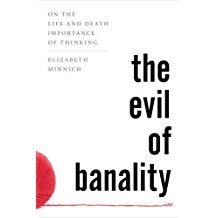
I’ve been unfairly slow in writing my review of Elizabeth Minnich’s book, The Evil of Banality: On the Life and Death Importance of Thinking. This is unfair because this is the kind of book everyone should read. It’s that good and that important. I may even use the cliché and say it’s timely. We live in a post-truth age, where fake news seems to manipulate everyone and keep them from acting responsibly, that is, from thinking.

Let me start with an example from my own backyard. I live in Barcelona in Catalonia, Spain, a place that has really been put on the map in the last few months. Here, Catalan separatist or nationalists play with people’s emotions and try to generate a certain belief, regardless of whether it’s true or not. For example, Spain is not a dictatorship; people are free in Catalonia to express their opinions. The Catalan language is not threatened; rather it’s spoken everywhere. All things the Catalan separatist claim. Furthermore, although I disagree with the imprisonment of certain Catalan politicians, they are not in prison for their ideas but for conducting illegal activities. While the Spanish government is not a perfect democracy, it is, nevertheless, still a democracy.

Thoughtlessness can also be related to the misuse of some concepts or ideas such as freedom of expression. Recently, a Catalan school teacher blamed one of his student in front of the whole class because the student’s father worked in the national police force. The teacher claimed that the police beat everyone and even killed someone. Afterwards, a Catalan politician said that, in Catalan schools, teachers have freedom to express themselves. That is, the teachers are free to say and act as they see fit. This is an extreme example, and not common, but I know that in Denmark such behavior would cause numerous problems and lead to scrutinizing the schools. In Catalonia, politicians seem to lack the capacity to reflect critically on their own behavior and ideas.

What does this have to do with Minnich’s book? Everything. She addresses how evil emerges when we “go along thoughtlessly—without paying attention, reflecting, questioning.” In other words, our lack of thinking, of critically evaluating what happens—including our own thoughts and behavior—can lead to many evils in this world. Thus, critical thinking is mandatory for all democracies. Minnich asks “What, how, are they thinking? Are we thinking? . . . How could they make sense of what they were doing?” These questions are alarming when put in a context like apartheid, Rwanda, or the sexual abuse of women and children.

The title of her book is an allusion to Hannah Arendt’s Eichmann in Jerusalem: A Report on the Banality of Evil, where Arendt concluded that Nazi crimes against Jews were also crimes against humanity. She showed how a totalitarian government affects every bureaucracy by dehumanizing them and motivating people to act without questioning.  Arendt called this “sheer thoughtlessness.”

Minnich continues, “I found myself reversing her (in)famous phrase and, having done so, thinking that perhaps it would have helped had she spoken, as she did not, of ‘the evil of banality,’ rather than—or, as I now think, in addition to—‘the banality of evil.’ To think of evil as ‘banal’ was then altogether too difficult.” Here, Minnich stresses that when someone has done something wrong, we tend to ask them, “What were you thinking?”

The foundational thesis of her book is that people who are doing evil are not thinking.

Minnich offers many examples in her book: From fiction like Camus’ The Plague to Darfur and Rwanda. She also develops two key concepts to help us understand the relationship between evil and thoughtlessness: intensive versus extensive evil and intensive versus extensive good.

Extensive evil refers to horrific harm-doing that persists for months, even years. For example, genocide, slavery, apartheid, financial exploitation, mistreatment of workers, or, as has recently become evident, when “powerful” men exploit and abuse women. It’s tempting to see the kind of people who do these things as psychopaths or sick. (I can’t help but see Weinstein and his ilk as sick.) However, Minnich emphasizes that these activities are done by inconspicuous people like your quiet next-door neighbor. She mentions several alarming examples from South Africa and Rwanda. And here we must collectively take responsibility if we witness any kind of wrongdoing. For instance, this is happening right now through the #MeToo Campaign. Such campaigns can relieve some of the pain; they can help, encourage, and illustrate that another world is possible,  one of trust, respect, and equality. Similarly, I would argue that when a school system becomes political, promoting rigid nationalism and legitimizing hate, as in some cases in Catalonia, then we must look at this with care—even if we only speak of a handful of concrete examples. Ignorance should never be an option.

Minnich emphasizes that we should be careful not to confuse extensive evil with intensive evil. Intensive evils “are great harms done by one or a few people. In that sense, they are contained . . . When they burst into our lives, almost all of us are genuinely spectators, not participants, not enablers, not perpetrators.”

She says extensive evil spreads like a plague, whereas intensive evil is like a poison. The book is full of such precise literary and metaphorical examples that make it not only a pleasure to read but also easy to follow.

The problem, Minnich says, is that we think of extensive evil as intensive. That is, we may convince ourselves that only a few schools are indoctrinating their students, only a few men are raping women, only a few people are sexually abusing children, only a few organizations are over-stressing and discriminating against their workforce. “Thinking of all evils as if they were intensive—taboo, smacking of possession, shocking to still-functioning conventional society, hence readily felt to be anti-rational—blinds us to the on-the-ground realities especially of extensive evils that are enabled, instead, by such familiar motivators as careerism and greed . . .”

What to do? Well, we could all strengthen our vison. It’s a matter of “seeing, admitting, and thinking through the realization that there have been, and somewhere now are, times in which what ‘everyone is doing’ is morally, politically, deadly wrong.”

Luckily, we can also cultivate critical thinking. Through education, we can try to eradicate automatic thinking, like when some Catalan separatist always declare, “It’s Spain’s fault.” Automatic thinking is just confirming our default-setting without any reflection about what actually takes place.

In the last part of the book, Minnich offers a beautiful reminder of what philosophy is and what it can do. “Socrates was a practitioner and teacher of thinking and not knowledge.” That is, he was open, curious, and constantly questioning not only why and what people were thinking but also how they were living according to their thoughts or beliefs.

Like Arendt, Minnich stresses how stupidity and thoughtlessness are not the same thing. “Very smart people can be very thoughtless just like the rest of us.” This emphasizes that we need to be aware of how the system is nurturing a certain kind of behavior. Here, many studies in social psychology can inspire readers who wish to explore this further.

Still, some may ask, how can we really know if we are trying to critically and openly assess what is happening? Minnich says it clearly: “Self-respect is earned not by recognition, praise, status, net worth, power, influence or anything else externally conferred but by continuing to recognize ourselves as someone we can live with, and not be ashamed?”

I agree. I think of how some politicians seem incapable of being ashamed. They are determined to play the game well, to advance their career, and to achieve their objectives, regardless of the disagreement and suffering of the people they are supposed to govern. Is it arrogance? Minnich notes, “. . . Sometimes we do stop and think, and simply say, at the right moment, the No that is actually a profound Yes to what we will not violate because that is something we just cannot do and still live with ourselves.”

Yet, some people never seem to stop and think. How can some live with themselves?

Elizabeth Minnich’s The Evil of Banality merits a better and more thorough review than what I can provide here. Nevertheless, it deserves to be read. Recommend it to your friends, especially if you know someone who is in charge of other people’s destinies. It is well written, very well argued, full of good examples, and it is inspiring.

See also philosopher Skye Cleary’s interview with Elizabeth Minnich here.
theevilofbanality


Blog at WordPress.com.

Up ↑