Life is not personal

What if life is impersonal?

In the book The Identity Trap, political scientist Yascha Mounk argues how some ideas (or his interpretations hereof) are causing new forms of polarization, separatism, control, and even repression.

The identity trap, according to Mounk, refers to those people and institutions that prioritize identity over universalism–especially when specific identity categories like race, gender, and sexual orientation are favored. 

The book is filled with illustrative examples from the US of “progressive separatism” and “strategic essentials”, claiming to be for equality while not treating all people as equals.

Yet, some of Mounk’s claims regarding the cause of the emergence of identity politics require a comment.

Foucault & Deleuze

For example, Mounk writes: “Many postcolonial scholars were especially aghast when Foucault, in his exchange with Deleuze, argued that the oppressed do not need intellectuals to speak on their behalf.”

Mounk refers to the French philosophers Michel Foucault and Gilles Deleuze, who in 1972 discussed the struggles of women, homosexuals, and prisoners, as well as the relationship between theory, practice, and power.

In their conversation, they try to break away from the idea that the intellectual “spoke the truth to those who had yet to see it, in the name of those who were forbidden to speak the truth,” as Foucault says. Instead of claiming to speak the truth or have privileged access to it as intellectuals, Foucault and Deleuze discuss “the necessity” for individuals “to speak for themselves.” In continuation, Deleuze stresses: “Who speaks and acts? It is always a multiplicity, even within the person who speaks and acts… Representation no longer exists.”

Representation no longer exists, how should this postulate be understood?

First, each human being is never one fixed being or belongs to one identity group but is a multiplicity. Therefore, a focus on identity that is too rigid is a trap because it imprisons thought. In continuation, no one can speak on behalf of a person or a group because each person or group already is a multiplicity; or, if you should speak on behalf, you speak in several voices, precisely what identity-based politics rarely master, for example, due to strategic essentialism.

In his philosophy, Deleuze operates with an ontology of difference and repetition, where identity manifests after encounters. Deleuze would find it imprisoning to want a particular identity–that is, to restrict thinking to essential forms of being, whether referring to races, ethnicities, sexualities, etc. Thus, he, too, would be against the identity trap, although with different arguments.

To become with life

For example, part of the current focus on identity is trying to undermine the old dominant social order, or what Deleuze and Guattari would call the majority of being “white, male, adult, ‘rational,’ etc.; in short, the average European, the subject of enunciation.” Still, Deleuze and Guattari don’t tear down a dominant system by changing one ideal or one dominating identity with another. The problem is not that it is a man who is white, etc., but that a specific identity is favored over another, that some forms of life are worth more than others. Mounk addresses this problem and shows how the US, in several contexts, favors non-whites, i.e., discriminates. (He gives examples of the distribution of COVID-19 medicine, access to some schools, and certain groups having access to startup help). 

The problem, however, is not male versus female or black versus white, according to Deleuze and Guitar, because everyone should be equally treated, just as there ought to be room for all life forms. The problem is that we think and add authority to specific identities. Add authority to particular identities. Therefore, they suggest becoming imperceptible and impersonal–or simply forgetting about all these identity markers that become a prison. The current urge to seek an identity hinders people’s capacity to think for themselves. Hindering people to become with life.

For Deleuze, what is strange and unfamiliar makes a person think. For example, in the 1970s, Deleuze was active in the early French gay rights movement. He was a member of the group FHAR (Front Homosexuel d’action Révolutionnaire). For some, it might appear strange that a husband and father of two would care for other people’s rights, but why? Due to empathy, imagination, and selflessness, connecting with people different from yourself is possible. For example, you can fight for education even if you have no children or health care, even if you are not sick. This is trivial, yet for some, unfortunately, it is not due to selfishness or progressive separatism (nationalism is an example).

Another argument in favor of Deleuze is that his philosophy moves away from a philosophy of being towards one of becoming. Yet, becoming is not about the point from which something originates or the point at which it arrives. With this, Deleuze would agree with Mounk’s critique against “strategic essentialism” and “progressive separatism.”

Identities are fiction

In A Thousand Plateaus, Deleuze and the psychoanalyst Félix Guattari write: “A becoming is always in the middle; one can only get it by the middle.” Becoming, therefore, does not represent an ideal, a norm, or a reference point. On the contrary, becoming produces new ways of living, sensibilities, and relating to things such as race, gender, or sexuality where everything intersects. No race or sexuality is prioritized for another.

To emphasize the strength of the concept of becoming, they write “becoming-imperceptible.”

The writer Chris Kraus quotes Deleuze for the sentence: “Life is not personal,” in her book, I Love Dick. That idea is incredibly liberating, which Kraus’ work illustrates because the individual life isn’t just about itself; there is always room for becoming someone else.

To put it more simply, identities are fiction.

Using Iris Murdoch’s concept, contemporary society needs a little dose of “unselfing” to improve the world. “Unselfing” means I turn my attention outward, away from myself and onto the world. As a result, I will see things as they really are and not through the lens of my selfish concerns. Unfortunately, this is difficult because many people’s vision is colored by their concern and interest, Murdoch calls it the “fat relentless ego” in The Sovereignty of Good.

The best way to avoid the identity traps is to prevent craving for one.

Love holds the potential for political change

“Loving people is the only thing worth living for.” – Søren Kierkegaard

I believe that all kinds of discrimination, hate and suffering can only be destroyed by love.

In her book All About Love: New Visions, the philosopher Bell Hooks (or, as she prefers, bell hooks) defines love as the will to extend or expand oneself for the purpose of allowing the spiritual self to flourish—including the selves of others. According to the existential philosopher Søren Kierkegaard, love is edifying. Love is a verb; it does something. But that is not all! In a letter to his then-fiancée Regine Olsen, Kierkegaard wrote, “Freedom is the element of love.”

Love requires freedom. Or only free people can love.

I propose an understanding of freedom as being with friends. Freedom is the manifestation of a complete or meaningful relationship. Every relationship always assumes something that is not oneself. Love cannot therefore be reduced to self—love is, rather, an external force that arouses joy.

Seen in this light, I believe that a will to love—fundamentally—tries to overcome the devastating sadness that comes in the face of exploitation, discrimination, abuse of power, violence and death.

Works of Love, Kierkegaard argues that only love is edifying.Not anger. In connection with the religious injunction to love your neighbour as yourself, he emphasizes that the term neighbour does  not refer to your race, your gender or your nation, but all people. Anyone, he writes. All people should be loved as equals (not necessarily loved equally).

That is, treated equally. Treated with the same respect and rights.

With Kierkegaard’s call to love all human beings as equals, he turns love into a political concept that destroys the damning group identity politics of the time. Love possesses such a liberating potential. It confirms the wisdom of Hannah Arendt, when she said that evil is the result of our thoughtlessness, our reluctance to think well and thoroughly.

Mindlessness is associated with a lack of attention, an inability to love.

Love is the vitality with which all critical thinking begins. It’s like a friendly bond that can make you and me wiser. That which is part of life in all its complexity: everything that breathes, shits and dies.

Love can only flourish when we—all of us—recognize that none of us own life, but rather, that it is on loan. It is the manifold powers of life that we cherish, not our ego, race or territory.

Love holds the potential for political change. It happens when all people are loved, as equals.

A world of “alternative facts”?

In her essay, “Truth and Politics,” the philosopher Hannah Arendt wrote: “Freedom of opinion is a farce unless factual information is guaranteed and the facts themselves are not in dispute” (all quotes from Arendt are taken from Richard J. Bernstein’s brilliant book, Why Read Hannah Arendt Now).

Let me elaborate on that by referring to the #MeToo movement; the movement is, probably, one of the most interesting—and hopefully—sustainable movements of change in recent years. What concerns me here, however, is not who has the power to tell their story—although this is important as well—but how power shapes what any true story could possibly be. In other words, it’s obvious that most reasonable people welcome that women have both the courage and power to tell their stories, and yet, we should be careful not to let the label—#MeToo—paralyze the need for critical thinking regarding what is being said.

One way of blurring the distinction between fact-based truth (factual truth) and falsehood, as Arendt mentioned, is to claim that any factual truth is just another opinion. When dealing with abuse or violence is it enough to have an opinion about whether or not someone is being abusive? Without any sense of what is a so-called factual truth or facts, we too easily move into a fictional world of “alternative facts.”

Seen in this light, the accusation toward the writer Junot Diaz—to mention one recent example—might seem to neglect this distinction between falsehood and truth. Instead, the accusers tend to represent something Arendt would call propaganda. The issue here is not whether Diaz is a good guy or a bad guy, but how the accusers framed him as an abuser “under” the power of #MeToo, regardless of the factual truth of the matter. In doing so, the accusers have not only undermined the movement, but also showed—as Arendt also predicted—that they knew that many people don’t really care if they lie. Instead, many people will admire them (bandwagon mentality) for their tactical skills in accusing a well-known writer to gain publicity for themselves, or perhaps even to sell some books. As Bernstein writes: “Factual truth-telling is frequently powerless against image-making…”

Arendt also wrote: “The result of a consistent and total substitution of lies for factual truth is not that the lies will now be accepted as truth, and the truth defamed as lies, but that the sense by which we take our bearings in the real world—and the category of truth vs. falsehood is among the mental means to this end—is being destroyed.”  The possibilities for lying become limitless and, far too often, are met with little resistance. Referring to the Junot Diaz case and #MeToo, one obvious reason for this little resistance against falsehood can be that no sane person wants to appear as if they are against equality and respect, which the #MeToo movement represents. Yet, quite paradoxically, the power of this movement comes from telling the truth; the truth that is powerful enough without being fictionalized.

Arendt noted: “What convinces the masses are not facts, not even invented facts, but only the consistency of the system of which they are presumably a part.” Assuming that #MeToo is such a system, then, like all systems, it is maintained by the culture that the users install. Here, I prefer people who play fair, that care about the truth, that are capable of putting personal agendas aside to cultivate trust, respect, and equality which, actually, is what #MeToo is all about. Following the Junot Diaz case, the accusers appear deliberately to be committing what looks like a character assassin. Why? Some suggest envy, greed, hate, and even racism as motives… I’ve no idea. All I know is that the opposite of factual truth is deliberate lying. (On a similar note, see #MeToo exists in an ethical twilight zone).

Also I know that literature can help us experience the difference between falsehood and truth, it has the potential to confront us with our moral limitations. It can stimulate our empathy and make us recognize our need for compassion. In many important ways, writers and other artists hold a mirror to society that allows it to see its ugliness and its beauty. I think, we need to keep the madness alive—through art. We need this for the sanity of humanity.

In other words, writers must dare not to follow the herd. This requires writers who doesn’t simply moralize but who risk asking the ugly, offensive questions (see e.g. All women are not angels). The artist creates, imagines, and enlarges—and sometimes that is not pretty.

What is far worse than immoral art is when people—citizens in democratic societies—don’t know the difference between falsehood or truth, or when some people don’t really care. The theme that runs through Arendt’s thinking, according to Bernstein, is “the need to take responsibility for our political lives.” Lying and responsibility, of course, doesn’t go hand in hand. It never has. Instead, Arendt showed that organized lying and fictional image-making are techniques perfected by totalitarian regimes, she showed that the banality of evil comes from our inability to think, that is to say, our inability to question, doubt, wonder, analyze, and constantly debate and clarify the relationship between power, truth, and lying. “Thinking is an activity that must be performed over and over again in order to keep it alive,” Bernstein writes in another book called Violence.

The Junot Diaz case shows that we still, all of us, have a long way to go before the world is a safer place full of trust, respect, compassion, and equality for all.

Løgnen er demokratiets død

Filosoffen Hannah Arendt havde et skarpt blik for forholdet mellem sandhed og løgne. Hun vidste, at det, som overbeviser masserne ikke er fakta, end ikke alternative fakta, men hvor stærkt noget kan opretholde den fortælling, som nogle ynder at se sig selv igennem.

Den fortælling, som Arendt talte om, svarer til hvad vi i dag kalder identitetspolitik, hvor enhver gruppe ser sig selv som særegne, hvorved de værner om deres egen fortælling med en nidkærhed, der til tider gør dem blinde for egne mangler, eller andre menneskers ideer og tanker.

Problemet i dag er det samme, som Arendt rejste midt i det tyvende århundrede, nemlig at de fleste ikke ønsker at tænke, de foretrækker at ignorere besværlige politiske problemer, eller de tyer til klicheer og fjollerier. Det sker, når vi ryster på hovedet af Trump, og siger: ”Sikke en idiot.” Intet synes for alvor at vække vores slumrende handlekraft. Og dette er demokratisk problematisk.

Det modsatte af rationel sandhed er ignorance. Og det modsatte af en faktuel sandhed er den bevidste løgn. Det nytter altså ikke at ignorere politikere (eller andre), der lyver. Det nytter heller ikke – ganske misvisende – at kalde en løgn for en holdning, som kunne man kalde en regnefejl en holdning. Den rationelle sandhed krymper, når nogen bevidst fordrejer, undlader, overdriver eller lyver om faktuelle sandheder (se Den der råber lyver)

Politisk populisme henvender sig til befolkningens følelser; følelser, der som alt andet kan være sande eller falske, velbegrundet eller ubegrundet, fornuftige eller ufornuftige. Følelser er afhængige vores overbevisning eller tro – altså den fortælling vi ønsker at identificere os med – og ikke, hvorvidt noget er sandt eller falsk.

Måske det hele kan summeres igennem Arendts spørgsmål: ”Hvordan sker det onde?” (se  Are We Thinking?) Det sker ikke fordi vi er dumme, sagde hun. Snarere på grund af mangel på omtanke og ubesindighed. Ren og skær dovenskab og ligegyldighed.

Et politisk og socialt engagement kæver en vilje til sandheden, fordi dette engagement skaber fremtidens fundament.

#MeToo exists in an ethical twilight zone

What do we think about when we think of the #MeToo movement? #MeToo is many things—it’s complex and conflicting; it addresses our collective memory (or lack thereof) and history; it touches upon social and economic class, religion, race, and, of course, most of all on gender. And it touches upon the glue of our society: trust.

A few weeks ago, I heard that the Boston Review had decided to keep the writer Junot Díaz on as a fiction editor. Yesterday, the Massachusetts Institute of Technology (MIT) cleared Díaz of allegations of sexual misconduct and verbal abuse.

In many ways, the whole “Junot Diaz case” can be placed within the post-truth era of fake news, which again is one of ethics. For example, the journalist Ralph Keyes claims in The Post-Truth Era: Dishonesty and Deception in Contemporary Life, “Deception has become commonplace at all levels of contemporary life.” He goes on to consider that we may have reached a stage in our social evolution that is “beyond honesty.”

The era of post-truth is also an era of moralism. Everything is too easily reduced to good and bad, as if no grey areas exist. This is also part of the rigid identity politics that characterize US politics today, which far too often produce a mindless label—as if only a black person can speak against racism, a homosexual against homophobia, a woman against male abusers. Such assumptions show a lack of imagination. They also avoid staring at all the grey areas. For example, the grey areas are probably the weakest points in the otherwise powerful and very welcome #MeToo movement, in which the Junot Díaz case can be placed since it deals with a man of power accused of behaving badly.

Morality typically deals with whether something is right or wrong. However, being moral is not always the same as being right. For example, a story isn’t true because its moral is, and vice versa. Furthermore, morality is not something unchangeable; rather, it’s a social artefact. Our moral norms change as a result of new knowledge. This knowledge, of course, should be convincing, valid, reliable, and trustworthy. Unfortunately, lack of trust seems to be the protagonist in this particular case.

“Post-truthfulness exists in an ethical twilight zone,” Keyes writes. “It allows us to dissemble without considering ourselves dishonest. When our behavior conflicts with our values, what we’re most likely to do is reconceive our values.” Keyes’ point is interesting. One of Díaz’s main accusers was the writer Carmen Maria Machado, who referred to a Q & A session she had with Díaz, where she claims he was “abusive”, “bullying” and “misogynist.” However, when confronted with a recording of this particular discussion, Machado was forced to admit she had been exaggerating, saying, “I’m not a victim of Junot Díaz. I’m a female writer who had a weird interaction with him.”

Weird, of course, is not necessarily misogynist.

Why did she lie? Did she deliberately stretch her wording to fit the #MeToo vocabulary? So far, Machado has not apologized—perhaps because she is afraid of people’s hate and judgment, or afraid of losing face, or afraid of being accused of lack of empathy. Or, maybe, she doesn’t care, maybe she distrust the institutions who cleared him… no one knows. However, what’s “interesting” is that Machado’s accusations violate trust, which we all need to coexist, regardless of age, gender, religion or sexual orientation, etc.

In an essay entitled “Truth and Politics“, the philosopher Hannah Arendt wrote, “Freedom of opinion is a farce unless factual information is guaranteed and that facts themselves are not in dispute.” Truth, therefore, is not the same as having an opinion. For example, Machado might have the opinion that the she was verbally abused, but in reality she is fictionalizing the truth, or creating “alternative facts” as we call it today.

***

The Danish philosopher K.E. Løgstrup said that trust is elementary or fundamental to human existence. Would I leave my three children at a public school every morning if I didn’t trust the teachers? Would I cross the street with them if I didn’t trust people to stop their cars at a red light?

Trust binds us together. It affects marriages, friendships, parents, and society, including politicians and scientists who inform us about the ecological disasters that humans are creating. Løgstrup emphasizes that human interdependence only works if we trust one another. Trust allows me to surrender myself into the hands of another, to make myself vulnerable, because I expect a respectful, compassionate, and trustful feedback.

Therefore, when Carmen Maria Machado lied about Díaz, it was not just a little white lie. Her words impacted everyone. Not only because she accused a well-known writer but because we trusted her. Some may have been skeptical of the validity of the accusations—thinking of sensationalism, etc., but, at the same time, #MeToo taught us the importance of believing the girls and women who had come forward so courageously. For too long, the victim has suffered unnecessarily because being a victim has been associated with shame. Shame is the reason why many women (and men) and children don’t tell about abuse.

When I discovered that Machado lied and didn’t correct her words until she was confronted a month later with an audio recording of the interview, she became less believable. When she was confronted with a recording, she appears annoyed and defensive but, surprisingly, she also appears to be angry for being exposed. “Stop lecturing!” she said. “That’s what’s so fucking weird. The level of condescension.”

And this is perhaps the saddest part. It may cause people to doubt the sincerity of #MeToo. Machado’s behavior perfectly fits with our cultural acceptance of lying. As Keyes notes in The Post-Truth Era regarding the rise in the use of euphemisms for deception: “We no longer tell lies. Instead we ‘misspeak.’ We ‘exaggerate.’ We ‘exercise poor judgment.’ ‘Mistakes were made,’ we say.” It’s as if we—many, at least—have become careless of what is true or not true.

If we want to change society into something better—a society based on equality, respect, and compassion—then we must trust one another. Trust is also the foundation of critical thinking because we assume that people say what they mean for the sake of the truth, not their own agenda (read: self-serving).

We become wiser by admitting our mistakes, that is to say be accountable for our actions and words, but also by acknowledging all the grey areas when it comes to human interaction, not just between men and women but between all kinds of identities—gender, race, age, culture, beliefs, etc. Let’s not forgot that all identities are prisons. They might make us see something more clearly from our own point of view but are often blind to a lot of other aspects. Let’s not forget that men and women should be able to discuss things without fearing being labeled misogynistic. Let’s not forget that nothing is ever completely black or white. Sometimes women lie, use their power; sometimes men are falsely accused.

The great writer Terry Tempest Williams once said that she wanted to bear witness to both the beauty and pain of our world in her writing. By “bearing witness,” she said, “the story told can provide a healing ground.” With regard to the case of Machado and Díaz, healing arises if their conflict is not used to draw a deeper ravine between genders but, instead, to acknowledge that all parties have suffered, and that trust is only gained through apology and change of actions that will make the grey areas less grey.

We’re All Accountable

… From my essay on sexism, morality, identity politics, and compassion:

“I remember Rebecca Solnit saying something about men being the problem—not all men, but men. And she’s almost right. Because men, as philosopher Simone de Beauvoir said about women, aren’t born men; they become men. Weinstein didn’t come into this world as a sick misogynist. He, like all those like him, was formed by the culture in which he was brought up.

Luckily, I think, I spent a lot of time with my mother and my sister. Yet, many small boys spend time with their mothers, and less time with their fathers … or, at least, they used to. Does this mean that even women—some mothers—are favouring their sons? Encouraging them to see themselves as better than girls? Telling their daughters to passively obey?”

Read the entire essay here.

Are we thinking?

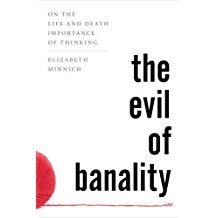
I’ve been unfairly slow in writing my review of Elizabeth Minnich’s book, The Evil of Banality: On the Life and Death Importance of Thinking. This is unfair because this is the kind of book everyone should read. It’s that good and that important. I may even use the cliché and say it’s timely. We live in a post-truth age, where fake news seems to manipulate everyone and keep them from acting responsibly, that is, from thinking.

Let me start with an example from my own backyard. I live in Barcelona in Catalonia, Spain, a place that has really been put on the map in the last few months. Here, Catalan separatist or nationalists play with people’s emotions and try to generate a certain belief, regardless of whether it’s true or not. For example, Spain is not a dictatorship; people are free in Catalonia to express their opinions. The Catalan language is not threatened; rather it’s spoken everywhere. All things the Catalan separatist claim. Furthermore, although I disagree with the imprisonment of certain Catalan politicians, they are not in prison for their ideas but for conducting illegal activities. While the Spanish government is not a perfect democracy, it is, nevertheless, still a democracy.

Thoughtlessness can also be related to the misuse of some concepts or ideas such as freedom of expression. Recently, a Catalan school teacher blamed one of his student in front of the whole class because the student’s father worked in the national police force. The teacher claimed that the police beat everyone and even killed someone. Afterwards, a Catalan politician said that, in Catalan schools, teachers have freedom to express themselves. That is, the teachers are free to say and act as they see fit. This is an extreme example, and not common, but I know that in Denmark such behavior would cause numerous problems and lead to scrutinizing the schools. In Catalonia, politicians seem to lack the capacity to reflect critically on their own behavior and ideas.

What does this have to do with Minnich’s book? Everything. She addresses how evil emerges when we “go along thoughtlessly—without paying attention, reflecting, questioning.” In other words, our lack of thinking, of critically evaluating what happens—including our own thoughts and behavior—can lead to many evils in this world. Thus, critical thinking is mandatory for all democracies. Minnich asks “What, how, are they thinking? Are we thinking? . . . How could they make sense of what they were doing?” These questions are alarming when put in a context like apartheid, Rwanda, or the sexual abuse of women and children.

The title of her book is an allusion to Hannah Arendt’s Eichmann in Jerusalem: A Report on the Banality of Evil, where Arendt concluded that Nazi crimes against Jews were also crimes against humanity. She showed how a totalitarian government affects every bureaucracy by dehumanizing them and motivating people to act without questioning.  Arendt called this “sheer thoughtlessness.”

Minnich continues, “I found myself reversing her (in)famous phrase and, having done so, thinking that perhaps it would have helped had she spoken, as she did not, of ‘the evil of banality,’ rather than—or, as I now think, in addition to—‘the banality of evil.’ To think of evil as ‘banal’ was then altogether too difficult.” Here, Minnich stresses that when someone has done something wrong, we tend to ask them, “What were you thinking?”

The foundational thesis of her book is that people who are doing evil are not thinking.

Minnich offers many examples in her book: From fiction like Camus’ The Plague to Darfur and Rwanda. She also develops two key concepts to help us understand the relationship between evil and thoughtlessness: intensive versus extensive evil and intensive versus extensive good.

Extensive evil refers to horrific harm-doing that persists for months, even years. For example, genocide, slavery, apartheid, financial exploitation, mistreatment of workers, or, as has recently become evident, when “powerful” men exploit and abuse women. It’s tempting to see the kind of people who do these things as psychopaths or sick. (I can’t help but see Weinstein and his ilk as sick.) However, Minnich emphasizes that these activities are done by inconspicuous people like your quiet next-door neighbor. She mentions several alarming examples from South Africa and Rwanda. And here we must collectively take responsibility if we witness any kind of wrongdoing. For instance, this is happening right now through the #MeToo Campaign. Such campaigns can relieve some of the pain; they can help, encourage, and illustrate that another world is possible,  one of trust, respect, and equality. Similarly, I would argue that when a school system becomes political, promoting rigid nationalism and legitimizing hate, as in some cases in Catalonia, then we must look at this with care—even if we only speak of a handful of concrete examples. Ignorance should never be an option.

Minnich emphasizes that we should be careful not to confuse extensive evil with intensive evil. Intensive evils “are great harms done by one or a few people. In that sense, they are contained . . . When they burst into our lives, almost all of us are genuinely spectators, not participants, not enablers, not perpetrators.”

She says extensive evil spreads like a plague, whereas intensive evil is like a poison. The book is full of such precise literary and metaphorical examples that make it not only a pleasure to read but also easy to follow.

The problem, Minnich says, is that we think of extensive evil as intensive. That is, we may convince ourselves that only a few schools are indoctrinating their students, only a few men are raping women, only a few people are sexually abusing children, only a few organizations are over-stressing and discriminating against their workforce. “Thinking of all evils as if they were intensive—taboo, smacking of possession, shocking to still-functioning conventional society, hence readily felt to be anti-rational—blinds us to the on-the-ground realities especially of extensive evils that are enabled, instead, by such familiar motivators as careerism and greed . . .”

What to do? Well, we could all strengthen our vison. It’s a matter of “seeing, admitting, and thinking through the realization that there have been, and somewhere now are, times in which what ‘everyone is doing’ is morally, politically, deadly wrong.”

Luckily, we can also cultivate critical thinking. Through education, we can try to eradicate automatic thinking, like when some Catalan separatist always declare, “It’s Spain’s fault.” Automatic thinking is just confirming our default-setting without any reflection about what actually takes place.

In the last part of the book, Minnich offers a beautiful reminder of what philosophy is and what it can do. “Socrates was a practitioner and teacher of thinking and not knowledge.” That is, he was open, curious, and constantly questioning not only why and what people were thinking but also how they were living according to their thoughts or beliefs.

Like Arendt, Minnich stresses how stupidity and thoughtlessness are not the same thing. “Very smart people can be very thoughtless just like the rest of us.” This emphasizes that we need to be aware of how the system is nurturing a certain kind of behavior. Here, many studies in social psychology can inspire readers who wish to explore this further.

Still, some may ask, how can we really know if we are trying to critically and openly assess what is happening? Minnich says it clearly: “Self-respect is earned not by recognition, praise, status, net worth, power, influence or anything else externally conferred but by continuing to recognize ourselves as someone we can live with, and not be ashamed?”

I agree. I think of how some politicians seem incapable of being ashamed. They are determined to play the game well, to advance their career, and to achieve their objectives, regardless of the disagreement and suffering of the people they are supposed to govern. Is it arrogance? Minnich notes, “. . . Sometimes we do stop and think, and simply say, at the right moment, the No that is actually a profound Yes to what we will not violate because that is something we just cannot do and still live with ourselves.”

Yet, some people never seem to stop and think. How can some live with themselves?

Elizabeth Minnich’s The Evil of Banality merits a better and more thorough review than what I can provide here. Nevertheless, it deserves to be read. Recommend it to your friends, especially if you know someone who is in charge of other people’s destinies. It is well written, very well argued, full of good examples, and it is inspiring.

See also philosopher Skye Cleary’s interview with Elizabeth Minnich here.

theevilofbanality


Philosophy in dark times

Martin Luther King Jr. once said: “Only when it’s dark enough can you see the stars.”

I like this quote; it consists of several interesting elements. Most obvious is the ambiguity of stars: they can both guide us and blind us. I’ll get back to that.

We live in dark times, where terrorism, fascism, racism, sexism, and rigid nationalism seem to flourish everywhere. In addition, I am not even mentioning the environment, that is, how we treat this lovely earth that we are lucky enough to inhabit for a time. We live in a time where egoism has hindered us—that is, all sentient beings—from seeing how we are all interrelated.

Just a few days ago, the city where I live, Barcelona in Spain, suffered an awful terror attack, like so many cities before it. It happened in La Rambla, a commercial and touristic area characterized by its openness.

LaRambla

People come and go; even the locals that tend to avoid it have to pass through or by it, stroll along for a while when they go to the theater, the market, the museums, bookstores, cinemas, etc. It’s an intersection where all paths in Barcelona are fated to pass, once in a while. What happened in Barcelona was, of course, just one of far too many murderous attacks on innocent people, which has happened, and continues to happen, all around the world.

But let me step away from the street and over to an important and relevant book in these dark times. Hannah Arendt’s The Origins of Totalitarianism opens with a German quote from Karl Jaspers. In my English translation, it says something like: “Don’t give in to the past or the future. Be entirely present is all that matters.” Or, “What matters is to be entirely present.”

The moral is clear: to pay attention to the present moment, that is, to what happens right now. Totalitarianism emerges because of our ignorance, our lack of awareness of what is taking place right here and now.

This Jasper quote makes me recall the story of Oedipus, who, after realizing that he had killed his father and made love to his mother, tears out his own eyes. He couldn’t take or carry the pain. For me, philosophy is about trying to become capable of carrying, that is, live on with pain. In Barcelona, like so many other places, people screamed, “We are not afraid!” I share this but yet, I am afraid … afraid that we don’t learn to see better, that this act of terror will not sharpen our senses, afraid that we will still neglect to deepen our questions about ourselves, involve ourselves. I’m also afraid that this tragic event might be used strategically by Catalan nationalists …

If Oedipus were a philosopher, he would not have blinded himself but looked the fear and pain right in the eyes.

LaRambla02

Let’s return to Dr. King’s quote emphasizing how we ought to look into the dark, perhaps to reflect why we didn’t notice the stars before it became so dark. Apparently, terrorism, racism, fascism, hatred, stupidity, etc. were already there; yet, how come we didn’t see them, just ignored them? Yes, many of the elements on my list have been very overt in many places in recent times, and still, how come so many didn’t notice the hate? Here, of course, the stars don’t refer to anything heroic—quite the contrary: they blind some, they seduce some with their too naïve logic. No one is born hating another person because of the color of her skin, as Barack Obama once said. It is easy to stigmatize. They appeal – those hateful ideologies – because they don’t require the hard work related to thinking, analyzing, etc.

A simple example is how changes in society happen gradually. Some people use diminishing and hateful words to describe other forms of life; some make jokes about minorities. And people let these pass. “It’s nothing,” they say. And yet, gradually what began with us not paying attention to how people use language strangles us.

On a more positive note, when it is dark we can see the stars, referring to those who are already fighting back, resisting stupidity. Those stars guide, inspire, or challenge us to think. It can be through demonstration (recall the women’s march soon after the election of Trump), humor, as well as serious and thorough in-depth journalism that allow readers to sharpen their vision. Those who meet hate with hate are not the stars. Hate is too easy. Instead, the stars are those who are capable of creating alternative ways of living, who are open to more compassionate and loving paths, who establish sustainable futures where we all can live together without being reduced to the same. We must take direct action. Question the dominant worldview in our culture such as neoliberalism, white supremacy, sexism, rigid religious interpretations, etc.

So, in dark times, like in all times, we need philosophy. Luckily, philosophy is for all. No discrimination here (see more here). Furthermore, love and thinking have always walked hand in hand in philosophy; if you’re not capable of loving, you’re not capable of thinking. That is why you find no convincing philosophy among political and religious terrorists, fascists, sexists, or racists. Socrates, one of the first philosophers, interacted with people out of love, and he cared for their reasoning, as if he knew that depression, unhappiness, or feelings of inferiority were symptoms of mental illness.

It is as if people who can’t think are responsible for what we call “evil.”

Indfør et filosofikum i folkeskolen

Skoling i filosofi og kritisk tænkning bør ikke kun være universitetsstuderende forundt. Hvis vi skal sikre demokratisk engagement og væbne os mod fake news og manipulation skal vi i gang allerede i folkeskolen.

De falske nyheder er blevet en ustoppelig nyhed i sig selv. Lidt komisk kunne man spørge, hvorvidt nyhederne om de falske nyheder er sande. Det er som om, at jo mere der tales om falske nyheder, desto mere rigtigt må problemet være.

Ikke desto mindre er det svært at afgøre, hvilke nyheder, der er sande eller falske. Den objektive journalist findes ikke. Alt vinkles og drejes for at underbygge en tese, en ide, en påstand eller på grund af hensyn til ens egen karriere eller øvrige interesser.

Spørgsmålet om sandhed har altid været befængt? Der er noget frelst og totalitært over at hævde at have adgang til sandheden. Af samme grund synes mange at være villige til at deponere ansvaret for nyhedernes faktuelle sandhedsværdi hos Facebook eller medierne generelt. Enkelte hælder til en politisk beslutning. Kun ganske få synes at mene, at det er borgernes ansvar.

Jeg mener i høj grad, at det er borgernes ansvar. Men før borgerne kan tage ansvar, må de tilbydes nogle kvalificerede redskaber, der kan hjælpe dem med kritisk at analysere og reflektere over, hvorvidt det, der siges, er sandt. Eller om vedkommende, der siger det, mon ikke har en underliggende dagsorden.

Hvis man vil give borgerne de redskaber, er en mulighed at genintroducere det for længst begravede filosofikum. Dog ikke på universitetsniveau, som bl.a. Søren Pind foreslog for nylig, men fra første dag i folkeskolen. Et sådan kursus skal ikke kun fokusere på etik, som to etikere fra RUC sjovt nok foreslog i Politiken. Etik handler om hvad der er godt og ondt, hvilket ofte også er rigtigt og forkert. Det er forkert at slå sine børn, fordi det er ondt, og det er ondt, fordi de ikke fremmer læring eller kærlige individer. Tilsvarende vil en religiøs person mene, at noget er godt eller ondt, fordi det står i Koranen eller i Biblen. Men hverken Koranen eller Biblen er mere rigtig eller forkert end Søren Kierkegaards bøger. Det er blot to bøger, som for mange betyder enormt meget, men antallet af tilhængere gør stadigvæk ikke bøgerne rigtigere end så meget andet. Sagt anderledes: Der er flere, som køber bøger af Jussi Adler-Olsen end af Olga Ravn, men det betyder ikke partout, at hans bøger er bedre, mere rigtige og sande. Selvfølgelig ikke.

Et filosofikum bør præsentere filosofi. Ud over etik vil det sige, videnskabsteori, kritisk tænkning og æstetisk.

Det som filosofien tilbyder ud over indsigt i, hvad der er viden, hvad der er mere rigtigt end forkert, er en tilgang til verden. En tilgang, som er spørgende og undersøgende. En nysgerrig og åben tilgang, der løbende øger vores engagement. Eller fastholder engagementet. Og netop engagement er noget af det, som mangler.

Hvis folk er engageret i samfundet, vil de også helt naturligt sætte spørgsmålstegn ved noget af det, som bliver sagt. De vil undersøge argumenterne. Hænger logikken sammen? Stemmer dette billede overens med, hvad andre siger, ser, hører, beretter? Den engagerede vil kigge efter alternative kilder.

Vi skal lære at tænke

Den demokratiske proces begynder allerede i familien, dernæst i skolen. Måske ikke alle familier kan kultivere en kritisk tænkning. Jeg kommer selv fra et hjem, hvor der kun var få bøger, og hvor ingen kendte til forskellen mellem en klaver og et piano. Men skolen kan. Eller sagt mere moraliserende: Den skal.

Hvorfor skulle jeg betale skat og sende min børn i skole, hvis den ikke kan lære noget af det mest basale, men også det allermest vigtige: at tænke. Filosoffen Hannah Arendt påpegede at ondskabens største problem er, at folk ikke tænker. Hermed mener jeg, at de ikke stiller spørgsmål, undrer sig, reflektere, undersøger.

Filosofi burde være på skoleskemaet fra første klasse og ikke noget, der introduceres for de privilegerede få, der eventuelt skal læse videre. Filosofi skal ind med alfabetet, hvis ikke vi ønsker at skabe en akademisk elite, der måske nok er forfærdeligt klog, men som ikke besidder empati nok til at forestille sig, hvorfor andre kan stemme, gøre, sige, mene, føle noget andet, end den selv gør. Ignorance eller uvidenhed har altid været uacceptabelt i filosofien.

Filosoffen er den, der ønsker at forstå, fordi han eller hun ved, at der er meget, som vedkommende endnu ikke ved. I denne erkendelse ligger selvindsigten, som minimerer risikoen for selvbedrag. Sagt anderledes: Hvis du tror på alt, hvad du læser, så er det ikke Facebooks eller Informations skyld, men din egen. Tænk dig om.

Og hvis dette er svært, så bliver det at tænke et fælles anliggende.

Denne kommentar blev bragt i Information den 25. februar 2017.


Vold eller ikke-vold

“Thinking is an activity that must be performed over and over again in order to keep it alive.” – Richard J. Bernstein

I filosofiens verden er èt liv i fokus. Ikke forstået biologisk eller juridisk, men etisk. Hvilke måder tænker, føler og ånder det på? Hvorledes kan det udfolde sig? Hvilke rammer og strukturer lever det under? Er det underlagt trusler om vold? Yder det modstand? Er det frit? Engageret? Revolutionært?

Et godt eksempel på denne praksis udføres af den amerikanske filosof Richard Bernstein. I bogen Violence filosoferer han med lige dele pragmatisk snilde og hermeneutisk grundighed, hvorved han formår at hænge fem forskellige tænkeres tanker om vold op på en kompetent narrativ snor. Bernstein er en god fortæller, fordi han er en god tænker. De fem tænkere som han beskæftiger sig med er: Carl Schmitt, Walter Benjamin, Hannah Arendt, Frantz Fanon og Jan Assmann. Alle fem essays er læseværdige, selvom jeg fandt hans introduktion, Arendt-essayet og Fanon-essayet mest oplysende. 

Et par nedslag. Bernstein viser, hvordan Arendt argumenterer for at revolution ikke har noget som helst med vold at gøre. Tværtimod. Formålet med en revolution er folkets frihed, og vold kan ikke skabe frihed, kun destruere. Bernstein hiver blandt andet fat i Arendts definitioner af begreberne magt, styrke og kraft. Med disse viser hun nemlig, at magt ikke er magt over. Magt er ellers noget, som de fleste er vant til at forbinde med noget vertikalt. Eksempelvis: politik er et magtspil, hvor den ultimative form for magt er vold. Eller: magt, som når A kan få B til at gøre noget, som B ellers ikke ville gøre (igen vold, fx verbal vold). Hos Arendt er der dog tale om noget horisontalt. Hun taler om med-magt (eller empowerment), som noget der opnås, når mennesker handler i samklang. Denne form for magt er baseret på samarbejde, forførelse, undersøgelse, deling af viden, en vedvarende test af ideer og meninger – ikke vold. Denne forståelse  hænger sammen med Arendts forståelse af politik. Et sted siger hun at målet for modstand er en frigørelse fra undertrykkelse, mens målet for en revolution, som sagt, er frihedens fundament.

Det er pudsigt, at nogle af de mest interessante tanker omkring magt i det tyvende  århundrede kommer fra to kvinder. Udover Arendt har ledelses- og organisationsteoretikeren Mary Parker Follet (som oplever en mindre renæssance p.t.) ligeledes talt om med-magt (ikke magt til) og sam-magt, som noget der udfoldes i et fællesskab; et fællesskab, hvor den enkeltes singularitet ikke reduceres. Skyldes det at nogle mænd ikke kan adskille styrke og magt fra hinanden? Skyldes det at nogle mænd holder fast i det romantiske billede af den ensomme ulv, a.k.a. John Wayne, selvom de fleste ensomme ulve reelt stikker af, fordi de ikke kan begå sig i en socialitet? Ja, selv ulve jager i flok.

Bernstein slår dog ned på Arendts bløde punkter. Han viser blandt andet, hvordan hun argumenterer for en retfærdiggørelse af vold, fx som voldelig modstand til nazisternes undertrykkelse af jøderne. Hun siger, at det er på sin plads at yde modstand, sågar vold, som jøde, fordi man er undertrykt som jøde. Problemet for Bernstein er ikke retfærdiggørelsen af vold per se, men kriteriet for hvornår en undertrykkelse retfærdiggør vold. Arendt er ikke klar.

Her dukker meget passende en ny tænker op. Fanon argumenterer eksempelvis for at vold kan retfærdiggøres, når et land koloniserer et andet. Problemet er dog, siger Fanon, når en koloniseret mentalitet underminerer revolutionens mål, nemlig frihed. Ofte sker der det, at en undertrykkelse erstattes af en anden. De færreste besidder en tilgivende og fremtidsorienteret mentalitet, som Nelson Mandela.

Bernstein anvender Fanon for at understrege, at vold nogle gange er retfærdig. Imidlertid understreger Bernstein, at der aldrig kan og være principielle regler for, hvornår dette gælder. Det er demokratiets opgave, at debattere åbent og kritisk. Intet argument kan stå alene. Som pragmatisk filosof ved han, at intet er givet, at der ikke findes et urokkeligt og sikkert fundament. Med andre ord: “There is no escape from risky political judgments.”

Apropos vold og debat. I de seneste år er Spanien begyndt at debattere hustruvold mere aktivt. About time! I 2011 døde 60 kvinder pga. voldelige mænd. Det er mere end et dødsfald om ugen! Spanien er på nogle områder modbydeligt patriarkalsk, men noget er heldigvis begyndt at røre på sig. Dog er der desværre endnu tilbageskridt for kvinderne, fx i forbindelse med abort (se mere her).

I essayet der handler om Jan Assmann, som har forsket i religiøs vold beskriver Bernstein, hvordan det aldrig er monoteisme, der fører til vold og mord ophøjet eller retfærdiggjort i en sand guds navn. Derimod er det politisk misbrug af monoteisme, der leder til vold. Dette leder læseren tilbage til Benjamin-essayet, hvor Bernstein – ganske interessant – læser med og mod Simon Critley og Judith Butler, når de hævder at “divine violence” er op til den enkeltes dømmekraft. Pointen er, at Benjamin hævder at det religiøse bud: ”Du må ikke slå ihjel”, ikke er en kategorisk lov, men en form for guide. Konklusionen bliver derfor, at ens forpligtelse på ikke-vold kan eksistere sammen med en retfærdiggørelse af vold. Hvornår vold er acceptabel er, ifølge Critley og Butler, en individuel beslutning. Dette kan Bernstein selvfølgelig ikke acceptere. Man skal ikke beslutte sig for at anvende vold i ensomhed. Det er den beslutning simpelthen for vigtig til.

Politiske vurderinger og beslutninger er altid fuld af risici, men en ordentlig udførelse af politik afhænger af hvordan offentligheden engageres til at debattere. Ingen offentlighed er ufejlbarlig. Men problemerne opstår, når offentligheden manipuleres af ydre interesser, hvorved den engagerede debat uddør. Uden debat er der intet andet tilbage end voldens triumf.

Bernstein er en fortaler for at udforskning af, hvad det vil sige at være menneske. Det vil sige, hvordan man frit kan ytre sig, teste sine ideer og meninger uden frygt for liv og lemmer. Undervejs i denne samling siger han mange interessante ting, og foretager oplysende og interessante læsninger. Bernstein er en kompetent guide rundt i voldens teoretikere.

Vold eller ikke-vold … bogen er hermed varmt anbefalet.

Blog at WordPress.com.

Up ↑