Right here, right now

“Know thyself” is one of Greek philosophy’s best know aphorisms. This aphorism, or saying as Aristotle called it, was inscribed in the forecourt of the Temple of Apollo at Delphi. Greek philosophy tried to turn people inward in a friendly confrontation with themselves and their approach to the life around them.

“Know thyself” was not the only aphorism in ancient Greece. Another well-known example is “Take care of yourself”.

The two aphorisms are tied. The better care you can take of yourself, the better you will know yourself. And the reverse. Philosophic practice consists of both. You cannot get to know yourself better without self-care. One way to show self-care is to know yourself better, for example, by acknowledging your limitations and mistakes.

The two aphorisms underscore that philosophy is a practical investigation of life. An investigation into what it means to live. Seen in this tradition, philosophy is both ethical and spiritual, because in order to gain self-awareness, the individual must necessarily take his or her experiences seriously. Philosophy becomes an ongoing testing of one’s opportunities and conditions for existence. Life becomes a great laboratory. And it is here that philosophy’s third aphorism or pillar comes into play, as a balance between “Know thyself” and “Take care of yourself”.

The third aphorism is “Know your place”.

Knowing your place is to know your own history as well as the history that surrounds you: for example, when you were born, where, in which body, with which colour, which gender. To know your place is one way of making the ideal of knowing yourself and taking care of yourself relative, as it always happens in a specific context. Life is always lived here and now. A here and now that winds back and forth in time, yet underscores that what happens is happening here and now.

It is through your presence in the now that you can take care of yourself, test or experiment with life as a lasting attempt to become better at living, meaning knowing yourself. It is never too late, as every self-examination begins here and now.

The moral is therefore just as simple as it is difficult to practice: If you are not paying attention to where you are, if you are never present, it is difficult to care for yourself and impossible to get to know yourself better.

This journey never ends, as you and I and everyone else changes all the time. That is why certain questions never go out of style:

Who are you? What kind of life do you want to live? Are you here?

***

In connection with the launch of a new Danish ecological clothing label, I was invited to write three semi-philosophical reflections: I am Right Here, Right Now is the second.

A Smile for You

It is said that a smile knows no boundaries, that it is universal.

A smile can cross continents and time. It can overcome ugly ideologies, whether they are tied to race, religion, age or sexual observance.

A smile is more mobile than the internet. It connects. It is life’s messenger.

A smile can be decoded at a very early age. Children know whether what they are doing causes concern or earns approval – just by looking at their parents or other adults.

A smile is a language that connects, touches and penetrates because it confirms life. No less than life.

A smile is a smile is a smile. It can be said that simply. It can’t be misunderstood. Naturally, false smiles exist. But such smiles are not really smiles, but rather false smiles. They are assumed, like the Joker’s smile in the Batman comics and films – pasted on. A false smile can seem frightening, because it pokes fun at life. No one knows that better than best-selling suspense author Stephen King, who in his book IT has a clown represent man’s deepest fear. The false smile lacks respect.

A smile is something happy, as well as something serious. It is a love missile that does not seek, but gives, shares. A smile is generous.

A smile comes when it comes, as we say. And indeed it does. But it is possible to cultivate a more smiling approach to life, as when the Vietnamese monk Thich Nhat Hanh encourages his readers to wake up with a smile on their lips. It is life you are smiling at, from and with. You have awakened, not died in your sleep. You can always smile, because things could be worse. You could be dead. A smile is what always makes us turn towards life, even when we feel that life has turned its back on us. A smile wills life.

A smile is disarming. You can go through most of a day without speaking to other people but still treat others with respect and kindness, if only you smile.

A smile is more than an upward curve on your lips. The smiling sun in children’s drawings always has a mouth turned upward. But even if your mouth were to be sewn shut, you could still smile with your eyes. In fact, you can smile with your entire face. Your entire body. You can have a smiling approach to life. Not a frivolous or unserious approach, but one that is life affirming. The French philosopher Michel Serres has said that people who age unattractively do so because they so rarely smile. Even your wrinkles can smile. Yes, even your frame can smile.

A smile always emphasizes three things: I have lived, I am living, and I want to live.
That is why you smile.


***

In connection with the launch of a new Danish ecological clothing label called Change yourself, I wrote three semi-philosophical reflections: A Smile for You is the first.

A Fragile Life

The main argument in Todd May’s book, A Fragile Life: Accepting Our Vulnerability, is that most of us would be unwilling to choose an invulnerable life even if we were given the opportunity. Of course, we all understand that in reality, it is impossible to live a life where we avoid all sources of pain. In his book, the author proposes that we should accept our vulnerability and acknowledge that the suffering is part of life. The question is: How do we develop that acceptance within ourselves?

It is doubtful whether May is correct in his assumptions regarding what most people might choose or might not choose. When supporting his supposition, he references Buddhism, stoicism, and the thoughts of Tolle Eckard, an extremely popular spiritualist currently. Many people might find the opportunity to live an invulnerable life, one in serenity or full awareness, an attractive option. However, this possibility seems highly unrealistic for the majority of us if we take the philosophical perspective seriously. Still, regardless of the truth regarding this particular claim, May’s book can be a useful companion for people who want to reflect on their lives. It is full of examples and is written for a broad audience.

The book starts by setting the scene regarding the inevitable vulnerability inherent in our lives. It then moves on to discuss to what extent having a project is required to provide meaning for our lives. He suggests that, “understanding how we can suffer requires that we first understand how we live.” May loosely follows the ideas of Bernard Williams with his suggestion of a meaningful project since it is embedded in a net of social practices such as rules and norms. By living our lives according to a meaningful project, we encounter some of the first potential problems. He writes that ,  “many of the ways we are vulnerable to sufferings” comes from the various things affects us negatively, that is, hinder “our ability to engage with our projects.”

The two opening chapters of the book provide excellent examples of the problems that result from vulnerability as compared to invulnerability. Next, May introduces various philosophies that claim to provide us with a model of how to live without suffering: Buddhism, Taoism, Stoicism, Eckard, and Epicurean. He describes how psychological and physical pain are connected for example. Then, he mentions that one of the challenges when it comes to suffering is whether or not we are capable of accepting the situations we cannot control. This section begins to sound like a book for consulting managers, but it does present an easily understood summary of these various philosophical schools of thought.

One of the guiding ideas links the introduction and his conclusion is how our past has led us to who we currently are and where we are in our lives today. The question is whether we should affirm our past or just simply accept it. May favors the latter approach. He uses the example of the Holocaust to illustrate his point. This is not an event we would want to affirm. Instead, he suggests that we accept that it happened neither affirming nor refusing it. Similarly, we should try to accept our past without necessarily assigning it a positive or negative value.

May’s book focuses on the fundamental question of how to live a life worth living with or without suffering. The answer that May provide us hinges on acceptance. We should learn to acknowledge our suffering. Acceptance, he writes, “does not render us immune to our suffering. It does not take us beyond our fragility. But neither does it leave us bereft. To accept the contingency of things and the quiet sadness that may go along with it is not to lie prostrate before the world. Rather, it is to embrace a perspective that can, with luck, help us find a path.”

The book deals with an interesting existential issue. Even though he uses personal stories as well as the experiences of others, the book never truly had an effect on me. It lacked the power of classical existentialist work, which really cut into my flesh. Perhaps, May’s conclusions were too banal. While I do feel that the invulnerable philosophies presented were relevant, the argument could have easily worked even without their reference. The distinction between a life with or without suffering is already clear enough. I would rather that he strengthened the argument regarding why it might be “attractive” for our lives to include suffering. For example, he could explore how we might develop creativity and artistic expression in an attempt to overcome our miserable lives.

Still, the book would be useful for newcomers to philosophy in my opinion. Also, readers who like a more conversational style would enjoy this book. The conclusions are not dramatic, but they might generate a new interest in the reader for further study of the existential philosophies that May summarizes in passing.

First published in Metapsychology, Vol. 21, Issue 21.

Kierkegaard’s True Love

In the twilight of Søren Kierkegaard’s life, he begins to question his own philosophical fundament. He did not plan this. Actually, he would prefer to avoid it. But it is happening. While lying for nearly five weeks at the Royal Frederiks Hospital certain images, memories, and ideas surface.

Some of these trouble him.

He inscribed himself at the hospital after suffering from a blackout in the middle of the day. The purpose for this inscription is not recovery. Although he is only forty-two years old, he knows that this is a last preparation for the inevitable fact of life: that it ends. Soon he will meet his only master: God.

What he didn’t expect were the questions now emerging.

Read the rest of the short story here

Against separatism

Fernando Savater’s Contra el separatismo is like a breathe of fresh air in a Catalonia marked by years of frustration, hate, manipulation, falsehood, and a scary nationalism.

Savater is a Spanish philosopher and prolific writer, who examines ethical issues. His writing usually covers topics in an existential way; for instance, he explored what makes a life worth living.

Recently, he published a small pamphlet, Contra el separatismo (Eng. Against Separatism). This was a collection of articles that he had published over the last few months in El Pais, La Cronica and La Republica. Most of the articles could probably be found on the Internet, so the necessity of a book is debatable. However, its errand is undoubtedly needed.

The objective of the book is to describe separatism in Catalonia, which is thought to be an increasingly problematic region in Spain since October.

Savater opened his pamphlet with an essay clarifying the difference between nationalism, which he considers to be a “collective narcissism,” and separatism. Nationalism can be either kind or pathologically aggressive. Normally, when we refer to nationalism, we don’t think of special national dishes or sports but something more sinister and dangerous. The Catalan separatists are nationalistic much in the same way that Albert Camus once described a German friend “as someone who loved his country too much.”

Still, Savater stresses that Catalonia is not simply an example of nationalism. It’s even worse. It’s separatism, which is characterized by a hatred towards anything Spanish. This must sound rather harsh for outsiders to hear. However, based on my own experiences while living almost ten years in Barcelona, I must admit that Savater is precise in his diagnosis. Hatred does exist. Some of it comes was frustration, lack of recognition, and some of it is, unfortunately, deliberately passed on from one generation to the next.

Let me emphasize that this hatred exists among the Catalan separatists, but not among all Catalans. Many Catalans view themselves as Spanish. However, the separatists have dominated the public dialogue due to the depth of their hatred. Luckily this seems to be changing as more and more people are able to see a more accurate picture of Catalonia. Additionally, more people are finding the courage to speak out against the separatists’ hateful rhetoric.

Savater writes, “Separatism is not a political opinion or a romantic dream, like nationalism; rather it’s a deliberate aggression, calculated and coordinated against the democratic institutions.” They only focus on their own needs. For example, the former Catalan president Puigdemont implies that he is speaking on behalf of all Catalans even though his viewpoints do not align with more than half of the Catalan population based on the results of the election. Furthermore, the Catalan separatists characterize themselves as victims of the Spanish state. For example, when the Spanish government criticized the Catalan schools in regards to indoctrination practices and the improper use of some teachers’ power over students, the Catalans school spoke about being violated. Rather than critically investigating and reflecting on whether wrongdoings really had taken place, they chose instead to play the victim. I would say that the Catalan separatists are known for a complete inability or an unwillingness to self-reflect.

Savater continues saying, “The devil is, etymologically, the separator, dia-bolum, the one who disconnect and destroys the established bonds. The task of the devil is anti-humanism par excellence, separate those who live together by obeying them to detest one another … painfully discord their hearts.” Again, I believe he is right when I reflect on my experiences. Everything has been reduced to either black or white over the last few months. This is especially true if you’re among the separatists, who often have no decorum when sharing their opinions. It is as if they can’t imagine that anyone would disagree with them.

Furthermore, Savater mentions that the Catalan separatists seem to excel in post-truth. For example, the fact of having an emotion depends on what the persons’s beliefs are, not whether these beliefs are true or false. Puigdemont excels in playing with emotional statements in order to establish and control certain beliefs by awaking certain emotions, for example, hate and mistrust. In the eyes of Aristoteles, Puigdemont is an irresponsible leader because he doesn’t care about the truth, only his political objective. Some other emotional claims made by the Catalan separatist are that they have compared themselves with Kosovo or Tibet, and have suggested that Puigdemont is a martyr like Nelson Mandela. Of course, this only shows their total ignorance and a lack of respect. Mandela fought heroically and inspired others to fight against a racist-regime. He fought to heal his country and to bring black and white people together. I assume that the separatists’ hatred blinds them to notice the clear differences between Puigdemont and Mandela. At times, living in Catalonia is like being part of an absurd theater.

Savater touches upon many things even though the text is short. He mentions how the Catalan separatists have tried to use the Catalan language as a racial marker. He points out how the education system usually is the first priority for every democracy. Of course, at this point, he could emphasize that the only reason why the Catalan school has been able to indoctrinate its students is because the Spanish government has neglected Catalan schools for so long. The problem, however, is not that the Catalans want to protect and cultivate their language and culture; rather when this care becomes exclusive and mean toward what is Spanish.

Apropos the educational system, then it is scary to meet young people in Catalonia who are not aware that the Spanish Civil War was a war where all of Spain was fighting Franco, not just the Catalans. Many young people in Catalonia are not aware that the last city to fall to Franco was Madrid, for example. It is also scary to witness the hatred towards Spain and everything Spanish, from language to football jerseys and even a refusal to travel around in Spain. I have met grown-ups who claim that all Spanish people are fascist. Parents don’t want their children to speak Spanish even though many other parents elsewhere would love their children to master two languages.

Savater also addresses the Catalan media. He argues that EITB, TV3, Catalunya Ràdio are manipulative and indoctrinating. Even the children programs on TV3 try to manipulate the children. How it is that parents accept this is beyond my imagination.

Savater lists seven reasons why separatism should be fought and prevented in the future:

  1. It’s antidemocratic.
  2. It’s reactionary in its beliefs in one land, one ethnic identity, and one language.
  3. It’s antisocial.
  4. It’s ruining the economy.
  5. It’s destabilizing
  6. It creates bitterness and frustrations.
  7. It creates dangerous precedents.

In a modern democracy, all citizens should be equal regardless of their birthplace, language, gender, skin color, their religion or philosophy. All of these qualities or characteristics are relevant to your personal biography, Savater says, but they should not give you extra influence as a citizen. In a democracy, all people have the same rights. In a democratic state, there are no Catalans, Spanish, or Danish people just like there are no white, black or Hispanic people. There are no homosexual or lesbians either. In the eyes of a democratic government, these identities are not relevant. People are all just people. Unless, of course, you’re a Catalan separatist.

Against separatism is an important pamphlet despite its short length. Mainly because the intellectuals in Spain, including the artists, have been neglecting or ignorant about the Catalan and Spanish problem for too long. The politicians could look toward Nelson Mandela as a role model and help to initiate the reconciliation process. Heal the country with compassion.

Also, I believe that artists can change how we see things, can help us to better understand differences. Art can open up our minds. It is their responsibility to shake our old habits and to assist in our growth. Nurture empathy and compassion. This is needed in Spain where the wounds from the civil war are still present. There is an explicit hatred existing among some, not all, Catalans towards the rest of Spain. Savater has illustrated that he has the knowledge and the courage to address this. I would embrace his pamphlet even for this reason alone.

With this publication, Savater has made it possible for me to focus on more gratifying issues than the exhausting political situation in Catalonia. For that I’m grateful.

Contra el separatismo

Are we thinking?

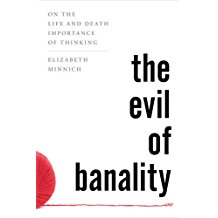
I’ve been unfairly slow in writing my review of Elizabeth Minnich’s book, The Evil of Banality: On the Life and Death Importance of Thinking. This is unfair because this is the kind of book everyone should read. It’s that good and that important. I may even use the cliché and say it’s timely. We live in a post-truth age, where fake news seems to manipulate everyone and keep them from acting responsibly, that is, from thinking.

Let me start with an example from my own backyard. I live in Barcelona in Catalonia, Spain, a place that has really been put on the map in the last few months. Here, Catalan separatist or nationalists play with people’s emotions and try to generate a certain belief, regardless of whether it’s true or not. For example, Spain is not a dictatorship; people are free in Catalonia to express their opinions. The Catalan language is not threatened; rather it’s spoken everywhere. All things the Catalan separatist claim. Furthermore, although I disagree with the imprisonment of certain Catalan politicians, they are not in prison for their ideas but for conducting illegal activities. While the Spanish government is not a perfect democracy, it is, nevertheless, still a democracy.

Thoughtlessness can also be related to the misuse of some concepts or ideas such as freedom of expression. Recently, a Catalan school teacher blamed one of his student in front of the whole class because the student’s father worked in the national police force. The teacher claimed that the police beat everyone and even killed someone. Afterwards, a Catalan politician said that, in Catalan schools, teachers have freedom to express themselves. That is, the teachers are free to say and act as they see fit. This is an extreme example, and not common, but I know that in Denmark such behavior would cause numerous problems and lead to scrutinizing the schools. In Catalonia, politicians seem to lack the capacity to reflect critically on their own behavior and ideas.

What does this have to do with Minnich’s book? Everything. She addresses how evil emerges when we “go along thoughtlessly—without paying attention, reflecting, questioning.” In other words, our lack of thinking, of critically evaluating what happens—including our own thoughts and behavior—can lead to many evils in this world. Thus, critical thinking is mandatory for all democracies. Minnich asks “What, how, are they thinking? Are we thinking? . . . How could they make sense of what they were doing?” These questions are alarming when put in a context like apartheid, Rwanda, or the sexual abuse of women and children.

The title of her book is an allusion to Hannah Arendt’s Eichmann in Jerusalem: A Report on the Banality of Evil, where Arendt concluded that Nazi crimes against Jews were also crimes against humanity. She showed how a totalitarian government affects every bureaucracy by dehumanizing them and motivating people to act without questioning.  Arendt called this “sheer thoughtlessness.”

Minnich continues, “I found myself reversing her (in)famous phrase and, having done so, thinking that perhaps it would have helped had she spoken, as she did not, of ‘the evil of banality,’ rather than—or, as I now think, in addition to—‘the banality of evil.’ To think of evil as ‘banal’ was then altogether too difficult.” Here, Minnich stresses that when someone has done something wrong, we tend to ask them, “What were you thinking?”

The foundational thesis of her book is that people who are doing evil are not thinking.

Minnich offers many examples in her book: From fiction like Camus’ The Plague to Darfur and Rwanda. She also develops two key concepts to help us understand the relationship between evil and thoughtlessness: intensive versus extensive evil and intensive versus extensive good.

Extensive evil refers to horrific harm-doing that persists for months, even years. For example, genocide, slavery, apartheid, financial exploitation, mistreatment of workers, or, as has recently become evident, when “powerful” men exploit and abuse women. It’s tempting to see the kind of people who do these things as psychopaths or sick. (I can’t help but see Weinstein and his ilk as sick.) However, Minnich emphasizes that these activities are done by inconspicuous people like your quiet next-door neighbor. She mentions several alarming examples from South Africa and Rwanda. And here we must collectively take responsibility if we witness any kind of wrongdoing. For instance, this is happening right now through the #MeToo Campaign. Such campaigns can relieve some of the pain; they can help, encourage, and illustrate that another world is possible,  one of trust, respect, and equality. Similarly, I would argue that when a school system becomes political, promoting rigid nationalism and legitimizing hate, as in some cases in Catalonia, then we must look at this with care—even if we only speak of a handful of concrete examples. Ignorance should never be an option.

Minnich emphasizes that we should be careful not to confuse extensive evil with intensive evil. Intensive evils “are great harms done by one or a few people. In that sense, they are contained . . . When they burst into our lives, almost all of us are genuinely spectators, not participants, not enablers, not perpetrators.”

She says extensive evil spreads like a plague, whereas intensive evil is like a poison. The book is full of such precise literary and metaphorical examples that make it not only a pleasure to read but also easy to follow.

The problem, Minnich says, is that we think of extensive evil as intensive. That is, we may convince ourselves that only a few schools are indoctrinating their students, only a few men are raping women, only a few people are sexually abusing children, only a few organizations are over-stressing and discriminating against their workforce. “Thinking of all evils as if they were intensive—taboo, smacking of possession, shocking to still-functioning conventional society, hence readily felt to be anti-rational—blinds us to the on-the-ground realities especially of extensive evils that are enabled, instead, by such familiar motivators as careerism and greed . . .”

What to do? Well, we could all strengthen our vison. It’s a matter of “seeing, admitting, and thinking through the realization that there have been, and somewhere now are, times in which what ‘everyone is doing’ is morally, politically, deadly wrong.”

Luckily, we can also cultivate critical thinking. Through education, we can try to eradicate automatic thinking, like when some Catalan separatist always declare, “It’s Spain’s fault.” Automatic thinking is just confirming our default-setting without any reflection about what actually takes place.

In the last part of the book, Minnich offers a beautiful reminder of what philosophy is and what it can do. “Socrates was a practitioner and teacher of thinking and not knowledge.” That is, he was open, curious, and constantly questioning not only why and what people were thinking but also how they were living according to their thoughts or beliefs.

Like Arendt, Minnich stresses how stupidity and thoughtlessness are not the same thing. “Very smart people can be very thoughtless just like the rest of us.” This emphasizes that we need to be aware of how the system is nurturing a certain kind of behavior. Here, many studies in social psychology can inspire readers who wish to explore this further.

Still, some may ask, how can we really know if we are trying to critically and openly assess what is happening? Minnich says it clearly: “Self-respect is earned not by recognition, praise, status, net worth, power, influence or anything else externally conferred but by continuing to recognize ourselves as someone we can live with, and not be ashamed?”

I agree. I think of how some politicians seem incapable of being ashamed. They are determined to play the game well, to advance their career, and to achieve their objectives, regardless of the disagreement and suffering of the people they are supposed to govern. Is it arrogance? Minnich notes, “. . . Sometimes we do stop and think, and simply say, at the right moment, the No that is actually a profound Yes to what we will not violate because that is something we just cannot do and still live with ourselves.”

Yet, some people never seem to stop and think. How can some live with themselves?

Elizabeth Minnich’s The Evil of Banality merits a better and more thorough review than what I can provide here. Nevertheless, it deserves to be read. Recommend it to your friends, especially if you know someone who is in charge of other people’s destinies. It is well written, very well argued, full of good examples, and it is inspiring.

See also philosopher Skye Cleary’s interview with Elizabeth Minnich here.
theevilofbanality


Camus: A Life Worth Living

The French writer, Albert Camus was ‘a moralist who insisted that while the world is absurd and allows for no hope, we are not condemned to despair.’

Like this, the historian Robert Zaretsky presents Camus in the book, A Life Worth Living — with the subtitle, Albert Camus and the Quest for Meaning. Camus was a moralist, but not a moralizer. He did not judge from a higher or more lucrative position, but tried to grasp what took place. He tried to create meaning where none was given.

Zaretsky organizes his portrait of Camus around five key-concepts: Absurdity, Silence, Measure, Fidelity and Revolt. The concepts are strongly related; that is to say that certain points in Camus’ thinking are repeated, but never in a tiring way. On the contrary, Zaretsky develops an intimate portrait of Camus showing how it most likely was for him to be in this world. Camus is placed both in his historical context — whether it is the struggles between Algeria and France, or between Sartre and Camus — and in conversation with contemporary thinkers.

What do we learn about Camus?

Like Nietzsche, Camus detested any kind of resentment. He knew that being faithful was not a virtue in itself. Instead, one only ought to be faithful towards a life served in happiness. Happiness, therefore, seems to be the main thread in Camus’ struggle. Not as something shallow, but as an existential guide that could help him balance his thoughts. This is an interesting reading.

Happiness is, of course, a difficult task for Camus. First of all, the world is absurd. It is without any meaning. One must invent meaning, just as one must ‘create happiness in order to protect against the universe of unhappiness.’ At times one can only do so by being silent. As Camus says, ‘we do not write in order to say things, but in order not to say them.’

Camus was a pragmatic. He did not idealize life or describe it through theoretical abstractions. He wished to witness life as an experience — no matter how painful or beautiful it appeared. This practical approach caused him several problems, going from his battles with Sartre and Merleau-Ponty, especially their idealized Marxism, to the confrontation with an Algerian student who, the day before Camus received the Nobel Prize in literature, criticized Camus for his silence over Algeria. At one point, Camus famously said: ‘People are now planting bombs in the tramways of Algiers. My mother might be on one of those tramways. If that is justice, then I prefer my mother.’

Zaretsky portrays Camus as a real human being, albeit a bit more gifted than most of us. His most impressive achievement is, I think, that he succeeds in describing Camus’ quest for meaning as if it was a psychological case-study. Recent studies in psychology show that a one-sided quest for happiness can result in the opposite. Instead, having a purpose or being able to produce meaning is more important to make a life flourish. ‘Today,’ Camus said in an interview, ‘happiness has become an eccentric activity. The proof is that we tend to hide from others when we practice it.’ Sixty years later, happiness seems to be something quite ordinary, vague even, that the majority of people like to expose. And yet, whether eccentric or ordinary, a deep felt happiness — then as now — is something that requires ‘attention and effort.’ There is no quick fix for achieving a life worth living.

For Camus, suffering is part of thinking. It is related with one’s active involvement in life. Paying attention. Trying to make sense. One might realize that violence is ‘unjustifiable,’ because of one’s compassion and empathy. As a consequence, one acts. ‘Rebellion, Camus declares, is born of the spectacle of irrationality.’ Like the ancient Greeks, Camus based his thoughts on the idea of limits, Zaretsky says. Nothing should be carried to extremes. Nothing should be denied beforehand. The quest for meaning never stops.

I believe that Zaretsky’s book  is not only interesting for readers of Camus, laymen as well as scholars (i.e. scholars from various disciplines, e.g., literature, philosophy, history and psychology), but also for anyone who would like to change the state of things. It can serve as a toolbox for future moralist! Changing the world requires more than a glittering or candied ideal. In fact, it requires a courageous and honest sensuality that allows one to be touched by life and death as something real — an experience.

Camus questioned life from within this life, the only life there is. No appeal is possible. Still, if we trust Zaretsky, Camus lived a life worth living because of his ongoing quest for meaning, a quest that brought him moments of happiness. ‘For Camus, true nobility lies in lucid acceptance of the world, its beauties and its limits, its joys and its demands, its inhabitants and our common lot,’ Zaretsky concludes beautifully. Absurdity might ‘ambush us on a street corner or a sun-blasted beach. But so, too, do beauty and the happiness that attends it.’ All it requires is attention and effort.

This book is worth reading.

Finn Janning, Ph.D. in philosophy, is a writer.

Review first published in Metapsychology, Volume 18, Issue 30

Be open to everything

This weekend I participated in Jeppe Hein’s exhibition Don’t Expect Anything, Be Open to Everything at the König Gallery in Berlin.

I organized a short writer workshop.

See more about it here.

Underneath a little meditation on writing.

IMG_4238

The risks of flexibility

“… we live in a world where we constantly have to perform or achieve something –often in a smiley and positive way– and still we presume ourselves to be free, although in reality we voluntarily exploit ourselves until we collapse.”

I recently did an interview with the Spanish paper Expansion about flexibility, stress, positivity, and leadership.

The entire interview can be read here.


Blog at WordPress.com.

Up ↑